PanamaTimes

Sunday, Oct 25, 2026

Senator reveals detailed steps to secure his homes as threats against US lawmakers surge

Senator reveals detailed steps to secure his homes as threats against US lawmakers surge

The letter from Sen. Mike Crapo's lawyers shows the tight residential security measures authorities believe are warranted in the current environment.

Camera views of all home access points.

Solid-core wood or metal-clad doors with non-removable hinges.

Security film on all accessible windows.

That's just a sampling of the multiple security upgrades the US Capitol Police are recommending for one senator — Republican Mike Crapo — at his homes in Washington, DC, and Idaho Falls, Idaho, according to a recent letter from his campaign lawyers to federal regulators.

"Current events involving concrete threats of physical violence against Members and their families have prompted Members to consider further security measures for themselves and their families," the lawyers wrote. "As has been well-documented in the media, Members and their families continue to endure threats and security breaches…"

The November 18 letter from Crapo's campaign committee lawyers to the Federal Election Commission provides a glimpse of the heightened security measures Capitol Police believe are warranted for one member in the current environment.

The letter underscores how serving in Congress may require living in a fortress as threats of violence against members surge in recent years — the January 6, 2021, attack on the US Capitol the most notable of a series of violent incidents.

The October attack on House Speaker Nancy Pelosi's husband, Paul Pelosi, with a hammer at their San Francisco home is a stark reminder of the dangers both members and their families face.

For Crapo's homes, Capitol Police recommend not just an alarm system, but one with video door intercom stations, motion sensors, duress alarms and mobile alarm pendants, according to Crapo's lawyers. 

The ideal exterior closed-circuit video system, meanwhile, would provide live monitoring, video recording, and motion and sound detection. And security film on all accessible windows would prevent "surreptitious observation into the residence," they wrote, citing Capitol Police recommendations.

Spokespeople for Crapo and Capitol Police did not immediately respond to a request to comment.

Crapo's lawyers wrote to the FEC because they want to know how to best pay for all of these updates on two homes. They're seeking confirmation that a senator can use campaign funds, under the Federal Election Campaign Act, to cover residential security expenses.

The FEC previously advised lawmakers that certain safety expenditures expenditures aren't considered a personal use of campaign funds — something that's generally illegal — and the commission has in other instances approved similar security upgrades on a case-by-case basis.

But the FEC cautioned in a 2017 advisory that their conclusion may not apply if threats diminish, they noted. Crapo's lawyers wrote, however, that the threat environment since then "has actually worsened."

"The collective threat faced by Members of Congress warrants increased security measures even when an individual Member has not yet received direct threats," they wrote.
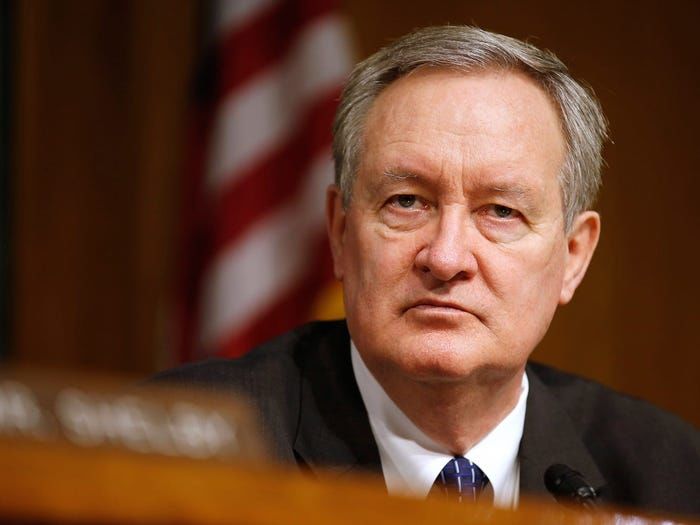

Sen. Mike Crapo, a Republican from Idaho, listens to testimony from Federal Reserve Chairman Janet Yellen on the "Semiannual Monetary Policy Report to the Congress" on Capitol Hill in Washington, U.S., February 14, 2017.

Crapo's letter points to multiple examples of threats and violence against members, including the mass shootings that severely injured House Republican Whip Steve Scalise of Louisiana in 2017 and former Rep. Gabrielle Giffords, an Arizona Democrat, in 2011. Six people were killed in the attack on Giffords.

A neighbor assaulted Sen. Rand Paul of Kentucky in 2017, and earlier this year, a man attacked Rep. Lee Zeldin, a Republican from New York who was running for governor, during a campaign event. Zeldin escaped injury.

Capitol Police surveys of Crapo's homes indicated that members of Congress "'may become the target of potential acts of terrorism, civil disobedience, civil disturbance, threats of violence, theft of services, theft of physical or intellectual property, burglary, vandalism, other acts of criminal mischief, and unauthorized trespassing,'" the lawyers wrote, quoting the surveys.

Crapo, who won reelection to his 5th term last month, is the top-ranking Republican on the Senate Finance Committee. In May, he joined other Republican senators in announcing a bill designed to protect government employees and their families from having their home addresses listed publicly online after activists organized protests at conservative Supreme Court justices' homes.

"Public servants and their families should not be subjected to protests or acts of violence at their private homes," Crapo said in a statement at the time.

Newsletter

Related Articles

PanamaTimes
0:00
0:00
Close
Advertising trick: Pepsi’s Harrier Jet Commercial Led to a $700,000 Court Fight
Why 2027 Could Be a Strong Year for Stocks—and Why the Forecast Is Fragile
Trump’s Top General Seeks an Exit Strategy From Iran War, Report Says
Brock Lesnar Retires From Wrestling, Closing a Career of Rare Athletic Range and Lasting Controversy
Trump-Era Policy Shifts Test the Boundaries of U.S. Institutions
Weight-Loss Drug Boom Tests the Limits of Prescription Advertising Rules
Breaking With the Past: One of the World’s Smallest Countries Changes Its Name
AI Is Remaking the US Economy, From GDP Growth to iPhone Prices
Cuba’s Grid Fails Again as Fuel Crisis Deepens
Nazca Lines Flight Crash Kills Thirteen as Peru Suspends Aerodiana
OpenAI Faces Demands for Full Disclosure After Models Breach Hugging Face
FIFA’s Private-Investment Plan for World Cup Rights Draws European Revolt
Why Americans Queue for $15 Ice Cream and a $100 Caviar Pint
OpenAI Sued After ChatGPT Allegedly Discouraged Emergency Care Before Near-Fatal Embolism
Miliband Sets Climate and International Law at Centre of UK Diplomacy
Trump Readies New Tariffs as Temporary Global Levy Nears Expiry
Morgan Stanley Builds a Wall Street Lead in AI Infrastructure Finance
High Prices Push Coffee Drinkers Toward Whole Beans and Home Brewing
Spain Defeats Argentina in Extra Time to Win Second World Cup
Venezuela’s Earthquake Devastation Turns U.S. Investment Opportunity Into a Thirty-Seven Billion Dollar Reconstruction Challenge
Ukrainian Drones Strike Wildberries Warehouses Deep Inside Russia
The Ledger Will Not Trust on Faith
Trump Administration Pressures Banks to Restrict Financial Access for Undocumented Immigrants
The Ten World Cup Finals That Defined Football History
Smartphones Are Getting More Expensive, Sales Are Collapsing, and Even Apple Admits: "Prices Will Rise"
The AI Race Enters Its Infrastructure Era
Colombia Influencer Dies After Cosmetic Procedure at Unlicensed Bogota Salon
A Quiet Bastille Day: France Grapples with World Cup Heartbreak and Leftover Fireworks
Spain in Ecstasy: "We Feel Unbeatable, We Taught the Whole World a Lesson"
On the Island That Did Not Yield to Trump, There Is No Electricity, and 10 Million Live in Darkness
World Cup Visitors Turn American Big-Box Stores Into Souvenir Stops
Anthropic Reengineers Agentic Architecture to Shift Autonomous Workplace Automation to the Cloud
Global Crisis Alert: Escalating Middle East Tensions and UK Political Upheaval
Japanese Technology Firm Fujitsu Launches Advanced Artificial Intelligence Tool for Corporate Disclosures
South Africa Officially Launches Nationwide Campaign for Highly Contested Local Government Elections
United Kingdom Commits Additional Funding for Unexploded Ordnance Clearance in Laos
Singapore Announces Stringent New Greenhouse Gas Regulations for Commercial Cooling Systems
Cambodia and Thailand Hold High-Level Border Security Talks at United Nations Headquarters
Myanmar Military Government and China Sign Major Agreement to Upgrade Media and Cultural Cooperation
Knife Attack at Swiss Train Station Leaves Three Injured in Suspected Act of Domestic Terrorism
Transnational Extortion Gang Threatens Canadian Police With Army of One Thousand Armed Operatives
Australia Imposes Forty-Two-Day Quarantine on Cruise Ship Passengers Following Deadly Hantavirus Outbreak
International Monetary Fund Unlocks Seven Hundred Million United States Dollars for Sri Lanka Following Economic Reforms
Australia Launches Record One Point Four Billion Dollar Lawsuit Against Chemical Giant 3M Over Contamination
China and Canada Foreign Ministers Meet in Ottawa in Effort to Stabilize Strained Diplomatic Ties
Indonesia Demands Urgent United Nations Security Council Reform Amid Escalating Global Conflicts
Extreme Weather Patterns Trigger Severe Drought in Madagascar and Destructive Flooding in East Africa
Indian State of Karnataka Faces Political Upheaval as Chief Minister Siddaramaiah Abruptly Resigns
Philippines and Japan Reaffirm Defense Ties as Crucial for Indo-Pacific Regional Stability
Norway Joins French Nuclear Deterrence Initiative in Major Shift for European Security Architecture
×