

Ukraine war: Who leaked top secret US documents - and why?
Complete with timelines and dozens of impenetrable military acronyms, the documents, some of them marked "top secret", paint a detailed picture of the war in Ukraine.
They tell of the casualties suffered on both sides, the military vulnerabilities of each and, crucially, what their relative strengths are likely to be when Ukraine decides to launch its much-anticipated spring offensive.
How real are these printed pages, unfolded and photographed, possibly on someone's dining room table? And what do they tell us, or the Kremlin, that we did not already know?
First things first: this is the biggest leak of secret American information on the war in Ukraine since Russia's full-scale invasion 14 months ago. Some of the documents are as much as six weeks old, but the implications are huge.
Pentagon officials are quoted as saying the documents are real.
Information on at least one of them appears to have been crudely altered in a later version, but out of a dump of as many as 100 documents, that seems a relatively minor detail.
BBC News has reviewed more than 20 of the documents. They include detailed accounts of the training and equipment being provided to Ukraine as it puts together a dozen new brigades for an offensive that could begin within weeks.
It says when the brigades will be ready and lists all the tanks, armoured vehicles and artillery pieces that are being provided by Ukraine's Western allies.
But it notes that "equipment delivery times will impact training and readiness".
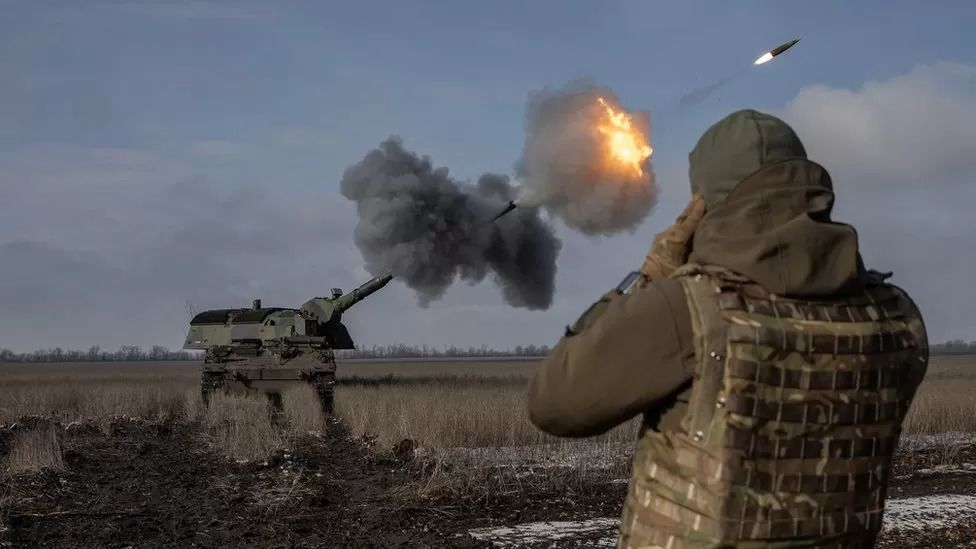 Ukrainian soldiers fire a German howitzer Panzerhaubitze 2000
One map includes a "mud-frozen ground timeline", assessing ground conditions across eastern Ukraine as spring progresses.
After a winter that has tested Ukraine's air defences to the limit, there's also a sobering analysis of Kyiv's diminishing air defence capability, as it seeks to balance its limited resources to protect civilians, critical infrastructure and its frontline troops.
Not only do the leaked documents say a lot about the state of Ukraine's military - they also talk about some of Washington's other allies. From Israel to South Korea, the documents reveal internal debates those countries are having about Ukraine and other sensitive issues.
Some of the documents are marked top secret, others to be shared only with America's closest intelligence allies.
How much of this is new?
A lot of the detail here is familiar. There's just a lot more of it, and it's all in one place.
Take casualty figures. It comes as little surprise to learn that the US estimates that between 189,500 and 223,000 Russian soldiers have been killed or wounded.
The equivalent figure for Ukraine's losses - between 124,500 and 131,000 - is also in line with ballpark figures briefed to journalists in recent weeks.
In both cases, the Pentagon says it has "low confidence" in the figures, due to gaps in information, operational security and deliberate attempts, probably by both sides, to mislead.
Tellingly, this is the one place where attempts have been made to alter the documents to make it look as if Ukraine is experiencing the worst casualties.
A version which appeared on a pro-Russian Telegram site took the number of Ukrainians "killed in action" ("16k-17.5k") and put those on the Russian ledger, while flipping the numbers on the Ukrainian side so they read "61k - 71.5k".
All of which brings us to the question of who leaked the documents, and why?
'Here, have some leaked documents'
The story of how the documents found their way from the messaging platform Discord, to 4Chan and Telegram, has already been told by Aric Toler of the investigative open source intelligence group Bellingcat.
Mr Toler says it has not yet been possible to uncover the original source of the leaks, but charts their appearance on a messaging platform popular with gamers in early March.
On 4 March, following an argument about the war in Ukraine on a Discord server frequented by players of the computer game Minecraft, one user wrote "here, have some leaked documents", before posting 10 of them.
It is an unusual, but hardly unique form of leak.
In 2019, ahead of the UK general election, documents relating to US-UK trade relations appeared on Reddit, 4Chan and other sites.
At the time, Reddit said the unredacted documents had originated in Russia.
In another case, last year, players of the online game War Thunder repeatedly posted sensitive military documents, apparently in an effort to win arguments among themselves.
The latest leak is more sensitive, and potentially damaging.
Ukraine has zealously guarded its "operational security" and cannot be happy that such sensitive material has appeared at such a critical moment.
Ukraine's spring offensive could represent a make-or-break moment for the Zelensky government to alter dynamics on the battlefield and set conditions for peace talks later.
In Kyiv, officials have spoken about a possible disinformation campaign by Russia.
Other military bloggers have suggested the opposite: that it is all part of a Western plot to mislead Russian commanders.
Crucially, there is nothing in the documents leaked so far that points to the direction or thrust of Ukraine's counter-offensive.
The Kremlin ought to have a pretty good idea already of the scope of Ukraine's preparations (although Moscow's intelligence failures have been much in evidence throughout the war), but Kyiv needs to keep its enemy guessing about how the campaign will unfold, in order to maximise the chances of success.