

Americans got smaller raises in December — and it could be exactly what we need to avoid a 2023 recession
Americans were getting jobs and raises in December, and it's good news all around for the economy.
The economy added 223,000 jobs in December, above the 200,000 payrolls economists surveyed by Bloomberg estimated, according to the latest report on employment from the Bureau of Labor Statistics. The unemployment rate came down, standing at a historically low 3.5%. At the same time, wages went up, but at a more moderate clip.
"Today's job report showed that we can still have a robust pace of hiring, even as wages begin to stabilize back toward a more sustainable level," Aaron Terrazas, chief economist at Glassdoor, told Insider on Friday.
All of that is good news for workers, and for the economy as a whole. The data is exactly what the Federal Reserve has been asking for — and means the central bank may not trigger a recession. The Fed has been trying to cool wage growth in an attempt to curb inflation, and it's hiked interest rates seven times in 2022 to do just that. Friday's data might show that the labor market has executed that successfully.
Nick Bunker, economic research director at job site Indeed, told Insider that he's not sure how much Friday's report will affect the Fed's view, but it could indicate good news.
"If what we're seeing in the average hourly earnings data is representative, or an indicator of what we might see for some other wage growth metrics or measures of wages moving forward," Bunker said, "then that will be very much welcome news" to the Fed.
Bunker added that the Fed is "just waiting on wage growth to come down, and I think that will make them feel more comfortable about the labor market and its potential impact on inflation."
Average hourly earnings increased 4.6% year-over-year in December, a small dip from the 4.8% year-over-year change in both October and November. It shows a continued decline from the highs seen last spring and summer. Bunker said that wage growth "is still robust but starting to moderate a little bit."
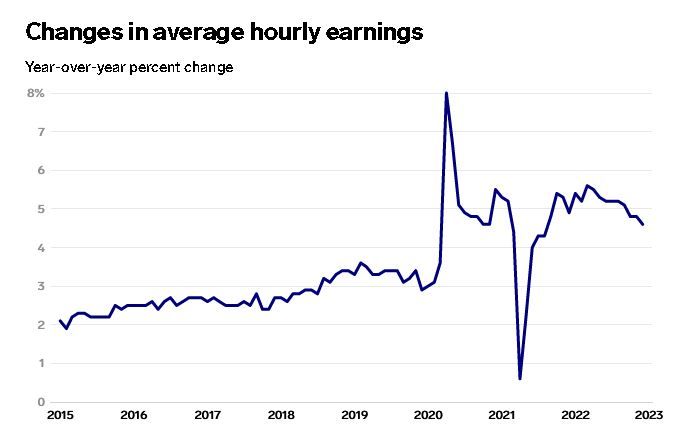
Revisions to the earnings data as a result of BLS seeing more survey results from previous months was important in showing this cooling, especially because the data in October and November originally had higher readings.
"If you looked at the average hourly earnings data at 8:29 a.m. this morning, you would've thought, okay, wow, there's no clear signs of moderation in wage growth," Bunker said on Friday, given the BLS report came out at 8:30 a.m. that morning.
And wage growth has slowed even more when looking at data from the most recent months, rather than just the year-over-year change. Julia Pollak, the chief economist at the job site ZipRecruiter, looked at annualized three-month moving average wage growth rates and told Insider that "with the revisions to the last two months of data, the November reading now is 4.4% and the December reading is 4.0%."
Wage growth slowdown could help the Fed fight inflation — and still get workers raises
While uncertainty toward the future of the economy has dominated the Fed's recent decisions, this latest jobs data might help the central bank reach its goal of lowering prices for Americans while avoiding an economic downturn.
During the December Federal Open Market Committee (FOMC) meeting, when the Fed announced it would be raising interest rates by 50 basis points, Fed Chair Jerome Powell expressed concerns with the wage growth he had been seeing up to that point, and the challenges the growth presented to the bank's goal of reaching the pre-pandemic 2% inflation level.
"We want strong wage increases," Powell said. "We just want them to be at a level that's consistent with 2 percent inflation. Right now, if you factor in productivity estimates, standard productivity estimates, wages are running, you know, well above what would be consistent with 2 percent inflation."
"We will be looking for wages moving, you know, down to more normal levels where workers are doing well and, ultimately, their gains are not being eaten up by inflation," he added.
And in the FOMC minutes from the December meeting, participants also expressed the importance of lowering wage growth to meet the 2% inflation level goal — and until that would happen, they said it will be necessary to continue tightening by raising interest rates.
Not one participant said it would be appropriate to cut rates in 2023, but the latest data on diminishing wage growth could signal the Fed may continue to slow the hikes to fight rising prices.
Labor Secretary Marty Walsh said that this report "contradicts all those conversations" about a recession.
"You're talking about 223,000 jobs added to the economy," Walsh told Insider. "We're seeing wage growth at 4.6% year-over-year. We're seeing opportunities of good jobs being created, particularly with folks without college degrees."
"The skeptics will say, well, there's layoffs in the tech sector and different areas, a recession's coming," Walsh added. "I don't necessarily qualify that as a recession."
For American workers, the latest data means that they might be able to have their cake and eat it too — wages going up as inflation slowly cools, but no recession on the other side.
"This does give hope that you can have the best of those both worlds," Terrazas said.