

Colombia’s new president Petro proposes ambitious tax reforms
On his first day in office, Colombian President Gustavo Petro introduced a new tax reform proposal to Congress that is expected to finance the ambitious programs and policies he hopes will transform the country.
The move on Monday by the country’s first leftist leader, was the first step to fulfilling his promise to millions of Colombians, like Maydany Salcedo, a 47-year-old social leader from the Putumayo province, who watched the inauguration Sunday with high expectations for Colombia’s new left-wing president.
Like many in Petro’s base, Salcedo has a lot riding on Petro’s success. Her home in Putumayo, in southwest Colombia on the border with Ecuador and Peru, is riddled with armed groups that threatened her in July after she joined Petro’s transition team.
Salcedo, who advises the administration on drug policy, believes Petro can bring the much-awaited peace, expected from a 2016 treaty between the Revolutionary Armed Forces of Colombia (FARC) and the government.
“We’re incredibly happy,” said Salcedo, dressed in a white lace blouse and golden cross, hours before Petro’s inauguration on Sunday, which she attended as a special guest. “But the expectations of poor farmers are high for what Petro can do and we hope that his discourse won’t be limited to paper.”
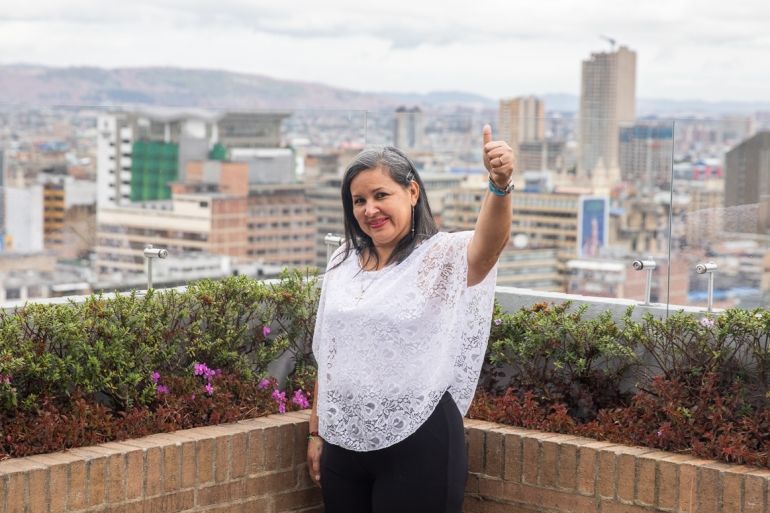 Maydany Salcedo, a coca grower from the Putumayo province, advises the Petro administration on drug policy
On the campaign trail, Petro had promised a deep transformation of Colombia, a country that historically has been run by a small group of elites and fraught with political violence. Uprooting government policies that have kept Indigenous people, Afro-Colombians, poor farmers, and women from equal income, land access and development was central to his platform.
Since the election, Petro has appointed cabinet ministers that have shown he is committed to that mission and has reconciled with political adversaries — moves that have boosted his overall popularity. Now, his supporters hope that political will and high favorability will prove enough to overcome the many challenges ahead.
Petro has spelled out a vision of a more inclusive society for one of the most unequal countries in the world. He has promised the full implementation of the peace deal; the removal of police from military control; the reopening of relations with Venezuela; a renewal to negotiations with armed groups; major social programs, such as new subsidies for poor, single mothers and free college tuition; and a move away from oil, a top export.
Addressing inequality is a top concern for Colombians, who were badly hit by pandemic closures. About 40 percent of the population, some 20 million people, now live in poverty as a result. The war in Ukraine, and its disruption of supply chains, has only exacerbated the cost of living in Colombia.
On top of rising inflation and food prices, security conditions, especially in rural areas where the conflict has historically concentrated, have worsened for civilians as illegal armed groups proliferated and cocaine production increased.
These hurdles are not lost on Petro, who has worked on expanding his coalition in Congress, where his most ambitious proposals must go through. While Petro’s political party, the Historic Pact, made significant gains in the last elections, they still require support from establishment parties Petro has previously criticized to pass future legislation.
The Center Democratic Party, which is the only party so far that has openly declared itself in opposition to the Petro government, has been a strong critic of his proposals. It has argued that phasing out new oil exploration would hurt the economy, and that negotiating with armed groups would promote impunity.
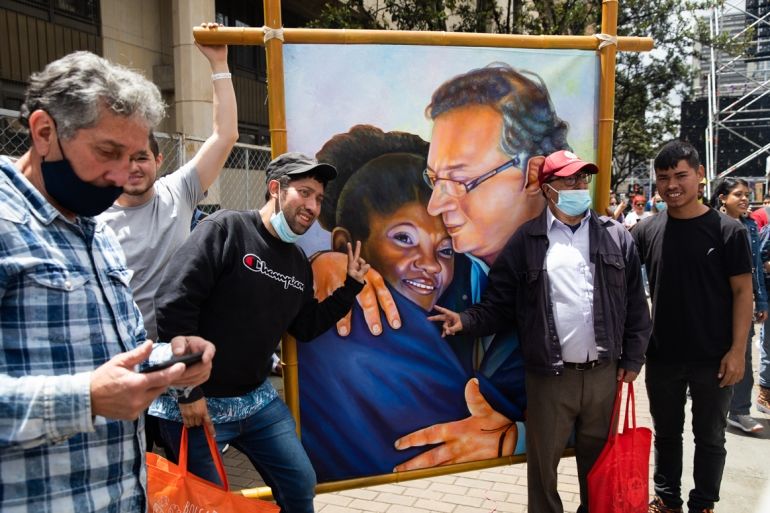 Supporters of President Gustavo Petro pose with a large-scale painting of the president with his vice president, Francia Marquez
Among the most contentious bills is the tax reform measure. It is vital to financing Petro’s social programs and curbing inflation, which reached 10 percent in July, the highest rate in 20 years.
The reform is expected to increase revenue by 25 trillion Colombian pesos ($5.75bn) in 2023 by hiking income taxes for the wealthiest Colombians, increasing export tariffs on oil and gas, and closing loopholes for tax evaders. The radical change to revenue collection may make it hard for some in congress to support it, analysts say.
“The challenge is to approve reforms in the first year or two [while Petro enjoys popularity] because what is not accomplished in that time will be difficult to do during the rest of this term,” Daniela Garzon, a political analyst at the Peace and Reconciliation Foundation, told Al Jazeera.
Outside social reforms, Petro’s other key promises such as the full implementation of the 2016 peace deal will require a concerted effort to “regain lost time”, said Gimena Sanchez-Garzoli, Andes expert at the Washington Office on Latin America.
The deal lost steam under the Duque administration, which openly opposed it. The Kroc Institute reported that just 30 percent of the peace deal, which includes provisions for rural development and a substitution plan for coca, had been implemented by November 2021. The Inspector General’s office is investigating purported corruption development projects mandated under the peace deal.
On Sunday, the Gulf Clan, one of the country’s largest paramilitary groups, announced a ceasefire and its willingness to negotiate with the new president. Other armed groups, including the National Liberation Army (ELN), the largest rebel group left, and a faction of FARC fighters who rejected the 2016 peace deal have also expressed their interest in negotiations, an important step forward for Petro’s “Full Peace” strategy.
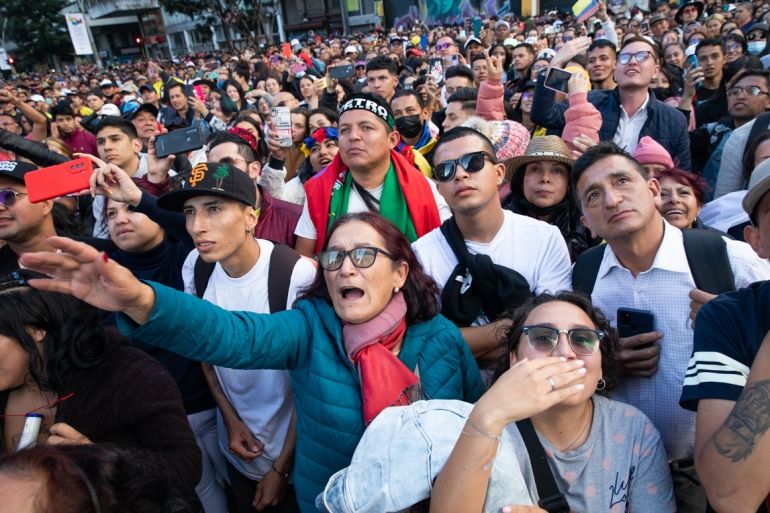 Thousands of people flooded the plazas of downtown Bogotá during the inauguration of President Gustavo Petro
To get these groups to disarm, however, may require incentives that could pose problems within Colombia and with its main ally, the United States, Sanchez-Garzoli told Al Jazeera.
“There’s going to have to be a lot of work done to convince, especially the United States, that this is a way that will lead to not only a decrease of these groups, a decrease of their reemergence, but also dents in the narco trafficking trade, which is what most of the US Colombia relationship is based on,” said Sanchez-Garzoli.
Still, Salcedo is optimistic. For the first time, communities historically pushed to the margins of society are a central part of a president’s political vision. As a female coca grower fielding death threats in a conflict zone, Salcedo says this is the first time her interests have been represented in government.
“I know there will be achievements. Maybe not all of them because time is short but I know this is the beginning of a new democracy, of a new path,” said Salcedo.