

Despite war ban, Russian seafood could enter the US anyway
Fishing is big business in Russia, one closely linked to the Kremlin and President Vladimir Putin’s projection of power at sea.
The country is one of the world’s top seafood producers and was the eighth-largest exporter to the United States last year, with more than $1.2bn worth of sales, the bulk of it king crab.
But it is unknown exactly how much manages to land in the US by way of China, which sent another $1.7bn in fish to the US last year. Nor does the Biden administration’s ban require companies importing from China to find out.
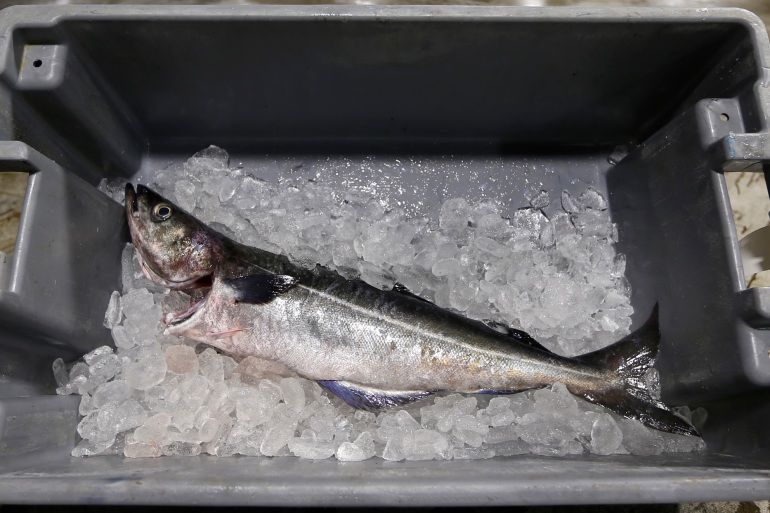
Among Russia’s biggest seafood exports is Alaska pollock. A cousin of cod, Alaska pollock is the most harvested fish in the US, showing up in everything from imitation crabmeat to McDonald’s Filet-O-Fish sandwiches. Every year, giant, floating factories in the Bering Sea and Gulf of Alaska catch 1.5 million tonnes of fish, the equivalent of more than four times the weight of New York’s Empire State Building.
But the same species is also harvested in Russia in similar amounts, and once processed and imported from China, fills an important gap in the US market. In lieu of tracing the country of origin, US producers rely on the name recognition of Alaska pollock to signal where the fish was caught.
 Shortcomings in US import regulations mean that Russian-caught pollock,
salmon and crab are likely to enter the US if they’re processed
elsewhere
Shortcomings in US import regulations mean that Russian-caught pollock,
salmon and crab are likely to enter the US if they’re processed
elsewhere
“Consumers can have confidence that if the name Alaska is on the box it unequivocally comes from Alaskan waters,” insisted Craig Morris, chief executive of Genuine Alaska Pollock Producers.
Even before the invasion of Ukraine, pressure had been building to prevent what Senator Dan Sullivan, a Republican of Alaska, called “authoritarian” pollock from entering the US. Putin banned US seafood in 2014 following American sanctions to punish him for the invasion of Crimea that year. Since then, Russian exports entering the US duty-free have nearly quadrupled in value.
US trade data analysed by The Associated Press show that the biggest importer of Russian-caught pollock from China last year was High Liner Foods. The company did not respond to the AP’s request for comment.
While overshadowed by Russia’s role as an energy powerhouse, Russia’s seafood industry has increasingly been flexing its own muscle with strong support from the Kremlin.
Two of the country’s largest seafood exporters — Vladivostok-based Russian Fishery Co and Russian Crab — are owned by Gleb Frank, the son of Putin’s former transportation minister and head of state-owned shipbuilder Sovcomflot.
Frank, dubbed Russia’s “Crab King,” is also the son-in-law of one of Russia’s richest men, Gennady Timchenko, who was among the first oligarchs sanctioned following the 2014 invasion of Crimea.
With generous state loans, Frank’s companies have been at the forefront of an effort to renew Russia’s ageing fleet. Last year, during a Navy Day ceremony at a St Petersburg shipyard with Putin and 50 warships looking on, he launched an advanced supertrawler capable of hauling in 60,000 tonnes of pollock per year.
After Frank himself was hit with US sanctions last month, he sold part of his ownership stakes in both seafood companies and resigned as chairman. Russian Fishery Co did not respond to a detailed list of questions about the US embargo but Russian Crab said Frank has never played a role in the management of the company.
It is not just the industry’s ties to the Kremlin that are driving concern.
For years, activists have complained about Russia’s poor record in caring for the oceans. The country was ranked second out of 152 nations in a recent study of global efforts to combat illegal, unregulated and unreported fishing. Only China scored worse.
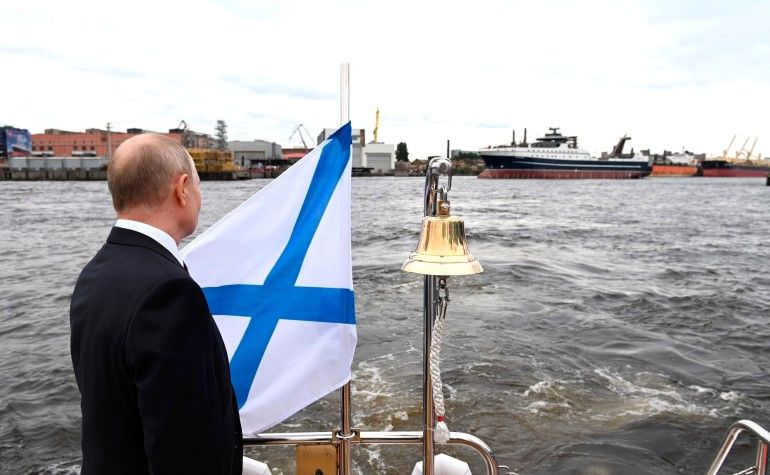 Vladimir Putin attends the launch ceremony for Mekanik Sizov, a super
trawler belonging to a company partly owned by sanctioned Russian
businessman Gleb Frank
Vladimir Putin attends the launch ceremony for Mekanik Sizov, a super
trawler belonging to a company partly owned by sanctioned Russian
businessman Gleb Frank
Allegations of illegal fishing have even followed Russia to the south pole, where a Russian ship in 2020 was accused of faking its location data to fish illegally off season. A Russian observer was also found to be behind anomalous catch data from several Antarctic fishing vessels. In both cases, Russia denied any wrongdoing.
At a congressional hearing this month on the Russian seafood ban, Representative Jared Huffman, a California Democrat, led calls for the expansion of NOAA’s Seafood Import Monitoring Program, which aims to prevent illegal seafood from entering US supply chains by tracking shipments from the point of catch. Currently, the programme covers just 13 species, only two of which — red king crab and Atlantic cod — are fished by Russia.
“Until that happens, Russian seafood will continue to line grocery store shelves and American consumers will continue to unwittingly support Putin’s war machine,” Huffman said.
Peter Quinter, a former US Customs Service lawyer, said that the Biden administration could easily close the China loophole by requiring importers to inspect their supply chains to make sure none of their fish comes from Russia.
“They can and should fix this,” said Quinter, who now advises seafood companies on compliance with American trade law. “The old days of being sure your fish is caught in a single place or country is no longer the case.”