

One year on, Peru’s president fights for political survival
A year since his moonshot ascent to Peru’s highest office, socialist President Pedro Castillo is in the throes of political crisis.
Sworn in last July, the campesino teacher and union leader from rural Peru today faces mounting corruption allegations, a grim approval rating and a stillborn legislative agenda thwarted by an opposition-dominated congress.
One year into his five-year term, Castillo has survived two impeachment attempts, a whiplash-inducing change of cabinet ministers, and deepening economic and political strife.
Last summer, Castillo, a political fledgling and son of illiterate farmers, stormed into Lima from his native Cajamarca in Peru’s northern Andes. An improbable frontman for his Marxist Free Peru party, he promised to rewrite Peru’s constitution, redistribute mineral wealth and resuscitate a nation reeling from the COVID-19 pandemic.
Backed by a coterie of peasant supporters, his message confounded Peru’s left-wing bourgeoisie and shook business and political elites. Rarely seen without his trademark straw hat, Castillo fired up campesino and Indigenous Peruvians with a simple mandate: “No more poor people in a rich country.”
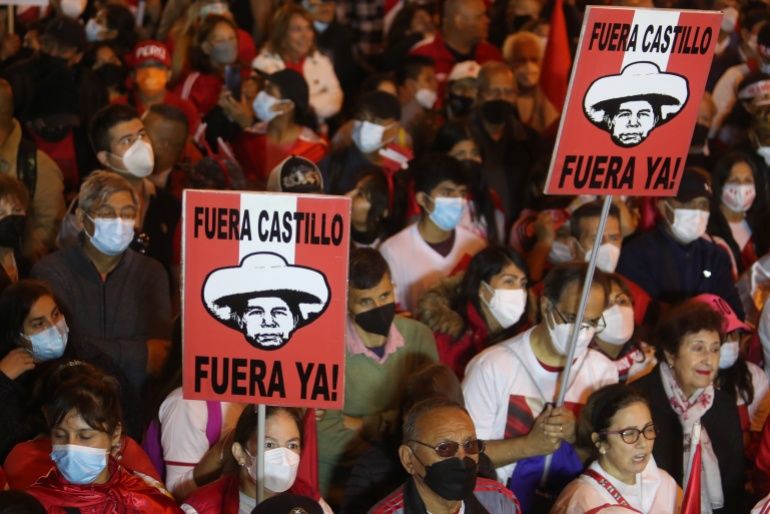 Demonstrators protest against Castillo’s government in Lima in June
His deeply unpopular far-right challenger, Keiko Fujimori, daughter of Peruvian strongman Alberto Fujimori, admonished voters that Castillo’s economic policies would steer the country into a crisis similar to Venezuela’s. But to many among Peru’s exasperated electorate, which had endured four presidents and two congresses in five years, both candidates represented dangerous extremes. Castillo won by just 44,000 votes in a runoff election last June.
“When he came into office, it’s not at all that he enjoyed the mandate of a majority,” Cynthia McClintock, a political science professor at George Washington University, told Al Jazeera. “He faced a congress in which forces on the right were very opposed to him, and a lot of people voted for him very worried.”
Corruption probe
Days after assuming office, Castillo drew fire for naming a number of inexperienced and hardline nominees to his cabinet, some with alleged criminal ties. His fealty to Marxist Free Peru’s party boss, Vladimir Cerron, raised the spectre that he would embrace regional autocrats and enact a radical agenda that would spook foreign investment.
Amid multiple cabinet reshuffles, his marquee campaign promises, including amending Peru’s 1993 dictatorship-era constitution, were rebuffed by congress. In March, he survived a second impeachment attempt, driven by right-wing parties who cited “moral incapacity” and corruption allegations.
In May, Peru’s attorney general revealed that Castillo would be included in a corruption probe into his alleged role as ringleader of a “criminal network” within his transportation ministry, which purportedly received bribes for public works contracts. Castillo, who testified before prosecutors in June, has denied wrongdoing. He is the first president in Peru’s history to be investigated by national prosecutors while in office.
The president has also been at the centre of other recent criminal probes, including for allegedly pressuring military leadership to promote officers favourable to his government.
Twisting the knife, prosecutors last week announced plans to investigate Castillo for alleged obstruction of justice over the firing of his interior minister, Mariano Gonzalez, who had sanctioned a special task force to locate and arrest fugitive allies of the president.
Former transport minister Juan Silva and the president’s nephew, Fray Vasquez, both facing criminal charges, are currently in hiding. Peru’s public ministry has also opened a preliminary investigation into Castillo’s sister-in-law, Yenifer Paredes, for allegedly using ties to the president to win a sanitation contract in Cajamarca.
Castillo’s office did not respond to Al Jazeera’s request for comment on the ongoing investigations. On Thursday, the embattled president is set to address congress and the nation on the 201st anniversary of Peru’s independence from Spain.
“I think the overall consensus is that he is not prepared at all for this job,” McClintock said. “The learning curve has not been what anybody has hoped for. I would say an awful lot of the debate is: Will he survive, and what’s going to happen if he doesn’t?”
‘We’ve been duped’
With a divided opposition, no clear presidential successor and a populace hardened by government corruption, Castillo faces mounting problems. National strikes by truckers unions and farmers over the soaring costs of fuel, fertiliser and food sparked by Russia’s war in Ukraine have undermined trust in his ability to govern.
The president’s disapproval rating reached 70 percent in a recent poll – and that discontent was apparent earlier this month in Lima’s San Martin Plaza, where Mari Castillo, also a Cajamarca native, served up stewed chicken to a crush of protesters marching for housing justice.
“We were proud to have a campesino president. But he’s doing an awful job,” Castillo told Al Jazeera. “Prices are going up. We thought things would get better, but we’ve been duped.”
Snapping photos of the government palace in Lima’s main plaza, Hualberto Sandoval, a small-town mayor in the coastal department of Lambayeque, also expressed dismay. “I speak for a lot of Peruvians who are upset about what we’re seeing and hearing,” he told Al Jazeera. “We want to believe he’s capable of leading. We need police funding, infrastructure. It’s been a year and he hasn’t delivered.”
Blocks away, Jaime Amasifuen was selling fish parts from a styrofoam cooler alongside the Pan-American Highway. “[Castillo] promised to help the poor,” he told Al Jazeera. “But things are worse. The prices of fish are sky-high. He’s the leader. He needs to do something about it.”
The president has proposed legislation to congress that would lower sales tax on essential food items. While Peru’s economy has remained relatively stable during Castillo’s tenure, girded in part by the country’s robust mining sector, countless Peruvians toiling in the informal economy have felt the pinch of rising prices.
In central Lima’s hillside shantytown of Cantagallo, Pilar Arce, a native Shipibo artist from the Amazon, said she was hopeful that a president with humble origins might advocate for Indigenous people. “But a year later, the country isn’t advancing,” Arce told Al Jazeera. “Who can buy art when they’re worried about where their next meal is coming from?”
Meanwhile, supporters of the president, such as Andres Huamani, blame the country’s elites for inventing corruption allegations and polarising the nation: “The media, the rich and powerful, and the conservative political class have all been hellbent on taking him down,” Huamani told Al Jazeera. “They haven’t given him a chance from the start.”