

US to take in some Venezuelans but will send most back to Mexico
The United States and Mexico have announced a joint migration plan that will see most Venezuelan asylum seekers trying to enter the US through its southern border sent back to Mexico while granting access to the US to thousands of others who come by air.
The effort, announced late on Wednesday, aims to address the growing number of Venezuelans arriving at the US-Mexico border.
Under the new programme, which came into effect immediately, up to 24,000 Venezuelans will be allowed to enter the US by air, the Department of Homeland Security (DHS) said. Others who try to enter the US through the border without documentation will be returned to Mexico.
“These actions make clear that there is a lawful and orderly way for Venezuelans to enter the United States, and lawful entry is the only way,” US Secretary of Homeland Security Alejandro Mayorkas said in a statement.
“Those who attempt to cross the southern border of the United States illegally will be returned to Mexico and will be ineligible for this process in the future,” he said.
President Joe Biden’s administration has struggled to cope with record migrant and asylum seeker arrivals at the southern US border as more people come from Venezuela, Cuba and Nicaragua.
Biden’s Republican adversaries, who are seeking to gain control of Congress in the November 8 midterm elections, have criticised what they view as his failure to secure the border.
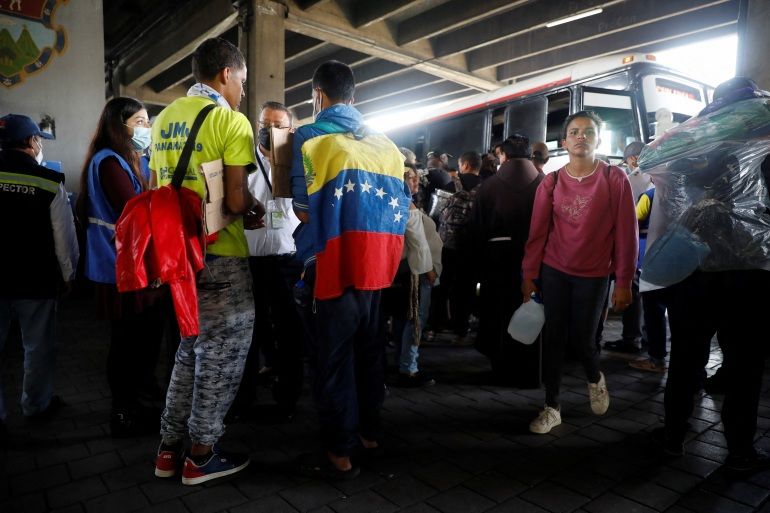 Migrants from Venezuela on their way to the US-Mexico border wait to board buses in Guatemala City
The expulsions of Venezuelans will be carried out under Title 42, a pandemic-era policy that allows US border officials to swiftly send asylum seekers to Mexico without the chance to submit a claim for protection.
Until now, Mexico had only agreed to accept migrants expelled under Title 42 from Guatemala, Honduras and El Salvador, resulting in an uneven enforcement of the rule. The US struggles to expel other nationalities due to costs, strained diplomatic relations and other considerations.
Poor relations with the Venezuelan government have made it nearly impossible to apply Title 42 to Venezuelan asylum seekers, and in recent months, many had been allowed to apply for asylum and are then released into the US while they await their court dates.
In August, Venezuelans were stopped at the US-Mexico border 25,349 times, up 43 percent from 17,652 in July and four times the 6,301 encounters in August 2021, DHS said, signalling a remarkably sudden demographic shift.
Migrant advocates welcomed the new humanitarian programme but slammed what they said was an expansion of Title 42, a Trump-era policy that has denied access to protection to thousands of people.
“The program … should not be viewed as a replacement for asylum protections enshrined in both US and international law,” Krish O’Mara Vignarajah, president and CEO of the Lutheran Immigration and Refugee Service, said in a statement. “It provides only temporary protection to a very limited subset of the millions of Venezuelans forced to leave their homeland.”
Vignarajah said the programme will disproportionately affect Venezuelans who deserve protection but do not have ties to the US.
To qualify for entry into the US when arriving by air, an applicant must be sponsored by a US-based person or organisation, DHS said.
Venezuelans who are accepted into the programme will be granted what is known as “humanitarian parole”, allowing them to live and work legally in the US for a limited time but not offering them a path to permanent status.
The US and Mexico said their plan is modelled after the “Uniting for Ukraine” programme, under which the Biden administration has allowed Ukrainians fleeing Russia’s invasion to enter the US to live and work if they can secure a financial sponsor in the country.
The US said it plans to admit up to 100,000 Ukrainians fleeing the war for stays of up two years under the scheme. So far, the US has admitted tens of thousands of Ukrainians.
Meanwhile, more than 6.8 million Venezuelans have fled their country since the economy tanked in 2014, mostly to Latin American and Caribbean countries.
But an increasing number of people have been heading towards the US, and the 24,000 slots that the Biden administration is offering are fewer than the number of Venezuelans who crossed the border from Mexico in August alone.
Alongside the agreement on Venezuelan migrants and refugees, Mexico’s foreign ministry and DHS said the US will make available about 65,000 temporary work visas for lower-skilled industries, roughly double the current annual allotment.
At least 20,000 of those temporary visas will be reserved for people from Haiti and northern Central American countries.
“The United States government has accepted the request of the Mexican government to substantially increase labor mobility in the region,” Mexico’s foreign ministry said in a statement. “The new proposal represents important and innovative progress towards the shared goal of ensuring orderly, safe, regular and humane migration.”