

‘What now?’: Scenes from the US-Mexico border
Attention once again turned to the US-Mexico border this week as a pandemic-era policy in the United States that allowed authorities to rapidly expel most asylum seekers under the pretext of public health expired.
Large numbers of migrants and refugees rushed to the border in hopes of seeking protection in the US in advance of the expiration of Title 42 late on Thursday, as new restrictions on asylum also came into effect.
At the same time, President Joe Biden’s administration had dispatched additional troops and other resources as authorities braced for an influx of arrivals.
Here are some of the stories that have marked the past few days along the 3,140km (1,950-mile) international border.
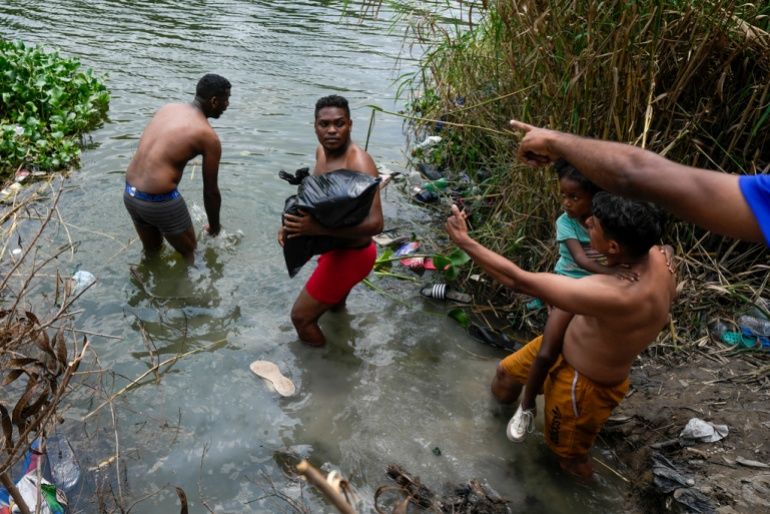 Migrants cross the Rio Grande River to the US, from Matamoros, Mexico, May 11
‘It’s over’
Aylin Guevara, 45, hurried her steps as she walked through the scorching desert of Ciudad Juarez towards the border.
She was accompanied by her two children, ages 16 and 5, and her husband. The family fled their coastal city in Colombia after receiving death threats and hoped to seek refuge in the US.
After spending the previous night in a hotel, they were eager to get to the border — “to get in and go with the help of God and baby Jesus”, Guevara said.
But when they arrived with just hours before the end of Title 42, a US immigration officer said they could not pass. “Not any more, it’s over,” he told them in a firm voice, instructing them to go to bridges 16km (10 miles) to their left or right.
‘Now find ourselves with this’
Maria Jose Duran, a 24-year-old student from Venezuela, was on the verge of tears as she sat on a riverbank in Matamoros, Mexico.
Mexican immigration officials were trying to move people to an improvised camp and away from a spot where they could wade across the Rio Grande.
Duran said she dropped out of college when her parents could no longer afford it and set out for the US with a group of friends and relatives. They crossed the treacherous Darien Gap dividing Colombia and Panama and then a half-dozen more countries before arriving at the US border.
“I don’t know what to think now, having made such a difficult journey to now find ourselves with this,” she said, motioning towards the opposite shore where at least a dozen Texas state troopers with rifles stood behind concertina wire.
From the Mexico side, Texas National Guard members could be seen reinforcing another stretch of wire to keep migrants out. Later, Duran could be seen walking along the levee with other migrants who had crossed the Rio Grande and passed the barbed wire.
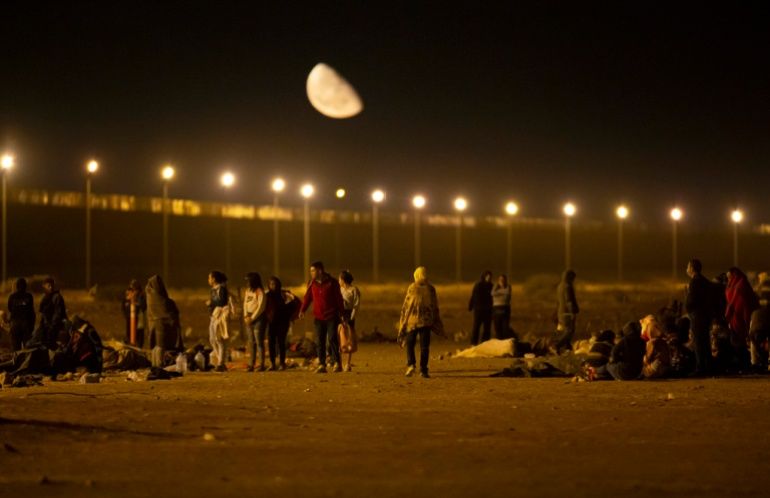 Migrants arrive at a gate in the border fence after crossing from Ciudad Juarez, Mexico into El Paso, Texas, May 11
‘Will it be better or worse for us?’
Hundreds of prospective immigrants lined up next to the border wall in Ciudad Juarez, Mexico, were still crossing over on Thursday and being received by the US Border Patrol in the hours before the Title 42 restrictions were lifted. The numbers were notably lower than in recent days.
Ecuadorians Washington Javier Vaca and his wife, Paulina Congo, along with their two children, ages 14 and seven, knew nothing about the change in rules.
“And now will it be better or worse for us?” Congo asked. “We asked for asylum in Mexico and after four months they denied us.”
A Salvadoran man who gave his name as David moved away from the border and back into Ciudad Juarez for fear of being deported.
‘What now?’
Authorities in the remote desert community of Yuma, Arizona, expressed alarm after the average daily number of arrivals grew this week from 300 to 1,000.
Hundreds who entered the Yuma area by crossing the Colorado River early on Thursday surrendered to border agents, who later brought adults and children to buses.
Mayor Doug Nicholls asked that the federal government declare a national disaster so that Federal Emergency Management Agency (FEMA) resources and National Guard troops can be rushed to his and other small border communities.
Most migrants and asylum seekers are transported to shelters operated by non-profit organisations farther away from the border, but border officials will release them into communities if enough transportation is not available.
Nicholls said officials have already told him they plan to release 141 people in Yuma County on Friday. “The question keeps coming up: ‘What now?’ I’ve been asking that question for two years, with no answers,” Nicholls said. “We are at a situation we’ve never been at before.”
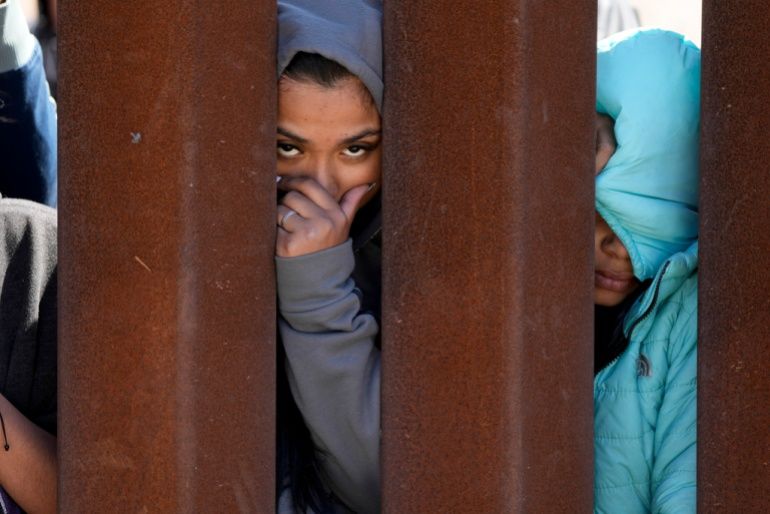 The US is seeing an uptick in migrants and asylum seekers at its southern border
‘It may not be enough’
Leaders of non-profit organisations that assist asylum seekers away from the border in Arizona have said they are as ready as possible for the new scenario.
“We’ll put our best foot forward and approach this with every resource available,” said Teresa Cavendish, executive director of the Tucson shelter Casa Alitas, the state’s largest. “But it may not be enough.”
Catholic Community Services of Southern Arizona runs Casa Alitas’s new 300-bed facility for men, as well as four other locations that also temporarily house women, families and vulnerable people for a combined capacity of more than 1,000 beds.
David Miliband, president of the International Rescue Committee, who visited the organisation’s Welcome Center in Phoenix this week, expressed confidence in the agency’s ability to handle any increase in asylum seekers there. The 340-bed shelter was at less than half capacity.
“The challenge can be managed as long as it is done in an organised and humane manner,” Miliband said.
Beth Strano, engagement manager for the centre in a quiet south Phoenix neighbourhood, said, “We served 50,000 people last year and 38,000 people the year before that without any negative impact to our clients or community.”
‘It was all a lie’
Smugglers helped Guatemalan Sheidi Mazariegos and her four-year-old son get to Matamoros, Mexico, where she and the child crossed the Rio Grande on a raft.
But Border Patrol agents took the pair into custody a week ago near Brownville, Texas. On Thursday, the 26-year-old and her son arrived back in Guatemala on one of two flights carrying a total of 387 migrants.
“I heard on the news that there was an opportunity to enter,” Mazariegos said. “I heard it on the radio, but it was all a lie.”
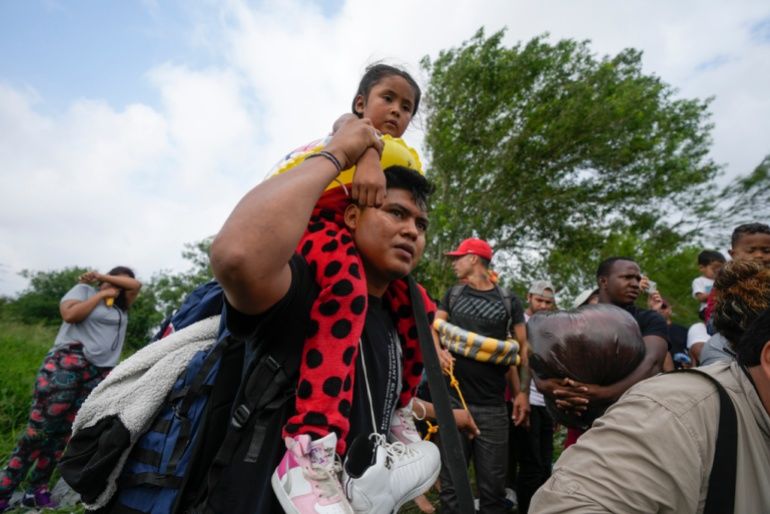 A group of people arrive at the Mexican side of the Rio Grande with plans to cross to the US, May 11
‘It’s very hard’
On a stretch of border wall in Tijuana, some of those hoping to cross asked passersby for blankets, food and water as the sun set over a steep hill.
Gerson Aguilera, 41, got to Tijuana at around 4pm with his three children and wife to make a go at crossing and asking for asylum. From Tegucigalpa, Honduras, Aguilera said he and his family fled after organised criminals started demanding he pay twice the extortion money he was already paying of 2,000 Honduran lempira (roughly $81) a week.
“It’s very hard. For a payment, they will kill you,” Aguilera said with tears in his eyes.
The owner of a welding shop, Aguilera said he left his home once before in 2020 because of threats, but returned when things calmed down. That was not an option any more.
“We ask that God help us,” Aguilar said.