

‘A megaproject of death’: fury as Maya train nears completion in Mexico
Diggers trundle across the chalky bare earth just outside the town of Xpujil, in Campeche state, southern Mexico. The land is being cleared to make way for the Maya train line, a controversial megaproject that will cross the Yucatán peninsula, whisking tourists from the beach resorts of Cancún and Tulum to Maya archeological sites in the heart of the jungle.
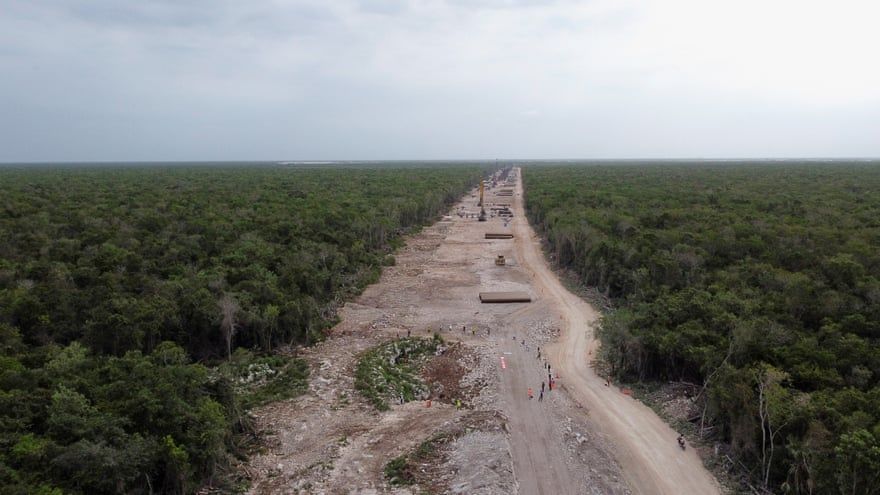
A sizeable area has already been gouged out of tropical rainforest, the second largest in the Americas after the Amazon, for the 1,525km (948 mile) route that will cut through land largely inhabited by Indigenous groups.
“What is being done with the Maya train megaproject is not Mayan in any way. It is a decision from above,” Q’anjob’al Maya leader Romel González Díaz shouted through a megaphone on the outskirts of Xpujil earlier this month. Listening were about 100 Indigenous leaders, activists and international observers who had joined La Caravana el Sur Resiste (the south resists caravan), which passed through the five states where the train will run, visiting communities to encourage opposition to the project.
 Protesters gather near section 5 of the Maya
Train, where it is feared construction will impact a system of cenotes
known as Dama Blanca (White Lady), in Playa del Carmen, 30 April.
Members of the caravan, as well as academics, scientists and lawyers warn that the scheme will cause serious environmental damage, particularly along part of the route that runs though the Calakmul biosphere reserve, a Unesco world heritage site, where ancient pyramids erupt through the forest canopy. More than 100 species of mammal inhabit the forest, including the most important jaguar population in Mesoamerica, 398 species of birds and 84 reptiles, some at risk of extinction.
Almost 3,000 households living along the route have been displaced.
The Maya train is a pet project of Mexico’s President Andrés Manuel López Obrador, who says it will bring employment and infrastructure to one of the poorest and least connected regions of the country. Work started in early 2020 and López Obrador is determined to see it finished before he leaves office in 2024. Fonatur (the National Fund for Tourism Promotion), the government office managing the project, says the first high-speed trains are due to arrive in Cancún in July, and will be tested along part of the route in August. The $20bn project is due to be completed by the end of the year.
López Obrador’s government has declared the railway line a national security project and put the army in charge of patrolling, protecting and overseeing part of the construction.
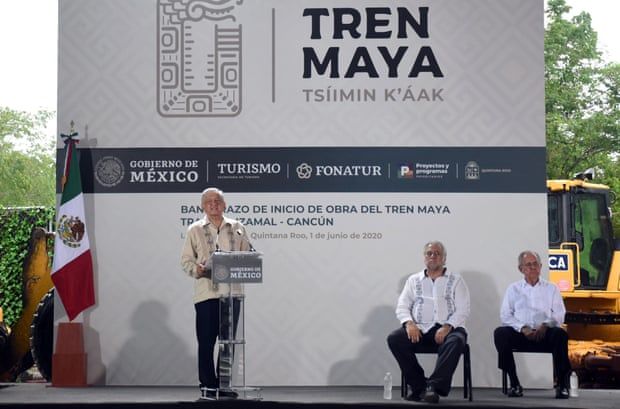 President Andrés Manuel López Obrador at the
laying of the first stone of the Maya train, in El Ideal, Quintana Roo
State on 1 June 2020.
At least 25 legal complaints have been filed by groups living along the route attempting to halt or hinder the railway’s progress. In March 2020, the Regional Indigenous and Popular Council of Xpujil, of which González Díaz is a member, obtained a court order to stop construction, but the authorities have pressed on with the work.
A glimmer of hope came last Thursday when Mexico’s supreme court decreed the train and other development works cannot arbitrarily be declared issues of “national security”. However, the president reinstated the designation just hours later.
The caravan set off from Chiapas at the end of April and travelled for 10 days on foot and by bus along the entire route. Carrying banners that read “No to the killer train” and shouting “Calakmul is a treasure worth more than gold”, the protesters reached the site of the proposed station at Xpujil in early May. About 20 soldiers stood guarding a lone tree amid the desolation. González Díaz handed the guard at the sentry post a piece of paper with the judge’s decree, while soldiers took photos of the protesters. Members of the caravan know they are taking risks by opposing a government project of this size and importance. Mexico was named the most dangerous country in the world for environmental activists last year.
However, not everyone is opposed to the railway. As the protesters marched through the sunbaked streets of Xpujil, shouts of “Viva el tren Maya” – long live the Maya train, could be heard. A man leaned out of his car window to ask why the marchers don’t want an end to poverty in the area. There was a tense moment near the construction site when a car faced down the protesters, before grudgingly allowing them to pass.
According to the government, the project received an almost 90% approval rating in a 2019 referendum conducted in the affected states. Opponents said there was a low turnout and a lot of the information – specifically details of how the train will affect the environment – was poorly translated into Indigenous languages. The Mexico office of the UN high commissioner for human rights said the government’s consultation process was flawed.
While López Obrador initially promised that not “a single tree” would be felled, the government now concedes that 3.4 million have been cut down so far, although environmentalists say the actual number is nearer 9 million.
For Ezequiel Cauich Cauich, a tourist guide at Calakmul, every tree is “a habitat where there are bats, birds, insects and water”. Cauich worries that the damage to the ecosystem will further affect water supplies in the region. Last August, Mexico’s water board said water availability has reduced by almost two-thirds in the Yucatán peninsula in the past two decades.
Water already has to be rationed in the dry season, says Cauich, pointing to the tanks on the roofs of the houses in Xpujil, where two hotels and a casino are due to be built.
Renovation of an aqueduct and building two new wells and a water treatment plant have failed to ease concerns over shortages. “How are we going to compete with tourists for water?” says Cauich.
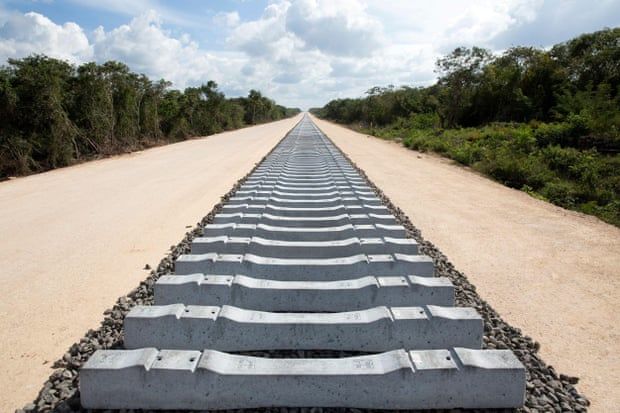 Construction of section 3 of the railway, from
Calkiní, in Campeche state, to Izamal, Yucatán. So far, 3.4 million
trees have been felled to make way for the track.
Sara López González, another member of the Regional Indigenous and Popular Council, is saddened by how the railway has divided the community.
She says Fonatur held several meetings “to tell us about all the beautiful things the Maya train would bring, but they never talked to us about the negative impacts”. “The consultation was rigged, held just to legitimise” the Maya train, which she claims is a misnomer because it takes the name of the Indigenous people whose rights it is infringing. López González, who has been jailed for her activism, adds: “They said it would bring development but it will be just the opposite. It is a megaproject of death. It is an ecocide.”
Pedro Uc Be, of the Múuch’ Xíinbal Assembly of Defenders of the Mayan Territory, says he is losing hope that the protests will succeed. “I don’t know if I have hope any more, my hope is splintered, broken and sealed within each of the cenotes [underground caverns filled with water] that the government has paved over” to allow the train to pass. “It is regrettable, but we don’t see a promising future.”
Fonatur have not responded to requests for comment.