
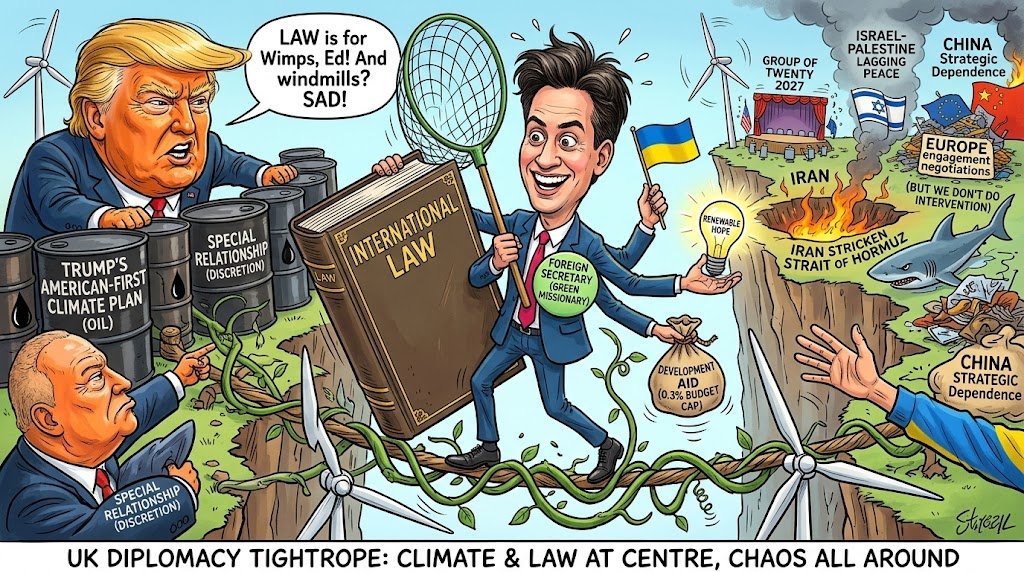
Miliband Sets Climate and International Law at Centre of UK Diplomacy
Britain’s new foreign secretary promises continuity on Ukraine and the American alliance while signalling greater emphasis on climate action, development and legal restraint.
Ed Miliband has taken control of British foreign policy with a promise to restore climate diplomacy, defend international law and maintain the country’s principal alliances, including its strategically indispensable but politically difficult relationship with the United States.
His appointment by Prime Minister Andy Burnham signals a change of emphasis more than an immediate rupture with the policies inherited from the previous government.
Miliband became foreign, commonwealth and development secretary on July 20 after two years overseeing energy security and the transition to net zero.
A former Labour leader and climate secretary, he arrives with greater cabinet experience and a more clearly defined ideological record than many newly appointed foreign ministers.
That record combines Atlanticism, European engagement, environmental activism and a longstanding reluctance to treat military intervention as the default response to international crises.
His initial commitments were deliberately broad.
He identified continued support for Ukraine, preservation of Britain’s special relationship with the United States, a sustainable peace between Israel and the Palestinians, and the reopening of the Strait of Hormuz as immediate priorities.
He also placed climate change and international development among the threats to justice and security that the Foreign Office must address.
The American relationship will provide the earliest test.
Britain depends on the United States for intelligence cooperation, nuclear deterrence, advanced defence technology and much of the military capacity underpinning the North Atlantic alliance.
Burnham has already spoken with President Donald Trump and indicated that he intends to engage candidly while preserving practical cooperation.
Miliband has promised to nurture that alliance despite substantial differences with the Trump administration.
Those disagreements encompass climate policy, North Sea drilling and aspects of the war with Iran.
Trump has criticised Britain’s restrictions on new offshore oil and gas development, while Miliband spent his tenure as energy secretary arguing that renewable power and reduced exposure to volatile fossil-fuel markets offer the more durable route to energy security.
The foreign secretary’s challenge will be to compartmentalise those disputes.
Britain can continue intelligence, defence and diplomatic coordination with Washington without adopting every American policy.
The more openly London invokes international law or questions military escalation, however, the more friction it may encounter with an administration that places greater weight on national discretion and coercive leverage.
Iran illustrates the tension.
Britain has a direct interest in restoring safe passage through the Strait of Hormuz, a crucial route for global oil and gas supplies.
It also has military facilities, citizens and commercial interests exposed to regional escalation.
Miliband is likely to support measures protecting navigation while applying a more exacting test to British participation in offensive operations, particularly where parliamentary authority, strategic objectives or the legal basis remain contested.
That caution reflects his political history.
As Labour leader in 2013, Miliband prevented the government from securing parliamentary approval for military action in Syria after a chemical-weapons attack.
Supporters viewed the decision as necessary scrutiny of an inadequately defined intervention; critics argued that it weakened deterrence.
The episode established his preference for explicit evidence, legal justification and a credible plan before Britain uses force.
Policy toward Ukraine is expected to remain substantially unchanged.
Miliband has reaffirmed support for Kyiv and characterised Russia’s invasion as a violation of international law.
Britain is therefore likely to continue military assistance, sanctions and diplomatic coordination with European and transatlantic partners, subject to the spending decisions of Burnham’s government.
Relations with Europe may acquire greater political energy.
Burnham inherited negotiations intended to reduce post-Brexit trade barriers, expand security cooperation and connect British and European climate policies.
Miliband’s multilateral instincts and familiarity with European energy institutions should support that reset, although the government has not proposed rejoining the European Union, its single market or its customs union.
The appointment of a dedicated minister for European relations strengthens that division of labour.
Practical negotiations will concentrate on food trade, emissions markets, security and youth mobility.
Progress will still require compromises over regulatory alignment, financial contributions and movement between Britain and the continent, matters that remain sensitive within domestic politics.
Climate policy is the clearest prospective departure.
Miliband treats global warming not as a specialist environmental portfolio but as a foreign-policy issue affecting migration, food security, debt, conflict and geopolitical influence.
He is expected to use diplomatic missions, development finance and trade relationships to promote emissions reduction, renewable investment and adaptation in countries most exposed to extreme weather.
That approach could restore climate diplomacy as a prominent component of British soft power.
It also creates difficult choices.
Britain wants affordable clean technologies and resilient supply chains, yet the global solar-panel, battery and critical-mineral industries depend heavily on China.
Miliband will have to balance decarbonisation against concerns about strategic dependence, subsidies, forced labour, industrial competition and human rights.
The tension cannot be resolved by treating China solely as either a partner or an adversary.
Cooperation is necessary for meaningful global emissions reductions, while economic security requires diversification and enforceable standards.
British policy is consequently likely to combine engagement on climate with greater scrutiny of investment, technology transfer and vulnerable supply chains.
The Middle East may produce more visible change.
Miliband is Jewish and the son of refugees from Nazi persecution, and he has consistently defended Israel’s right to security while criticising settlement expansion and military actions he considered disproportionate.
He supports Palestinian statehood, opposes boycotts of Israel and regards Hamas as a terrorist organisation.
As foreign secretary, he has committed himself to a sustainable peace for both Palestinians and Israelis.
His emphasis on the rule of law may lead to firmer public scrutiny of conduct by every party, including Israel, Iran and armed groups such as Hamas.
Yet decisions on recognition, sanctions, arms exports or diplomatic pressure belong to the government collectively, and no immediate policy reversal has been announced.
International development presents a more concrete constraint.
Britain is reducing official development assistance toward 0.3 percent of gross national income by the 2027–28 financial year, down from the earlier 0.5 percent level.
The reductions were designed partly to finance higher defence expenditure and include severe cuts to bilateral programmes in several fragile African states.
Miliband wants development restored as an instrument of foreign policy, but rhetoric cannot replace funding.
Reversing the scheduled reductions would require agreement from the Treasury and difficult choices elsewhere in the budget.
Without additional resources, he will have to concentrate spending, rely more heavily on multilateral institutions and pursue reforms that allow poorer countries to mobilise investment without expanding unsustainable debt.
Britain’s presidency of the Group of Twenty in 2027 will give him a platform for that agenda.
Climate finance, sovereign debt, development-bank reform, taxation and illicit financial flows could connect his environmental and development priorities with the interests of emerging economies.
Success will depend on persuading governments with sharply different strategic interests that British proposals offer material benefits rather than moral instruction.
The broad direction is now visible: closer European engagement, continuity on Ukraine, disciplined management of the American alliance and a stronger role for climate, development and international law.
The actual change will be measured through decisions on Iran, Israel, China, aid funding and the use of force.
Miliband’s first task is to convert those principles into policy while preserving the alliances on which Britain’s security still depends.
His appointment by Prime Minister Andy Burnham signals a change of emphasis more than an immediate rupture with the policies inherited from the previous government.
Miliband became foreign, commonwealth and development secretary on July 20 after two years overseeing energy security and the transition to net zero.
A former Labour leader and climate secretary, he arrives with greater cabinet experience and a more clearly defined ideological record than many newly appointed foreign ministers.
That record combines Atlanticism, European engagement, environmental activism and a longstanding reluctance to treat military intervention as the default response to international crises.
His initial commitments were deliberately broad.
He identified continued support for Ukraine, preservation of Britain’s special relationship with the United States, a sustainable peace between Israel and the Palestinians, and the reopening of the Strait of Hormuz as immediate priorities.
He also placed climate change and international development among the threats to justice and security that the Foreign Office must address.
The American relationship will provide the earliest test.
Britain depends on the United States for intelligence cooperation, nuclear deterrence, advanced defence technology and much of the military capacity underpinning the North Atlantic alliance.
Burnham has already spoken with President Donald Trump and indicated that he intends to engage candidly while preserving practical cooperation.
Miliband has promised to nurture that alliance despite substantial differences with the Trump administration.
Those disagreements encompass climate policy, North Sea drilling and aspects of the war with Iran.
Trump has criticised Britain’s restrictions on new offshore oil and gas development, while Miliband spent his tenure as energy secretary arguing that renewable power and reduced exposure to volatile fossil-fuel markets offer the more durable route to energy security.
The foreign secretary’s challenge will be to compartmentalise those disputes.
Britain can continue intelligence, defence and diplomatic coordination with Washington without adopting every American policy.
The more openly London invokes international law or questions military escalation, however, the more friction it may encounter with an administration that places greater weight on national discretion and coercive leverage.
Iran illustrates the tension.
Britain has a direct interest in restoring safe passage through the Strait of Hormuz, a crucial route for global oil and gas supplies.
It also has military facilities, citizens and commercial interests exposed to regional escalation.
Miliband is likely to support measures protecting navigation while applying a more exacting test to British participation in offensive operations, particularly where parliamentary authority, strategic objectives or the legal basis remain contested.
That caution reflects his political history.
As Labour leader in 2013, Miliband prevented the government from securing parliamentary approval for military action in Syria after a chemical-weapons attack.
Supporters viewed the decision as necessary scrutiny of an inadequately defined intervention; critics argued that it weakened deterrence.
The episode established his preference for explicit evidence, legal justification and a credible plan before Britain uses force.
Policy toward Ukraine is expected to remain substantially unchanged.
Miliband has reaffirmed support for Kyiv and characterised Russia’s invasion as a violation of international law.
Britain is therefore likely to continue military assistance, sanctions and diplomatic coordination with European and transatlantic partners, subject to the spending decisions of Burnham’s government.
Relations with Europe may acquire greater political energy.
Burnham inherited negotiations intended to reduce post-Brexit trade barriers, expand security cooperation and connect British and European climate policies.
Miliband’s multilateral instincts and familiarity with European energy institutions should support that reset, although the government has not proposed rejoining the European Union, its single market or its customs union.
The appointment of a dedicated minister for European relations strengthens that division of labour.
Practical negotiations will concentrate on food trade, emissions markets, security and youth mobility.
Progress will still require compromises over regulatory alignment, financial contributions and movement between Britain and the continent, matters that remain sensitive within domestic politics.
Climate policy is the clearest prospective departure.
Miliband treats global warming not as a specialist environmental portfolio but as a foreign-policy issue affecting migration, food security, debt, conflict and geopolitical influence.
He is expected to use diplomatic missions, development finance and trade relationships to promote emissions reduction, renewable investment and adaptation in countries most exposed to extreme weather.
That approach could restore climate diplomacy as a prominent component of British soft power.
It also creates difficult choices.
Britain wants affordable clean technologies and resilient supply chains, yet the global solar-panel, battery and critical-mineral industries depend heavily on China.
Miliband will have to balance decarbonisation against concerns about strategic dependence, subsidies, forced labour, industrial competition and human rights.
The tension cannot be resolved by treating China solely as either a partner or an adversary.
Cooperation is necessary for meaningful global emissions reductions, while economic security requires diversification and enforceable standards.
British policy is consequently likely to combine engagement on climate with greater scrutiny of investment, technology transfer and vulnerable supply chains.
The Middle East may produce more visible change.
Miliband is Jewish and the son of refugees from Nazi persecution, and he has consistently defended Israel’s right to security while criticising settlement expansion and military actions he considered disproportionate.
He supports Palestinian statehood, opposes boycotts of Israel and regards Hamas as a terrorist organisation.
As foreign secretary, he has committed himself to a sustainable peace for both Palestinians and Israelis.
His emphasis on the rule of law may lead to firmer public scrutiny of conduct by every party, including Israel, Iran and armed groups such as Hamas.
Yet decisions on recognition, sanctions, arms exports or diplomatic pressure belong to the government collectively, and no immediate policy reversal has been announced.
International development presents a more concrete constraint.
Britain is reducing official development assistance toward 0.3 percent of gross national income by the 2027–28 financial year, down from the earlier 0.5 percent level.
The reductions were designed partly to finance higher defence expenditure and include severe cuts to bilateral programmes in several fragile African states.
Miliband wants development restored as an instrument of foreign policy, but rhetoric cannot replace funding.
Reversing the scheduled reductions would require agreement from the Treasury and difficult choices elsewhere in the budget.
Without additional resources, he will have to concentrate spending, rely more heavily on multilateral institutions and pursue reforms that allow poorer countries to mobilise investment without expanding unsustainable debt.
Britain’s presidency of the Group of Twenty in 2027 will give him a platform for that agenda.
Climate finance, sovereign debt, development-bank reform, taxation and illicit financial flows could connect his environmental and development priorities with the interests of emerging economies.
Success will depend on persuading governments with sharply different strategic interests that British proposals offer material benefits rather than moral instruction.
The broad direction is now visible: closer European engagement, continuity on Ukraine, disciplined management of the American alliance and a stronger role for climate, development and international law.
The actual change will be measured through decisions on Iran, Israel, China, aid funding and the use of force.
Miliband’s first task is to convert those principles into policy while preserving the alliances on which Britain’s security still depends.