


A wealthy California enclave has some of the purest tap water in the country, and it starts out as sewage
Orange County tap water is "as clean as water can be," activist Seth Siegel writes in his new book, "Troubled Water."
Things weren't always that way: For decades, seawater was seeping into the community's fresh water supply, threatening to expose residents to excess sodium in their taps.
But in 2008, the county revealed a new system that filters sewage water through microscopic holes and disinfects it with UV light to zap contaminants.
Siegel said the system can be replicated all across the country, even in low-income communities.
Whenever I visit my hometown of Orange County, California, I get to sip some of the purest drinking water in the country.
The quality is sometimes hard to spot, since many drinking water contaminants are odorless, tasteless, and invisible to the human eye. Even in cities where the water is contaminated with lead, residents have reported that their taps are crystal clear.
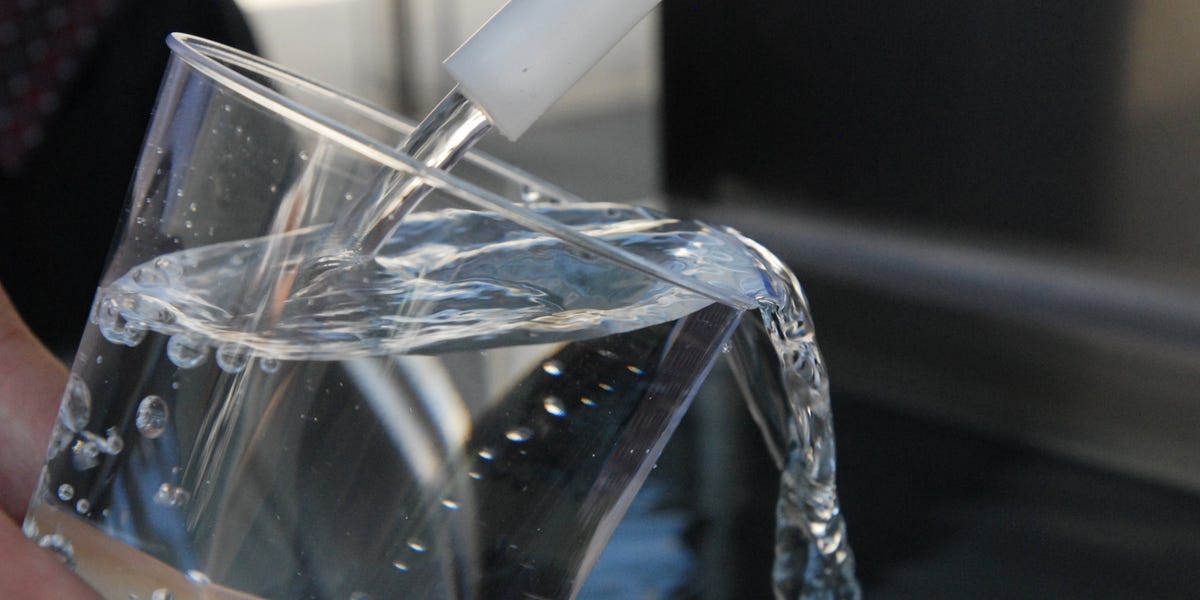
But in Orange County, the water is actually as clean as it looks.
It wasn't always that way. In his new book, "Troubled Water," activist Seth Siegel explains how Orange County's taps went from having too much saltwater to spouting the purest drinking water in the US.
Saltwater was seeping into Orange County's freshwater supply
Orange County is just 35 miles away from Los Angeles, but it relies on a completely different water system to serve its nearly 3.2 million residents. About a decade ago, that system begin churning out the most pristine water the country has ever seen.
From about the 1930s to the 1970s, farmers over-pumped water through Orange County's underground aquifers, the bodies of porous rock that act as a natural filtration system. The process allowed seawater to seep into the county's freshwater supply — what's known as "saltwater intrusion" — and threatened to expose residents to excess sodium in their taps.
Though scientists are still studying the health effects of too much sodium in drinking water, early research suggests it could lead to hypertension and chronic kidney disease.
Orange County prevented this scenario by getting people to drink recycled water instead.
Now, Orange County tap water starts out as sewage
In 2008, the county unveiled a Groundwater Replenishment System that purifies wastewater from the local sewage system and turns it into clean drinking water.
Many cities have struggled to implement the system due to pushback from local residents who aren't keen on drinking water that originated in their toilets. But more than 4 million Americans — including residents of Dallas, Phoenix, and Atlanta — now get at least a portion of their drinking water from treated sewage.
But Orange County's process is unique because it filters for inorganic contaminants — things like pesticides and industrial chemicals that are hard to detect in water, and may still be allowed under federal law.
The US Environmental Protection Agency currently has drinking water regulations for more than 90 contaminants, but Siegel said more than 100,000 chemicals and pharmaceutical compounds escape regulation.
"What makes Orange County so special is they say, 'Okay, fine, the federal rules are X. We don't really care. We're going to go so far beyond those rules that we're going to make the purest water flow we can possibly have,'" he told Business Insider.
Water gets filtered through invisible holes and zapped with UV light
Orange County's filtration process begins like most "toilet to tap" systems in the US. Household sewage arrives at local wastewater treatment facilities, where it's filtered by screens. Then friendly bacteria is added to get rid of lingering organic material (aka human waste).
Most communities allow this treated water to be discharged into public waterways, but Orange County's process doesn't stop there.
Next, the water heads to the Groundwater Replenishment System, where it passes through another set of filters with holes so tiny that they're invisible to the human eye. Mike Wehner, the assistant general manager at the Orange County Water District, told Siegel that the holes are 150 times smaller than the width of a human hair.
From there, the water goes through reverse osmosis, a process that extracts salt, minerals, chemicals, and pharmaceutical compounds.
The water that emerges is free of minerals, so it's slightly acidic, which means it can corrode local pipes. So the county adds crushed limestone back into the water supply to neutralize the pH. From there, it disinfects the water by zapping it with ultraviolet light. This ensures that not a single molecule of waste can survive.
"It's not fair to say that a contaminant could never possibly be in Orange County's water," Siegel said. But the community's taps, he added, are "as pure as pure can be."
The process could be replicated all over the country
Orange County's "toilet to tap" system was expensive — around $480 million to get off the ground. But Siegel makes the argument in his book that almost any city can replicate the process for cheaper.
In many poor communities, he said, water fees aren't actually used to improve the local water system by investing in water infrastructure and technology. The majority of these fees, he said, go toward the municipal budget.
"Flint actually had the highest water fees in the United States when the crisis broke," Siegel said. "What they did wrong was they diverted money from water fees to the general budget."
Based on his conversation with Wehner, Siegel estimates that having water as pure as Orange County's would cost communities an extra $33 per person per year. (That's after replaying any loans used to build the system, and not including state and federal subsidies.)
As filtration technologies become more advanced, he said, that cost could drop even lower.
"Now that Orange County has led the way and spent fortunes of money to figure it out, everybody can adopt more or less the Orange County system at not a phenomenal expense," Siegel said. "Why isn't everyone doing it? The answer is: because nobody's pushing them to."