

A year after Cuba's historic protests, the government's grip is tighter than ever
The episode might have remained as a Cuban urban legend, a whispered about moment of rare public dissent on the communist-run island, if not for recent upgrades to the island's mobile internet.
But that summer, Cubans across the nation were able to live stream and view in real time the unfolding protests in San Antonio de los Baños -- and join in. Almost immediately across the island, thousands of other Cubans took to the streets, some complaining about the lack of food and medicines, others denouncing high-ranking officials and calling for greater civil liberties.
The unprecedented demonstrations even spread to small cities and towns where there are more horse and carriages on the potholed-streets than automobiles.
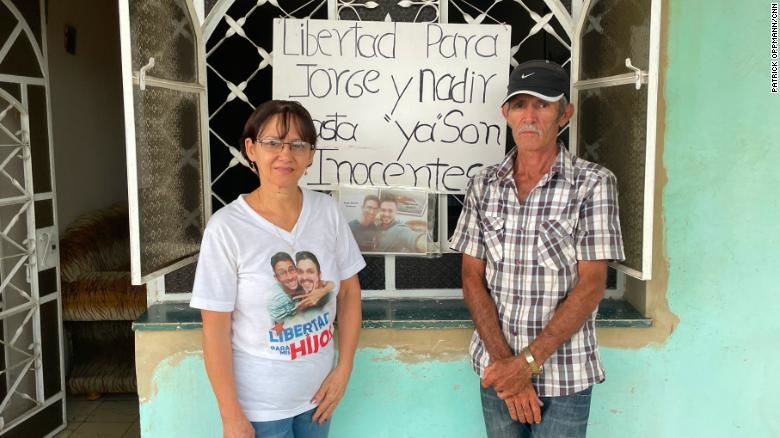 Marta and Jorge Perdomo stand in front of a sign on their home in San Jose de las Lajas, Cuba, on June 28, 2022.
In the city of San Jose de las Lajas, Marta Perdomo said her two sons Nadir and Jorge, both teachers, immediately joined protests as soon as news arrived of unrest elsewhere in the country.
"My sons went out because like every Cuban they were desperate over the situation," Marta Perdomo told CNN. "They are fathers. Every day here we have less. There was no medicine. It was a very sad moment with the pandemic. Children were dying and the elderly too."
Anger boiled over for Cubans as shortages of food and medicine -- already a regular occurrence in Cuba -- became increasingly dire. After years of government neglect, the creaky power grids were breaking down more and more often. While Cuban officials have long blamed US sanctions for the island's woes, protestors on July 11 raged squarely against their own government for their worsening living conditions.
Video Marta's son Nadir took that day shows crowds of anti-government protestors marching peacefully down the street, the demonstrators themselves seemingly in shock over what was happening.
"This is authentic! It's spontaneous!" Nadir says excitedly in the video.
According to Perdomo, protestors in San Jose de las Lajas did not sack government-run stores selling items in hard currency or flip over police cars, unlike in other cities.
As more and more Cubans took to the streets, it became clear that the Cuban government was facing the largest internal challenge to its hold on power in decades.
In a speech on state-run TV, Cuban President Miguel Diaz-Canel blamed the island's economic problems on US government sanctions, said the protests were the result of a subversion campaign directed from abroad, and called the loyal to take back the streets from protestors.
"We are convoking all the country's revolutionaries, all the communists, to go into the streets, to all the places where they might replicate these provocations," he said. "The order to combat has been given."
Government supporters carrying bats alongside police began to break up the protests. Hundreds of Cubans were arrested; some for clashing with officials, others for merely filming the turmoil with their phones.
As protests in San Jose de las Lajas were disrupted by government supporters and police, Nadir and Jorge Perdomo returned to their house and filmed a video on their phones that they were able to post online despite the government's attempts to cut internet access on the island.
"No one paid us," Nadir says in the video, rebuffing government claims that the protests had been contrived.
"We are just reacting the way all the people did."
Both brothers were arrested days later and charged with alleged crimes including public disorder, assault and contempt. Their mother Marta said the charges against her sons were fabricated and that they were being punished for peacefully speaking out against the government.
Cuban officials say that many of the protestors arrested were delinquents and "counter revolutionaries." But in their court records, prosecutors note that neither Nadir or Jorge had criminal records and both "were well regarded" in their community. In February, Nadir were found guilty and sentenced to six years in prison and Jorge to eight years.
To date, Cuban prosecutors say they have convicted and sentenced close to 500 people in relation to the protests, in the largest mass trials on the island in decades.
Preventing future protests
But international human rights organizations say the Cuban government is using the prosecutions to intimidate Cubans from daring to protest again.
"We found that prosecutors were constantly charging Cubans for exercising their basic rights such as the right to protest peacefully, the right to insult their president or the right to insult police officers, exercising the right of freedom of expression," said Juan Pappier, a senior Americas researcher at Human Rights Watch (HRW).
On Monday, HRW released a report on the protests that it says documents 155 cases of alleged abuse against people involved in last year's demonstrations, "including harassment, arbitrary detention, abuse-ridden prosecutions, beatings, and other cases of ill-treatment that in some cases constitute torture."
The organization also accused the Cuban government of further cracking down on civil liberties to prevent more protests from taking place.
Marta Perdomo said she encountered the tightening restrictions first-hand after she was invited to Europe in June to speak about her sons to human rights groups and lawmakers. When she reached the airport in Havana, officials there told her and another mother of an imprisoned protestor they would not be permitted to travel.
"They said I was 'regulated' and couldn't go," Perdomo said.
Cuban officials did not respond to a CNN request asking why Marta Perdomo was not allowed to leave the island.
Even though Perdomo says she is worried about when her three young grandchildren will see their fathers again, she does not have regrets.
"They didn't have to go out but they felt the pain of Cuba," Perdomo said. "That's why they went out. That day my sons were free."
It remains to be seen whether the July protests will be remembered as rare outburst of public rage or a new stage in the struggle for greater openness.
As the pandemic, US sanctions and the slow pace of reforms continue to batter the Cuban economy, officials on the island seem to realize that despite their heavy-handed crackdown last year, more protests could happen at any time.
In June this year, hundreds of Cuban students at a university in the city of Camagüey began a nighttime demonstration after power was cut in their dormitory.
"F**k these blackouts! Put the electricity on!" they chanted as they banged on pots as seen on videos that the students uploaded to social media.
Cuban officials quickly turned back on the lights.