

Amazon's controversial vision for the future of your home security
During an invite-only press conference on Tuesday, the company showed off an autonomous, 20-pound dog-like robot named Astro with large, cartoon-y eyes on its tablet face and a cup holder. The robot -- not unlike an Alexa on wheels -- uses voice-recognition software, cameras, artificial intelligence, mapping technology and voice- and face-recognition sensors as it zooms from room to room, capturing live video and learning your habits.
Amazon also announced a subscription service called Virtual Security Guard for Ring cameras. Ring, the smart doorbell and camera company it acquired in 2018 for $1 billion, will work with third-party professional monitoring companies, such as Rapid Response, to analyze a live feed from its outdoor cameras.
The agents can use the camera's two-way talk functionality to communicate with visitors and activate the camera's siren or send emergency services as needed. (Ring already sells a $250 drone called Always Home Cam with an attached camera that can automatically fly around your house and stream video to your smartphone.)
For Amazon, these products offer the promise of taking a piece of the lucrative home security market and also pushing customers deeper into its ecosystem of household products. Other tech companies have stepped into this market over the years, including Google with its Nest Aware video recording system and Nest smart doorbell. Companies such as Logitech, Arlo and Netamo offer similar products.
But Amazon's decision to expand its offerings in this product category comes at a time of widespread scrutiny of the power and data privacy practices of the tech industry's biggest players. And Amazon's latest eyebrow-raising security products, with their potential for greater surveillance in and around our homes, may test just how much further companies can push consumers' comfort levels with such intrusive technology.
"Tech companies once promised a future like Star Trek, but Amazon is trying to sell us RoboCops," said Albert Fox Cahn, founder and executive director of the Surveillance Technology Oversight Project and a fellow at the New York University School of Law. "And while these products promise safety, they're really a threat. These sensors would give us a disturbing new reality where it's impossible to escape the tech giant's roving drones within our own home."
It's a seemingly bold move for Amazon as its reach and power have drawn scrutiny from regulators around the world. Amazon has elicited privacy concerns before with its smart home devices. In 2019, for example, a Bloomberg report revealed Amazon employed a global team that transcribed Alexa's voice commands on Echo devices captured after the wake word was detected to help improve Alexa's grasp of human speech. (Amazon later said people could opt out of Amazon using their voice recordings.)
Privacy advocates also slammed a 2019 move by Ring to give law enforcement easier access to videos recorded on its doorbells for active investigations. (Since June, police and fire departments may only request information or videos related to an active investigation through public posts called Requests for Assistance.)
Shortly after Tuesday's event, leaked internal documents published by Motherboard revealed concerns raised by Astro's development team around the safety and privacy of the Astro robot, with one person who worked on the project reportedly calling it "a privacy nightmare that is an indictment of our society." An Amazon representative pushed back at characterizations in the report in response to Motherboard and noted Astro makes use of on-device
processing for tasks such as recognizing individuals.
Following the publication of this article, Amazon told CNN Business privacy is fundamental to its products' design. "We only collect information needed to provide and improve our customers' experience. When we collect data, we secure it and use it responsibly to improve the experience, while providing customers with transparency and control over their information," a spokesperson said.
How Amazon is trying to get inside customers' homes
Amazon kicked off its presence in our homes in 2014 with the Echo speaker, which became a hit for the company. Amazon has since crammed its Alexa virtual assistant into every kind of device imaginable, effectively acclimating its users to the possibility of the company listening to them all the time in exchange for greater utility. Now, its latest products are basically pitching that on steroids.
"Clearly we are moving into different territory now with the arrival of more experimental products such as the Always Home mini-drone camera and the Astro robot, but I believe that Amazon is using their products to learn more about consumers' willingness to have such devices in their homes," said Ben Wood, chief analyst at market research firm CCS Insight. Wood also said some consumers are willing to accept tradeoffs around privacy for the feeling of reassurance and security that products from companies like Amazon provide.
Amazon appears to be taking steps to make that tradeoff feel less severe.
A Ring spokesperson told CNN Business any agent monitoring a stream from its Virtual Security Guard service cannot access saved recordings, or download or store any videos, and customers will know what events were viewed by an agent. Customers can also set up privacy zones that are off limits for agents, but this may be small comfort to visitors and random passersby who are still caught on camera.
On the Astro product page, Amazon notes the robot's microphones, cameras and sensors will be disconnected when powered off. When Astro is recording, a light will turn green and it can be programmed to avoid certain areas of the house. In addition, images of faces can be deleted and anything that's sent to the cloud will be encrypted. Astro does create a map of the home based on where the robot explores, but the company said that data, which is sent to the cloud, does not contain actual images or streamed video.
Then there's the appearance. Amazon has dressed up surveillance technology as an adorable companion watch dog, making it much more appealing for customers, according to Jonathan Collins, a director at market research firm ABI Research. "Cute-ness is subjective but certainly the more emotionally invested someone is with a device -- and that can be driven by pleasurable visual or audio exchanges -- the more it is likely to be used," he said.
In a YouTube video posted by the company this week, Amazon developers said they took inspiration for Astro from science fiction movies and cartoons. They also noted it was important to include eyes on the robot and give it a personality, so it can better connect with users.
Other tech companies have tried to gain traction with home robots, including Softbank's Pepper, Anki's Vector robots and Samsung's Ballie, the latter of which would allow users to watch pets, family members or check in on things around the house when away. But Ballie was never commercialized and the others never caught on.
Astro, however, builds on the company's strength in robots, artificial intelligence, computer vision, sensor technology, voice interactions and edge computing, Wood said. Coupled with Amazon's reach and scale, this launch is far more notable, he added.
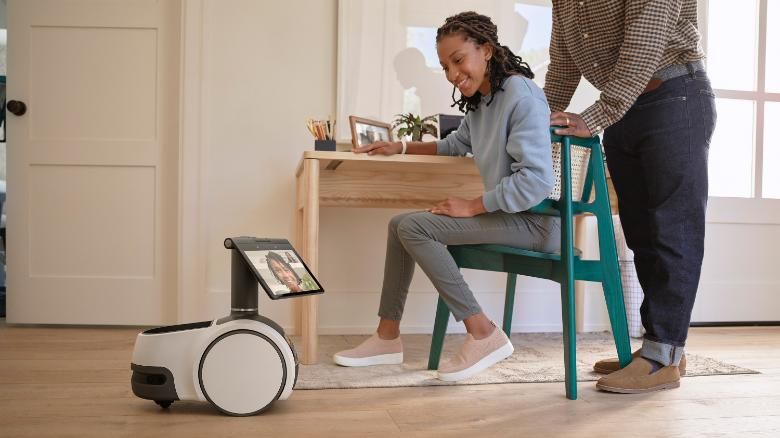 Amazon's Astro robot
"With an introductory price of $1000 and a small number of units available to a limited audience I believe the Astro robot will sell out in minutes when it becomes available in the US market," Wood said. (It ultimately will cost $1,500 after an invitation-only purchasing period.)
If Astro succeeds, it may be just the start. According to previous ABI Research projections, about 79 million homes globally will have a robot in the house by 2024. And one of the selling points for these robots will almost certainly be home security features.
In the YouTube video, Charlie Tritschler, a vice president of product for Amazon, said the idea for Astro came after a senior leadership meeting when someone asked if anyone in the room thought people wouldn't have robots in the home in next five to 10 years. "Everyone said, 'Yeah, we are.' So we said, 'Let's get started," he said.