

As El Salvador’s arrest wave continues, families live in worry
Alexander Eduvay Guzman Molina’s daughters want to know when he will be coming home.
They have not seen their father, a 45-year-old teacher, since he was arrested by Salvadoran police on March 27 during the country’s continuing state of exception, which authorities say aims to crack down on gangs and gang-related violence.
Guzman Molina has been accused of “illicit association”, but a relative told Al Jazeera the charges are unfounded. Now, the family fears for his safety, as Guzman Molina has missed his physical therapy appointments for a bone fracture in his hand and never made it to a doctor’s appointment after being told he was vulnerable to suffering a stroke.
“I’m worried that they aren’t giving him medical attention and that something could happen to him,” his relative, who asked not to be identified for fear of retaliation from authorities, told Al Jazeera. “They [authorities] are doing horrible damage, because behind him is a wife, children, mom, dad and siblings, who are all suffering terribly because of this situation.”
Thousands of Salvadoran families are experiencing the same anxiety after the government arrested more than 24,000 people since the state of exception began on March 27. The government says it is arresting “terrorists” and gang members to take control of the streets after a spike in homicides from March 25 to 27 left more than 80 people dead.
But family members say some of the people arrested have no gang ties and have been caught up in a policy that is targeting innocent Salvadorans.
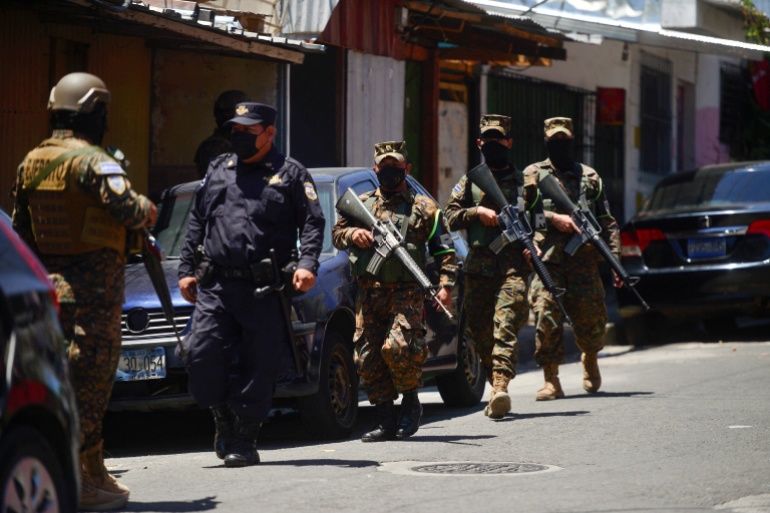 El Salvador has arrested more than 24,000 people since the state of exception came into force in late March
Some wives, mothers and other relatives spend days outside prisons waiting for a sign of their loved ones, whom the authorities in most cases have shared little to no information about. Others write desperate messages on social media, tagging journalists and authorities in hopes someone will help them reunite with their relatives.
“Start of a new week and we are without knowing absolutely ANYTHING about my brother. This nightmare repeats itself in many homes of honest Salvadorans who have been detained illegally,” wrote Fernanda Alvarado on Twitter on May 2. Her brother, Jose Luis Iglesias Alvarado, 30, was detained while working as a food delivery driver on April 26.
“This situation causes despair, anguish and everything that can be felt by a human being,” Iglesias Alvarado’s mother, Alma Ruth Alvarado Peralta, told Al Jazeera. “We have to be strong for him and we have to prove his innocence.”
‘We’ve seen this before’
The trauma currently experienced by the families of detainees echoes past periods of state violence in El Salvador.
During a civil war between left-wing rebels and the US-backed Salvadoran government from 1980 to 1992, more than 70,000 people were killed and 5,000 disappeared. Student leaders and activists were taken off the streets and never seen again, and babies were stolen from their families and put up for illegal adoption.
“These are clearly mass arrests without any investigation and that are intended to generate an impact of terror in the population,” said Leonor Arteaga, a Salvadoran lawyer and director of the Impunity and Grave Human Rights Violations programme at the Due Process of Law Foundation, which promotes the rule of law in Latin America.
 Alexander Eduvay Guzman Molina’s relatives say he has nothing to do with
gangs [Courtesy Alexander Eduvay Guzman Molina’s family]
“We’ve seen this before in the armed conflict,” Arteaga told Al Jazeera.
A recent report by Human Rights Watch (HRW) and Salvadoran rights group Cristosal documented a trend of arbitrary detentions in the latest wave of arrests. The groups called some of them “enforced disappearances” because of the lack of information and contact with families.
An individual can be considered disappeared when “state officials (or someone acting with state consent) grabs them from the street or from their homes and then deny it, or refuse to say where they are”, according to Amnesty International.
But despite the criticism, members of President Nayib Bukele‘s Nuevas Ideas Party said they would continue the arrests during the state of exception until all the country’s gang members, estimated at 70,000 people, are detained.
“This work can’t end in just 30 days,” Security and Justice Minister Gustavo Villatoro said, justifying a 30-day extension approved on April 24. Bukele has said that there will be some errors in the arrests, but that these represent only a small, one-percent margin that the system will correct. The president’s office did not respond to Al Jazeera’s phone calls seeking comment.
Psychological toll
Unlike what occurred during the civil war, Arteaga hesitated to use the term “disappearances” to describe the current wave of detentions. She said that is because it remains unclear if the government is implementing an official policy of withholding information about detainees or if the lack of information results from poor record-keeping or an overburdened penitentiary and judicial system.
Still, the psychological toll is agonising. “This uncertainty of not knowing where their relatives are, not being able to communicate with them, not being able to send them food or visit them is causing very serious psychological effects, that if maintained over time could even be considered a form of torture under international law,” said Arteaga.
Since 19-year-old Oscar Eduardo Morales Recinos was arrested on April 6 in his gang-controlled neighbourhood just outside the capital, San Salvador, his mother Lilian Argelia Recinos Lainez has had trouble sleeping.
The family knows that he is in the Izalco prison in Sonsonate, about an hour’s drive from his home, but has not had contact with him or his public defender. “I start to think about all of the things that are happening in the prison where he is now,” said Recinos Lainez, who migrated to Spain last year. Four deaths were reported at Izalco prison in April. “It pains me because I can’t do anything from here.”
A relative of 26-year-old Ramon Aparicio Vega – who was detained on April 13 on his way to work at a stationery shop – has similar concerns, but has been able to take action. He has been going to the public prosecutor’s office as often as he can to seek information about Aparicio Vega, but says officials always tell him they have no information.
“My question is, where is he? Because they don’t give me an answer. It’s as if they try to evade the questions that you ask them,” the relative, who also asked to remain anonymous for fear of retaliation, told Al Jazeera. “It fills us with worry.”
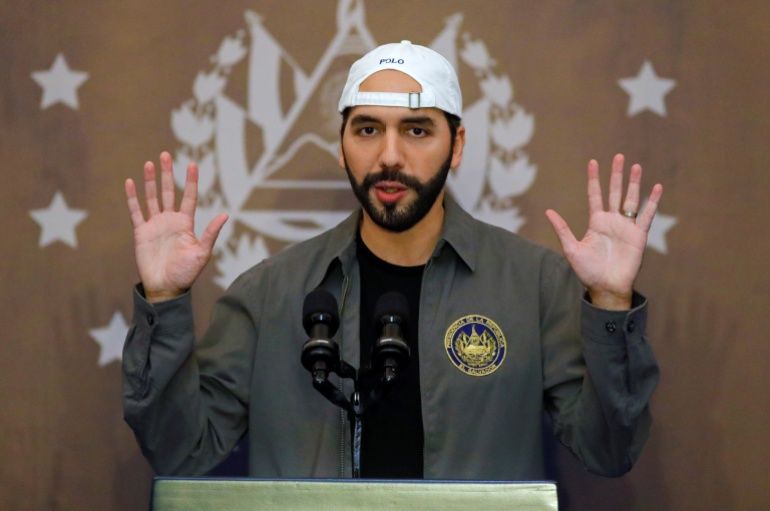 President Nayib Bukele’s party has said the arrests will continue until all gang members are behind bars
No gang connections
Because authorities used sweeping powers authorised under the state of exception and did not investigate many of the gang-related charges before carrying out the arrests, human rights groups have categorised them as arbitrary detentions.
Arteaga said the detentions show a clear trend of discrimination against “young men who live in conditions of poverty” in El Salvador.
The relatives Al Jazeera spoke to said their family members – all of whom are accused of “illicit association”, a charge commonly used against suspected gang members – do not have any gang connections or past criminal records. The police did not respond to Al Jazeera’s phone calls to their central line or to local offices where the men were imprisoned.
Guzman Molina, the teacher who also runs a taxi business on the side, has always “worked honestly”, his relative said. The relative said police have categorised him as a gang member for having a sum of cash on him related to his taxi business. Iglesias Alvarado has dreadlocks and artistic tattoos, but has never been involved in criminal activity, and volunteers and plays soccer in his free time, according to his mother. Aparicio Vega has no gang ties, tattoos or criminal record and is “a person that works all day and then stays at home at night”, his relative said.
Morales Recinos’ family members say that the “illicit association” accusation stems from a misunderstanding over his collecting of payments for his bread business that was misinterpreted as charging extortion due to the gang presence in his neighbourhood.
“Just for living in these communities, they’ve taken so many youth away,” said his mother, Recinos Lainez. “Imagine all the trauma they are causing.”