

Asylum seeker crossings into US city of El Paso spike on weekend
The US border city of El Paso, Texas, has said an estimated 5,105 asylum seekers are in custody as of Monday, after a wave of people crossed the Rio Grande River over the weekend.
Data compiled by El Paso showed that agents for the United States Customs and Border Protection (CBP) documented 2,399 encounters in the area over the last 24 hours alone, including 892 people released into the community, where shelters and non-profits are stretched to capacity.
On its website, El
Paso said the majority of the refugees and migrants are arriving from countries such as Venezuela, Ecuador, El Salvador, Haiti, Nicaragua and Cuba, where violence and economic strife are widespread.
The city has tallied an average of 900 people per day passing through its facilities or that of local nongovernmental organisations (NGOs).
The influx comes as a controversial US immigration policy called Title 42 is set to expire on December 21. Implemented in March 2020 due to the COVID-19 pandemic, Title 42 allows US border agents to rapidly turn away most asylum seekers on the grounds of public health.
Fifteen states, including Republican-led Texas, are fighting to keep Title 42 in place, warning that asylum seeker arrivals will spike without it. But migrant rights advocates say the policy violates US and international law and puts people at risk of violence upon expulsion.
Sue Dickson, a volunteer with the Annunciation House shelter in El Paso, told Al Jazeera that all 55 beds at the volunteer-run organisation are full, but people are still arriving.
“Right now there are a lot of people coming by the street and knocking on the door, but we can’t take them in because we can only receive people who’ve come through immigration,” Dickson said. “When you’re undocumented, many of the shelters cannot legally take you in. And so you’re kind of at a loss.”
She said another big wave of refugees and migrants arrived in September, when the city and local NGOs welcomed an estimated 1,000 people per day. “When a wave comes, we just deal with it the best we can,” she said. “We don’t have the resources or the people or the shelters to take care of them all.”
People staying at Annunciation House typically stay only a couple of nights, Dickson explained. Shelter volunteers work with the refugees and migrants to connect them with family members or other individuals who can serve as sponsors, supporting them while they stay in the US. From there, volunteers help arrange their travel to Dallas, New York, Chicago or other cities.
“People are coming through El Paso,” Dickson said. “They’re not actually settling here.”
Surge in arrivals
Immigration is a divisive issue in the US, where one in eight residents are foreign-born, according to the country’s census.
But over the past year, refugee and migrant arrests reached a record high, with the CPB reporting more than 2.7 million “enforcement actions” taken from October 2021 to September 2022.
That is an increase of approximately 41 percent over the previous year’s record total.
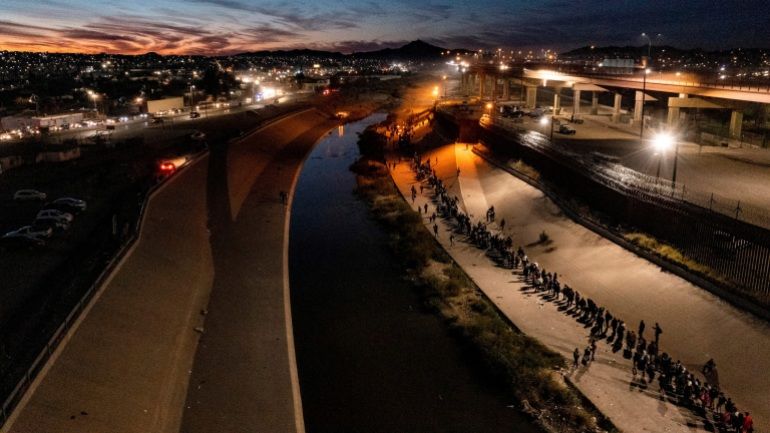 A line of refugees and migrants arrive from Juarez, Mexico, to El Paso, Texas, on December 11
Prominent Republican legislators have seized on the issue as a central part of their platforms.
In November, Republican Governor Greg Abbott of Texas said he had sent a bus of 28 refugees and migrants to Philadelphia, Pennsylvania, the latest in a series of moves to transport asylum seekers out of Texas to Democratic strongholds such as New York City and Chicago.
The Associated Press news agency reported that the bus arrived on November 16 carrying a 10-year-old girl who had to be hospitalised for fever and dehydration.
Critics have denounced the bus campaign as an inhumane publicity stunt, but Abbott defended the programme, saying it was a necessary response to Democratic President Joe Biden’s “reckless open border policies”.
Since April, Abbott has moved an estimated 13,000 refugees and migrants out of Texas by bus, first to Washington, DC, and then to other parts of the country.
“Texas will continue doing more than any other state in the nation’s history to defend against an invasion along the border, including adding more sanctuary cities like Philadelphia as drop-off locations for our busing strategy,” Abbott’s office said in a statement.
Similar programmes have arisen in other parts of the country, including Florida, where Governor Ron DeSantis made national headlines after chartering two planes to carry people to Martha’s Vineyard, a small resort island on the coast of Massachusetts home to about 20,000 people.
And in Arizona, a state that, like Texas, sits on the US-Mexico border, outgoing Governor Doug Ducey has chartered 70 buses to transport 2,500 asylum seekers to Washington, DC. His final days in office also have been the subject of protest, as work crews attempt to fill gaps in the state’s border wall with rows of stacked shipping containers topped with razor wire.
By August, 1,164 metres (3,820 feet) of double-stacked shipping containers had been placed near Yuma, Arizona. The latest spurt of construction is part of a larger, $95m project to cover 16km (10 miles) of border near Arizona’s Cochise County with approximately 3,000 shipping containers.
But federal agencies such as the US Forest Service and environmental groups have called for a halt to the construction, and the Cocopah Indian Tribe has urged the state to remove the shipping containers from its land.
Title 42 winding down
Ducey is among the governors who have called on the Biden administration to keep Title 42 in effect, arguing that the policy “is one of the last measures still in place that helps our border agents do their jobs”.
Last month, US District Court Judge Emmet Sullivan struck down the policy, calling it an “arbitrary and capricious” breach of federal law.
In his ruling, Sullivan wrote that the officials knew that, under the policy, refugees and migrants would be expelled to areas where there was a “high probability” of “persecution, torture, violent assaults, or rape”. He granted the Biden administration five weeks to prepare for its end.
The American Civil Liberties Union (ACLU) — which had sued to overturn the Trump-era policy — and other rights groups applauded the judge’s ruling.
“This is a huge victory and one that literally has life-and-death stakes,” Lee Gelernt, the ACLU’s lead lawyer in the case, said in a statement. “We have said all along that using Title 42 against asylum seekers was inhumane and driven purely by politics.”
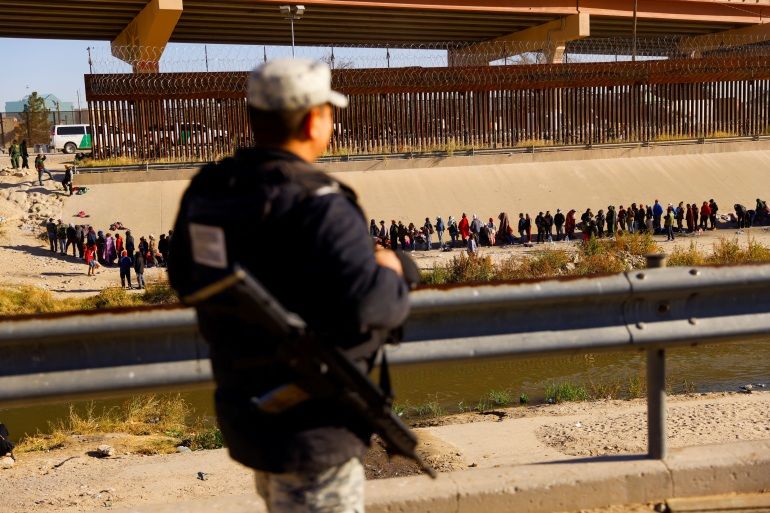 A member of the Mexican army watches from across the Rio Grande River as
refugees and migrants queue for immigration services in El Paso, Texas
Dickson, the volunteer at El Paso’s Annunciation House, said she encouraged Americans interested in immigration to visit shelters and meet asylum seekers firsthand.
Many, she explained, have lived through harrowing experiences walking across the Darien Gap, a perilous mountain region that connects Colombia and Panama.
“They’ve seen dead bodies on the side of the road. They’ve seen people with snake bites who take two or three steps and then collapse and are left along the trail. And the countries that they’ve come from, they would not leave unless it was a dire situation, a desperate situation,” she said.
“It’s not like they have a nice life, and they want to just have a better life. These are people who are desperate, who have no work, no food, no medical care for their children. There’s no hope, no future.”