
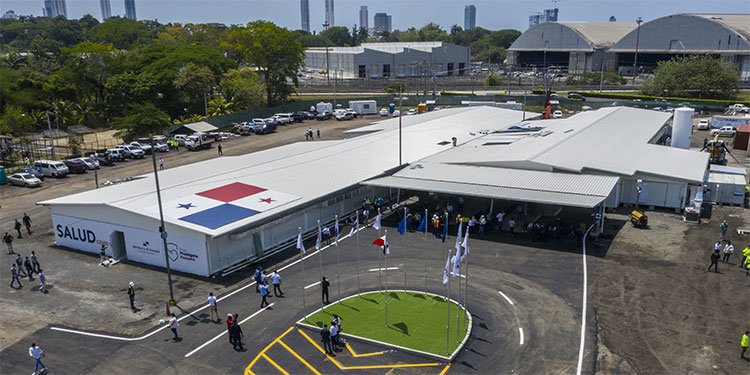
Audit asked for the modular hospital – the accounts are not clear
The authorities are asked to carry out an audit of the work.
The final price of the hospital has not yet been defined, although reports have been obtained from official sources that the cost of the structure and its medical equipment has so far been around $12 million.
The hospital has several contracts which have recently come to light. Based on the information available, various sources consulted by La Prensa calculate that the company that built the modular hospital - which does not include medical equipment - will charge several million more.
For example, SmartBrix Central America - the company responsible for the modular structure - will charge $ 157,000 for the fire alarm system. But specialized sources consulted by this means calculated that this work does not exceed a cost of $ 42,000, since the contractor was asked for "a basic system. There is something wrong here," said the consulted expert.
The responses in queries have been contradictory.
The Press has tried, since last Monday, to obtain the version of Nitesh Mayani, president of SmatBrix, but at the end of this report, had not answered the questions.
The confusing value of the 'Panama Solidario' modular hospital
The Panama Solidarity program, created by the Government to face the pandemic, has allowed the management of a large amount of capital in a period of two months. One of its flagship projects is a modular hospital, built in record time - as China did - to serve Covid-19 patients.
The hospital would strengthen the combined capacity of the Ministry of Health and the Social Security Fund with 100 beds to attend to critical patients infected with the virus. The initiative was received positively by citizens. The Executive entrusted the construction task to the Ministry of Public Works (MOP).
But, the project has had irregularities since the beginning. To start with, the MOP invited three companies, two of them with no experience in the field of modular construction and less in building hospitals. The role of these companies was, apparently, to mediate with companies that would have had experience in this field.
The companies were VA Project International, SA and TKL Import & Export. The third was SmartBrix Central America, which was awarded the contract for nearly $7 million to build the structure of a 2,400-square-meter hospital and other facilities, and whose average construction is $2,916 per square meter, without equipment doctor.
And although the work was delivered weeks ago, it was last Tuesday when firefighters and the Municipality of Panama delivered the occupation permits. A technical inspection is still pending to verify the structural work.
Background
VA Project International, SA submitted an offer of $ 9.9 million, but it was not considered. Besides the price, it had other problems. According to the database of the National Customs Authority, VA Project did not make previous imports of modular structures, therefore it could not meet the delivery deadline. In its proposal, the company mentioned that it would finish the hospital in 45 days, instead of 30, as requested in the statement of objectives.
VA Project, which Jaime Ventura Cervera, the director of Mi Bus, is the president, was registered in the Public Registry in May 2015. It has an operating notice, dated March 21, 2019, to provide advice, consultancy and project designs.
The second offeror, TKL Import & Export, SA, was registered in 2006 by the current director of Immigration, Samira Gozaine. Following her resignation as a resident agent, a partner in his firm, Eric Pittí, was appointed a lawyer for TKL. The company made an offer, but, apart from its high cost – about $ 18 million – it was not considered as it did not comply with the statement of objectives.
TKL Import & Export, SA sells construction materials, plumbing and hardware. It says nothing about modular structures, although its proposal to the MOP came from a Turkish manufacturer with experience in modular hospitals. According to the Comptroller's Office, this year TKL obtained 18 contracts, between January and March, including two in Migration, directed by its former resident agent.
The third provider, SmartBrix Central America, had not built a hospital project, although its work area is construction with modular structures. The company is Colombian-Panamanian, and in May 2016 it was endorsed by the Technical Board of Engineering and Architecture (JTIA) to build small single-family homes with an alternative construction system.
The company provided a document for the tender indicating that it is the "only" JTIA accredited company to build a modular system in the country. He also kept a list of "satisfied" clients: Minera Panamá and the Ministry of Security. Also, Mi Bus, where – as previously mentioned – Jaime Ventura Cervera, sits on board of directors.
The cost
If there is something lacking in the hospital project, it is transparency. It as been difficult to gather documented information about its final cost, since that data and many more are not available.
Until now, La Prensa has discovered that it is not one or two contracts, but multiple. And the number has been increasing. Obtaining all those contracts has not been possible; He has only had verbal access from official sources to his amounts and, sometimes, the figures offered do not coincide.
Even so, La Prensa reported the information it has obtained so far, with the proviso that it is incomplete, given the contractual complexity and confusion that exists on the subject in the ministries that have managed the project: Ministry of Public Works (MOP) and Ministry Health (Minsa).
To the question, on what level the new hospital is at; the Minister of Health, Rosario Turner, replied that it is a "level 2 hospital, with complexity 5".
Former medical directors and current managers of public hospital centers who were consulted by this means considered Turner's classification of the complexity of this hospital “absurd”.
So, this would be the first hospital with those characteristics in Panama. In turn, the answer to the same question given by the head of the MOP, Rafael Sabonge, was: level 3.
On the equipment of the hospital, Minister Turner reported that she still does not have an expense report, but promised that the contracts will be disclosed on the Panama Compra portal, soon. Days before, in an interview with this newspaper, Sabonge said that the equipment would cost about $ 4 million.
As for the structure of the hospital, an issue that the MOP handled, the contract is for $6.9 million. This would theoretically mean that the hospital - built and equipped - would have a total cost of $10.9 million.
But Sabonge told he received $8.9 million to build the structure and that he will return almost $1 million. This suggests that the structure and its facilities cost about $8 million and not $6.9 million, and would raise the cost of the hospital - for now - to about $ 12 million.
In other words, the complete modular hospital would cost about $5,000 a square meter. To get an idea of how high this value is, La Prensa compared some prices with the new Children's Hospital, awarded last March. The latter is far from being a modular hospital, and that its complexity is among the highest in the country.
According to the website of the Dr. Renán Esquivel Children's Hospital, its new, fully equipped headquarters will have, in addition to the hospital area, gardens and 700 parking lots, for a total of 168,500 square meters of construction. That is 70 times larger than the modular hospital area.
If the value of the contract for the new Children's Hospital - awarded for $615 million - is divided among the square meters of construction, the average cost results in about $3,650 a square meter or $1,350 less than what the Government will pay for the modular hospital: $5,000 per square meter, as already stated.
The tender for the new Children's Hospital also includes medical equipment - highly complex, which also includes maternity and delivery facilities at the Santo Tomás Hospital, with 720 beds and 28 combined operating rooms in both hospitals - in addition to office furniture.
This part of the contract - medical and office equipment - represents an investment of 20% of the total contract for the new Children's Hospital. But in the modular hospital contract, the $4 million to equip it represents not 20% of the total cost of the work, but 33%.
Other opinions
So how much should the modular hospital cost? La Prensa spoke to a multiplicity of sources - all linked to the construction sector with modular structures - who gave their opinions on the basis of the information available, which, as stated, varies considerably.
According to the Customs Authority, last December, SmartBrix Central America imported 48 modular structures from China, and declared a price of $200,000. Months before - in April 2019 - it also imported 160 structures from Costa Rica, and declared a cost of $ 202,000. These prices give us an idea of what Smartbrix invests in its modules, its main raw material.
According to a collection management chart from the MOP, the State paid $2.9 million for the transportation, installation and supply of the modular structures (containers and accessories), the antibacterial epoxy floor and the thermoacoustic paneling and accessories. The Press counted - in a photo area of the MOP - 160 modular structures. The head of the MOP, Rafael Sabonge, assured that $7,000 were paid for each, plus flat fee of $130,000.
Two interested sources claimed that, paying three shifts a day during construction time and employing contractor companies, would bring the cost of labor to about $600,000, "and that would be too much."
The same sources - who are in the business of building with modular structures - agreed that the work has cost too much. In their opinion - without medical equipment or air conditioning - the value of the work should not have been more than $ 2.1 million. "And that includes a high profit margin," highlighted one of the respondents.
This would be equivalent to about $875 per square meter of construction – without medical equipment or air conditioning – but adding the latter, it would still be far from what the State is paying: $2,916 per square meter of construction and other facilities without medical equipment nor the air conditioners.
Acoording to another source, whose business is the sale and construction with containers, stated that “this prefabricated structure (the modular hospital) is not made of steel, so it will not last more than ten years in wet areas. The floor runs the risk of rotting, as can be verified in the modules placed in Calidonia, paid for by the previous Government”.
The source believes that the price of the hospital should not exceed $2.3 million. This would put the cost of the work at about $960 per square meter without medical equipment.
Likewise, a group of engineers, architects and companies dedicated to the sale of modular structures sent La Prensa a report in which they calculate that the cost of the hospital, without the equipment, should not have been more than $3.4 million. This would put the price per square meter, without the medical team, about $1,415, that is, less than half of what the government is now paying.
The last two prices would include the cost of the modules, civil works, electricity, air conditioning, plumbing, medical gases, and the fire alarm system, among others. Some businessmen suggest that an audit be carried out to verify the cost per unit of the containers, looking for irregularities in the import value, since the price "is very high for what you pay in this business."
Was the modular hospital the only alternative to serve Covid-19 patients?