

Buckingham Palace banned ethnic minorities from office roles, papers reveal
The Queen’s courtiers banned “coloured immigrants or foreigners” from serving in clerical roles in the royal household until at least the late 1960s, according to newly discovered documents that will reignite the debate over the British royal family and race.
The documents also shed light on how Buckingham Palace negotiated controversial clauses – that remain in place to this day – exempting the Queen and her household from laws that prevent race and sex discrimination.
The papers were discovered at the National Archives as part of the Guardian’s ongoing investigation into the royal family’s use of an arcane parliamentary procedure, known as Queen’s consent, to secretly influence the content of British laws.
They reveal how in 1968, the Queen’s chief financial manager informed civil servants that “it was not, in fact, the practice to appoint coloured immigrants or foreigners” to clerical roles in the royal household, although they were permitted to work as domestic servants.
It is unclear when the practice ended. Buckingham Palace refused to answer questions about the ban and when it was revoked. It said its records showed people from ethnic minority backgrounds being employed in the 1990s. It added that before that decade, it did not keep records on the racial backgrounds of employees.
Exemptions from the law
In the 1960s government ministers sought to introduce laws that would make it illegal to refuse to employ an individual on the grounds of their race or ethnicity.
The Queen has remained personally exempted from those equality laws for more than four decades. The exemption has made it impossible for women or people from ethnic minorities working for her household to complain to the courts if they believe they have been discriminated against.
In a statement, Buckingham Palace did not dispute that the Queen had been exempted from the laws, adding that it had a separate process for hearing complaints related to discrimination. The palace did not respond when asked what this process consists of.
The exemption from the law was brought into force in the 1970s, when politicians implemented a series of racial and sexual equality laws to eradicate discrimination.
The official documents reveal how government officials in the 1970s coordinated with Elizabeth Windsor’s advisers on the wording of the laws.
The documents are likely to refocus attention on the royal family’s historical and current relationship with race.
Much of the family’s history is inextricably linked with the British empire, which subjugated people around the world. Some members of the royal family have also been criticised for their racist comments.
In March the Duchess of Sussex, the family’s first mixed-race member, said she had had suicidal thoughts during her time in the royal family, and alleged that a member of the family had expressed concern about her child’s skin colour.
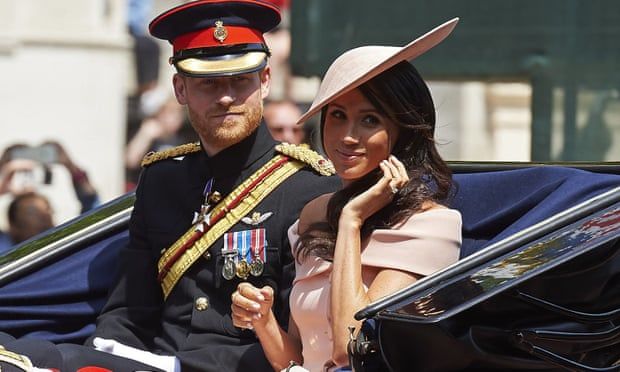 The Duke and Duchess of Sussex after attending the Queen’s birthday parade in 2018.
The allegation compelled her brother-in-law, Prince William, to declare that the royal family was “very much not” racist.
Queen’s consent
Some of the documents uncovered by the Guardian relate to the use of Queen’s consent, an obscure parliamentary mechanism through which the monarch grants parliament permission to debate laws that affect her and her private interests.
Buckingham Palace says the process is a mere formality, despite compelling evidence that the Queen has repeatedly used the power to secretly lobby ministers to amend legislation she does not like.
The newly discovered documents reveal how the Queen’s consent procedure was used to secretly influence the formation of the draft race relations legislation.
In 1968, the then home secretary, James Callaghan, and civil servants at the Home Office appear to have believed that they should not request Queen’s consent for parliament to debate the race relations bill until her advisers were satisfied it could not be enforced against her in the courts.
At the time, Callaghan wanted to expand the UK’s racial discrimination laws, which only prohibited discrimination in public places, so that they also prevented racism in employment or services such as housing.
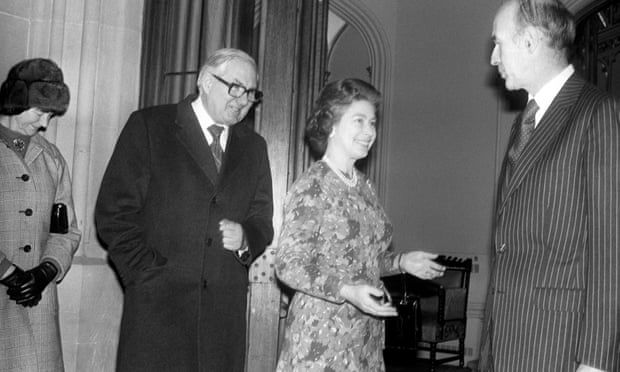 James
Callaghan pictured with the Queen in 1977, welcoming the then French
president, Valery Giscard d’Estaing, to Windsor Castle.
A key proposal of the bill was the Race Relations Board, which would act as an ombudsman for discrimination complaints and could bring court proceedings against individuals or companies that maintained racist practices.
‘Not the practice to appoint coloured immigrants’
In February 1968, a Home Office civil servant, TG Weiler, summarised the progress of discussions with Lord Tryon, the keeper of the privy purse, who was responsible for managing the Queen’s finances, and other courtiers.
Tryon, he wrote, had informed them Buckingham Palace was prepared to comply with the proposed law, but only if it enjoyed similar exemptions to those provided to the diplomatic service, which could reject job applicants who had been resident in the UK for less than five years.
According to Weiler, Tryon considered staff in the Queen’s household to fall into one of three types of roles: “(a) senior posts, which were not filled by advertising or by any overt system of appointment and which would presumably be accepted as outside the scope of the bill; (b) clerical and other office posts, to which it was not, in fact, the practice to appoint coloured immigrants or foreigners; and (c) ordinary domestic posts for which coloured applicants were freely considered, but which would in any event be covered by the proposed general exemption for domestic employment.”
“They were particularly concerned,” Weiler wrote, “that if the proposed legislation applied to the Queen’s household it would for the first time make it legally possible to criticise the household. Many people do so already, but this has to be accepted and is on a different footing from a statutory provision.”
By March, Buckingham Palace was satisfied with the proposed law. A Home Office official noted that the courtiers “agreed that the way was now open for the secretary of state to seek the Queen’s consent to place her interest at the disposal of parliament for the purpose of the bill.”
The phrasing of the documents is highly significant, because it suggests that Callaghan and the Home Office officials believed it might not be possible to obtain the Queen’s consent for parliament to debate the racial equality law unless the monarch was assured of her exemption.
As a result of this exemption, the Race Relations Board that was given the task of investigating racial discrimination would send any complaints from the Queen’s staff to the home secretary rather than the courts.
In the 1970s, the government brought in three laws to counter racial and sexual discrimination in the workplace. Complainants in general were empowered to take their cases directly to the courts.
But staff in the royal household were specifically prevented from doing so, although the wording of the ban was sufficiently vague that the public might not have realised the monarch’s staff had been exempted.
A civil servant noted that the exemption in the 1975 Sex Discrimination Act had been “acceptable to the palace, largely because it did not explicitly single out persons employed by Her Majesty in her personal capacity for special exception” while still removing them from its scope.
The exemption was extended to the present day when in 2010 the Equality Act replaced the 1976 Race Relations Act, the 1975 Sex Discrimination Act and the 1970 Equal Pay Act. For many years, critics have regularly pointed out that the royal household employed few black, Asian or minority-ethnic people.
In 1990 the journalist Andrew Morton reported in the Sunday Times that “a black face has never graced the executive echelons of royal service – the household and officials” and “even among clerical and domestic staff, there is only a handful of recruits from ethnic minorities”.
The following year, the royal researcher Philip Hall published a book, Royal Fortune, in which he cited a source close to the Queen confirming that there were no non-white courtiers in the palace’s most senior ranks.
In 1997 the Palace admitted to the Independent that it was not carrying out an officially recommended policy of monitoring staff numbers to ensure equal opportunities.
A Buckingham Palace spokesperson said: “The royal household and the sovereign comply with the provisions of the Equality Act, in principle and in practice. This is reflected in the diversity, inclusion and dignity at work policies, procedures and practices within the royal household.
“Any complaints that might be raised under the act follow a formal process that provides a means of hearing and remedying any complaint.” The palace did not respond when asked if the monarch was subject to this act in law.