

Chile’s new constitution finalised after turbulent process
Gaspar Dominguez briskly walked down the steps of Santiago’s majestic former Congress building into the harsh brightness of the winter sun in downtown Santiago. The 33-year-old medic has spent the past year in the building – now a national monument – writing Chile’s new constitution as part of a 154-strong assembly.
He hugged and congratulated his colleagues who gathered outside; they had just finished drafting the text that could change the course of the country’s history and set precedents for equal rights worldwide.
“On top of social rights, housing rights and education rights, the constitution innovates on matters of equality,” Dominguez told Al Jazeera.
He mentions equal participation quotas for women in public institutions and guaranteeing LGBTQ+ inclusion in political spaces.
“It’s not enough to just say we are all equal, we have to take affirmative action,” he added.
On Monday, the assembly will hand over the finished draft text to President Gabriel Boric before it is made available to the public. Chileans will have two months to review the document and decide its fate in an obligatory referendum on September 4.
Dominguez, who is the assembly’s vice president, hailed the constitution as a democratic victory and is confident with the final result: “We’re very excited about it,” he said.
Calls for a new constitution arose following protests during the Chilean spring of 2019 when millions took to the streets demanding social reform in spite of heavy-handed repression from state forces.
Thousands were injured and dozens were killed, fuelling discontent and exacerbating distrust of political actors, especially towards the conservative Pinera government which held power at the time.
‘Chained to Pinochet’
The country’s current constitution was singled out as the root cause of staggering inequality and high costs of living because it advocated unregulated privatisation and favoured neoliberal policies.
Protesters deemed the
document illegitimate as it was written in 1980 during the Pinochet dictatorship. In October 2020, an overwhelming majority of 79 percent of Chileans voted to draft a new charter.
“We’ll still be chained to Pinochet as long as we are ruled under his constitution,” said Erika Gonzalez, voluntarily handing out summarised, illustrated editions of the new text in downtown Santiago.
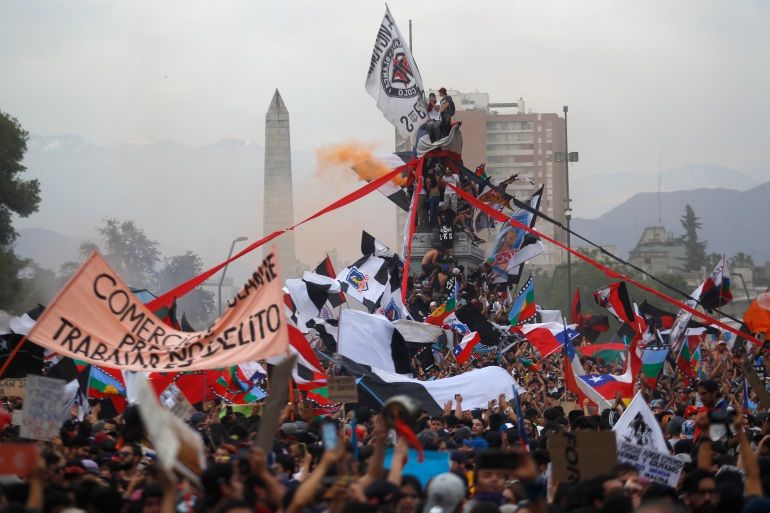 Calls for a new constitution arose following protests during the Chilean spring of 2019
Gonzalez was an active member of the socialist party during the 17-year-long Pinochet dictatorship, which ended in 1990. Under Pinochet’s military rule, socialists were forced to flee the country or operate underground. Many were tortured and murdered.
“It’s time to be done with Pinochet for once and for all,” she said, with tears in her eyes.
She believes the new constitution can help transform Chile by ensuring equal access to education, in particular. “A country that is educated is the most important for me.”
But not everyone shares her enthusiasm for the text. “It’s just a book with silly illustrations,” said one passer-by, aggressively flicking through the pages. Another shouted, “Reject it!” One rushed by muttering the word, “Lies!”
Conservative reaction
Chile’s right wing staunchly opposed the idea of the new constitution and only won a minority of seats in the writing assembly, whose members were chosen by election in May 2021.
Conservative constituent Ruggero Cozzi, a 35-year-old lawyer, said he believed the assembly failed in its objective.
“I thought we’d achieve a text that would give us unity and social cohesion, but we did not,” he told Al Jazeera. “It’s been a valuable year, exhausting, but above all, disappointing.”
Cozzi defended the free market system that the constitution is undoing, and believed privatisation is the reason for Chile’s relatively strong infrastructure compared with other Latin American countries.
“Getting the state to organise everything won’t result in the changes that are needed, and has not ended well for other Latin American countries” he warned.
Cozzi is lobbying for Chileans to reject the constitution in the September referendum – and polls are tipped in his favour. The latest data from pollster Cadem reveals that 51 percent of Chileans would reject it.
However, recent election outcomes have been difficult to predict. In 2021’s presidential election, far-right candidate Jose Antonio Kast claimed the lead in the primaries, only to be comfortably beaten by left-wing former student leader, Gabriel Boric, in the final vote.
It was the first time in Chile’s democratic history that a candidate who did not lead in primaries went on to win the presidency.
Boric’s victory further affirmed Chile’s desire to break from its conservative past and embrace drastic social change. Incumbent since March, Boric has been supportive of the constitutional process and is rallying for the new charter to pass.
‘Lot of aggression’
Claudia Heiss, head of political science of the Institute of Public Affairs, Universidad de Chile, similarly defends the text and quality of its content.
“It would have been better if the left- and the right-wing constituents found more points to agree on. The tone was not optimal and there has been a lot of aggression,” she told Al Jazeera.
”But if you take a step back and look at it from the uprising and the decision to write a new constitution, it has generally been a good process.”
If the new text is rejected, the current constitution will remain in place. However, Heiss believed there was no turning back, regardless of September’s outcome.
“One can be less dramatic concerning the virulence of the public debate we see today. Whether approved or rejected, the 1980s constitution is no longer viable,” she affirmed.
“Chile has to advance in a more social-democratic direction, with greater equality, with better distribution, and that’s inevitable.”