

China Promises Housing Program for its New Ally Nicaragua
But what are the experiences in other Central American countries that have relations with the Asian giant?
“We are working, we are finishing up, and we can reveal that the Government of the People’s Republic of China has approved an important cooperation project with Nicaragua and the Nicaraguan people, a great housing program for families throughout the country (…) the plan is for three years, and will benefit tens of thousands of Nicaraguan families in 84 municipalities of the country,” said Murillo on January 28 during her midday address, without providing an exact number of the homes they are planning to build.
During the relationship between Taiwan and Nicaragua, the Taiwanese cooperation was known for the construction of this type of projects. The last was the “solidarity housing for vulnerable families” program that the regime extended to 49 municipalities, and which, according to Taiwanese authorities, meant the construction of 400 homes in 2021.
What does China invest in?
Experts in international relations consulted by LA PRENSA agree that Beijing seeks to increase and strengthen its commercial position in the world and among its main investment objectives for the coming years is Latin America and especially Central America.
Andres Serbin, international analyst and president of the Regional Coordinator of Economic and Social Research (CRIES), founded in Managua in 1982, explains that what China is offering in place of Taiwan surely has to do with some type of investment and the scarce possibility of loans.
 Andres Serbin, international analyst and president of the Regional Coordinator of Economic and Social Research (CRIES).
“China has been quite reluctant to offer loans in Latin America. It has reduced the amount of lending but has increased its investments aimed at extracting minerals that are important to them to have available for their own development,” he told La Prensa.
Carlos Malamud, principal investigator for America of the Elcano Royal Institute, says that without a doubt China is in Latin America “with a long-term perspective, seeking a supply of raw material, food, and minerals.” From that perspective, what Nicaragua can offer “is relatively little. Nicaragua is a very small country, very poor, and with a very limited market. However, from a political perspective it is good for China because Nicaragua has now recognized the government in Beijing.
At the same time, he notes that the Chinese economy “is not going through great instability. It evidently does not have the other setbacks of other powers. However, the situation is still quite delicate”.
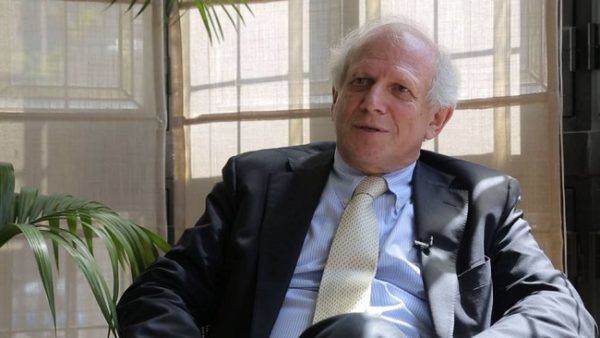 Carlos Malamud, principal investigator of America at the ELCANO Royal Institute
Andres Serbín points out that although it is true that China’s interests are in natural resources and in the development of infrastructures, these have to “benefit its export potential from the different countries of Latin America to its market; to China. It also has an interest in energy. These are the three keys regarding how China manages its interests apart from the increase in trade.”
China’s projects in Central America
China has made many promises to countries in Central America, but in reality, several have not materialized.
In Costa Rica, for example, which in 2007 was the first Central American country to establish diplomatic relations with China. That year, then-Costa Rican President Oscar Arias visited Beijing and was received by his Chinese counterpart, Hu Jintao. From that visit came the Chinese promise to build a new National Football Stadium, an oil refinery, and a highway to Puerto Limón, in addition to promises of investments in hydroelectricity and tourism. To date, only the construction of the stadium has materialized. The rest of the promises are pending.
The stadium, baptized as “The Jewel of La Sabana”, has 34,122 square meters of total construction, 34,762 seats, and cost 111 million dollars. The work generated controversy, because China brought its own labor, taking away job opportunities for Costa Ricans.
The other projects are in progress, but the scheduled completion dates have already passed.
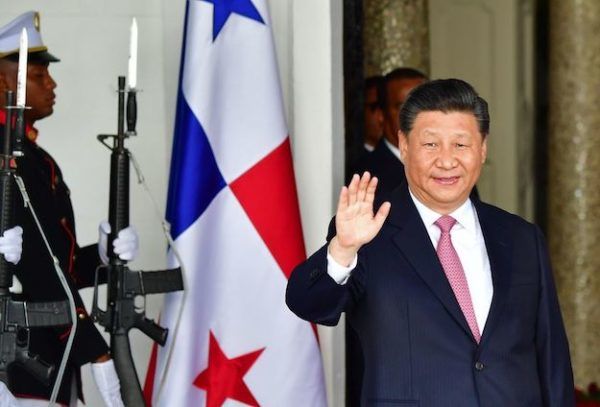 China’s President Xi Jinping waves upon arriving at the presidential
palace in Panama City, for a meeting with Panama’s President Juan Carlos
Varela on December 3, 2018.
In the case of Panama, the investments of Chinese companies in at least three infrastructure projects in maritime and transport fields exceeds 2,58 billion dollars. On June 29, 2018, the Chinese consortium (Panamá Cuarto Puente) gave an offer of 1.42 billion dollars for the design and construction of a fourth bridge over the Interoceanic Canal, and on November 9th of that same year the Panamanian Government signed a contract to carry out the project. Another project that was awarded to a Chinese company is the new cruiser port that will be built in Amador, on Perico Island. The estimated cost of the work is $165.7 billion.
The new port terminal, located on Margarita Island, was expected to be ready by the end of 2019. However, in June 2021 the Panama Maritime Authority initiated the process of cancellation of the concession to Panama Colon Container Ports for breach of contract. There was also a promise to build a high-speed rail line linking Panama City with Chiriquí on the border with Costa Rica at a cost of $4.1 billion to be completed in six years. However, the deal fizzled.
In El Salvador, the projects of the National Library, the National Stadium, the water treatment plant on the Ilopango side, and the La Libertad Pier are being worked on steadily. As explained by Salvadoran President Nayib Bukele on his Twitter account, the new National Library of El Salvador is a donation from China and will cost 54 million dollars, including equipment and books.