

China’s secretive state-owned firm taking on Elon Musk’s Starlink
In late April, a day before SpaceX launched its 10th batch of satellites this year, Chinese Vice-Premier Han Zheng attended a ceremony in Xiongan, a megacity that is about a two hours’ drive south of Beijing, celebrating the creation of a new state-owned enterprise set up to operate China’s answer to Starlink, run by Elon Musk’s SpaceX.
Known as China Satellite Network Group, the young company is tasked with launching low Earth orbit (LEO) satellites into space, beaming internet services to anywhere on the planet. It reports to the Assets Supervision and Administration Commission, which controls the Chinese government’s stakes in state-owned companies.
Other details about the new firm remain shrouded in mystery.
The company has no official website at the moment, and the government has yet to release any information about the firm’s organisational structure – except that Zhang Dongchen, former general manager at state-owned China Electronics Corporation, was appointed to oversee its establishment.
Yet the company’s strategic importance to Beijing has not gone unnoticed by industry insiders.
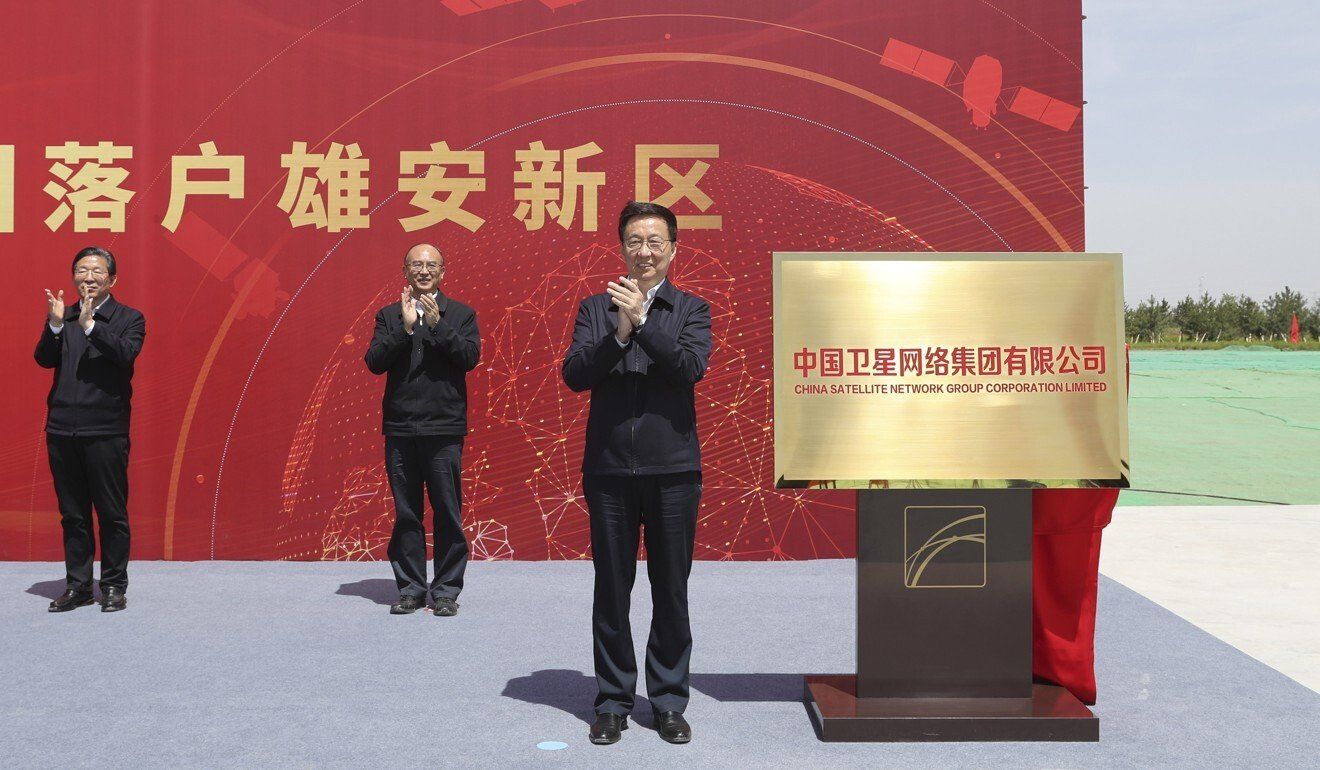 Chinese Vice-Premier Han Zheng attends an inauguration ceremony of China
Satellite Network Group during an inspection tour to the Xiongan New
Area in Hebei province, on April 28, 2021.
Despite its youth, China Satellite Network Group ranks 26th on Beijing’s official list of 98 state-owned firms – right behind the country’s “big three” telecoms operators: China Mobile, China Unicom and China Telecom.
The company is also China’s first state-owned enterprise at the state level to set up its head office in Xiongan, a formerly sleepy rural region hand-picked by President Xi Jinping four years ago to be rebuilt into a futuristic smart city.
“It shows that the state has officially joined the competition,” said Lan Tianyi, chief executive of Beijing-based space consulting firm Ultimate Blue Nebula. “State-owned enterprises have done some work in this area in the past … but now the country is considering the plan as a whole.”
The creation of China Satellite Network Group represents Beijing’s latest push in its ambitious bid to provide worldwide internet connection with satellites circling the globe – a technology currently dominated by US players such as SpaceX.
Before the birth of China Satellite Network Group, the country’s two major state-run aerospace companies – China Aerospace Science and Technology Corporation (CASC) and China Aerospace Science and Industry Corporation (CASIC) – already had their own satellite internet programmes.
CASIC, under its Hongyun and Xingyun programmes, is planning to launch 156 and 80 satellites, respectively, to achieve global coverage, while CASC announced plans in 2016 to set up more than 300 satellites under its Hongyan project.
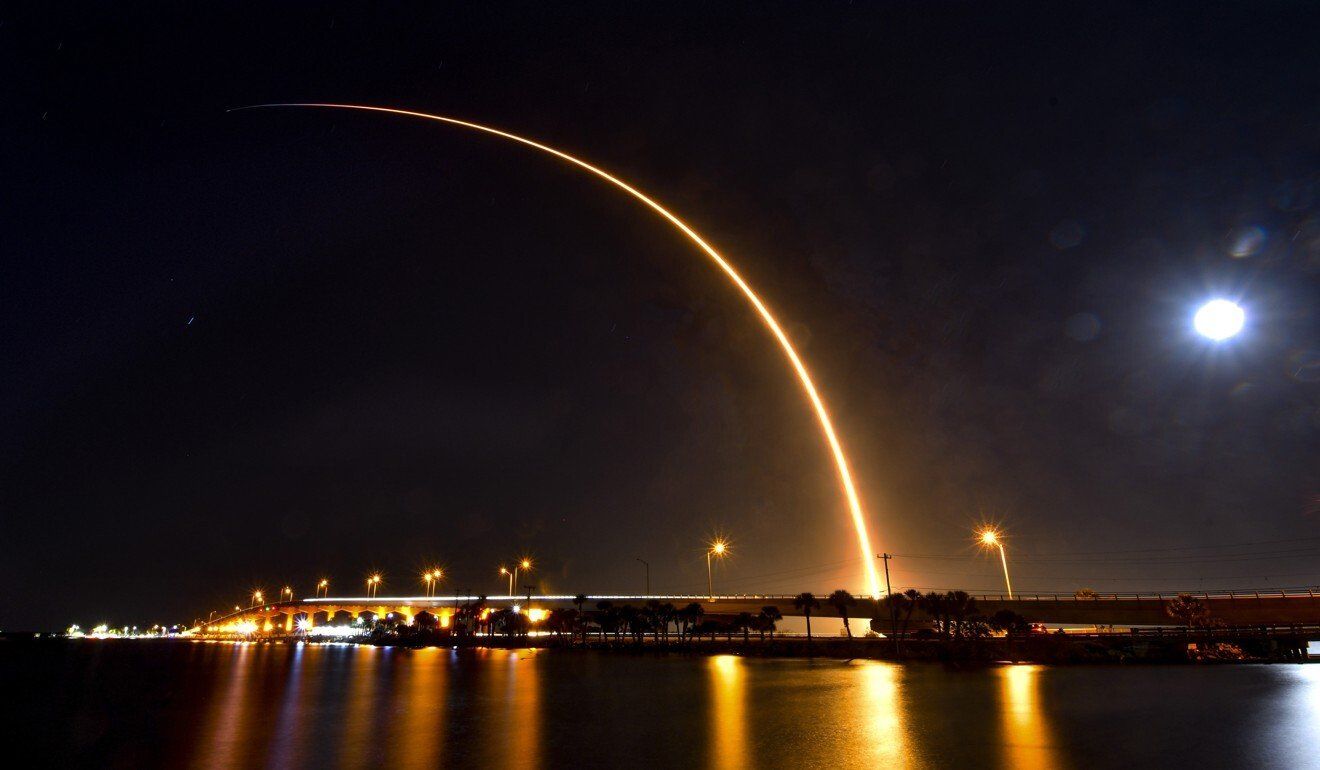 The SpaceX Falcon 9 rocket takes off on a mission carrying Starlink
satellites on April 28, 2021, from Complex 40 at Cape Canaveral Space
Force Station, Florida.
In April 2020, China added satellite internet, along with 5G and artificial intelligence, to a list of “new infrastructure development” that it aims to accelerate with government support. Earlier this year, Beijing rolled out a series of policy measures, including financing, to further the cause.
The government issued documents related to China Satellite Network Group early last year, Chinese media outlet Caixin reported in April, citing unnamed sources, with the country’s national space agency reportedly taking part in the project as well.
While China Satellite Network Group has yet to launch a single satellite, China submitted fillings to the UN’s International Telecommunication Union (ITU) last September, signalling the country’s intention to construct two LEO constellations totalling 12,992 satellites.
That number is still a fraction of the 42,000 planned satellites that Starlink registered with the ITU, and analysts say these filings are merely a preliminary requirement that does not always translate to actual launches.
“It’s kind of like when you grab a number ticket at a restaurant,” said Lan. “You have to have a number to get a seat. If you don’t have it, it’s impossible for you to get in.”
 A render of a SpaceX Starlink satellite in orbit.
In a venture as resource-intensive as building a global satellite internet network, ambition does not always guarantee success.
London-based OneWeb, one of the industry’s most prominent players, filed for bankruptcy in March last year having only launched 74 LEO satellites. It has since received a second chance after getting a US$1 billion investment from a consortium led by the British government and India’s Bharti Enterprises.
Meanwhile Starlink, which rolled out its early access programme to consumers last year, is continuing to bulk up its constellation. It delivered its latest batch of 60 satellites into orbit on Tuesday, and has more launches scheduled for this month.
Experts say China has a lot of catching up to do.
“If you are talking about just the internet, China is doing well, but in terms of satellite internet, there is objectively a gap [with the US],” said Lan.
“China is five to 10 years behind in most technologies,” in this field, said Blaine Curcio, founder of Hong Kong-based Orbital Gateway Consulting.
Still, the country has a few strengths that might help it pull ahead.
“China’s advantages would be the speed that its whole start-up ecosystem moves at, the level of government investment into the sector, and the low costs for certain things in the supply chain,” said Curcio.