
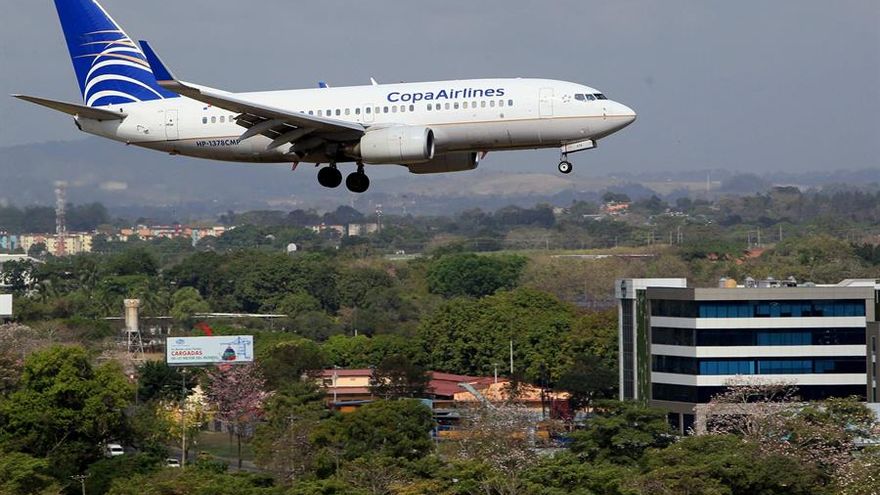
Copa Airlines cautiously begins flights amid the slow global recovery
The Panamanian Copa Airlines timidly begins to operate flights amid the prolonged restrictions due to the COVID-19 pandemic, with a "robust" biosecurity protocol and with full awareness that the recovery after the worst crisis in the history of commercial aviation will be slow.
The Panamanian government suspended international flights for 30 days on March 22, a measure to stop the spread of the new coronavirus that has been extended five times, the last until September 21.
Panama accumulated until yesterday Monday 87,485 confirmed infections and 1,906 deaths in 169 days of pandemic, the largest figures in Central America.
READ ALSO: Cabinet approves new dates for the opening of economic activities as of September 7
In this scenario of restriction of flights, the Copa operation reached practically zero, with only the realization of "humanitarian flights", about 130 in total.
SMALL SCALE RESTART OF OPERATIONS
The government authorization given on July 31 for the Tocumen International Airport, or the "hub of the Americas" due to its high connectivity, to be opened to receive limited international commercial flights in transit, has allowed the Panamanian airline to timidly operate flights.
Since August 14, we are making an average of 40 flights per week, compared to the more than 2,500 weekly flights that Copa operated prior to the crisis caused by COVID-19, the airline's executive president, Pedro Heilbron, said.
The airline currently operates flights to Miami and New York in the US, Mexico City, San José in Costa Rica, Santo Domingo in the Dominican Republic, Quito and Guayaquil in Ecuador, Sao Paulo in Brazil and Santiago in Chile, which is equivalent to less than 2% of the total weekly flights made before the crisis, Heilbron said.
Copa Airlines connects 80 cities in 33 countries in America and the Caribbean before the pandemic, but many airports on the continent are still closed and / or their countries maintain strong restrictions for foreign visitors.
BIOSECURITY PROTOCOL
Copa has implemented robust disinfection, hygiene and biosafety measures to offer a safe environment at every stage of the journey, including the use of high-efficiency filters (HEPA), which purify up to 99.97% of the virus and bacteria particles, similar to an operating room, according to Heilbron.
The air recirculation system in the cabin renews the air every 2 to 3 minutes and its vertical movement prevents it from being shared with passengers on the sides and front, which added to the mandatory use of the mask during the entire flight, offers a safe and healthy environment on board, he added.
Copa has also adopted other procedures in the airport's facilities and contact points, all developed by a committee specialized in biosecurity, following the recommendations of national health authorities and international organizations, as well as the best practices observed in the industry since it began. the pandemic, Heilbron said.
TROUBLED FINANCES AND A SLOW RECOVERY
Copa has suspended contracts, negotiated early retirements or agreed to a half-working day with its more than 7,000 workers in Panama, and has already announced that some thirty of its aircraft, 14 Embraers and 16 Boeing 737-700s, are not going to fly anymore and that they are thinking to sell part of them.
Copa Holdings presented its financial results for the second quarter of 2020 (2Q20), in which it reported a net loss of 386 million dollars, said Heilbron.
And the expected scenario in the medium and long term is that of a slow recovery for commercial aviation, which expects 84.3 billion dollars losses this year for airlines.
Experts agree that it will take at least 4 years to return to the previous levels of the pandemic. In our case, we estimate that by the end of 2020 we will be approximately 30% of our capacity that we used to have pre COVID-19. In 2021, we estimate to operate just over 40%, that is, we will be less than half of what we had, said Heilbron.