

Derek Chauvin says he will not testify at trial and testimony ends. Closings are set for Monday
Chauvin, speaking into a microphone before the jury entered the court, said it was his decision and his decision alone not to testify. Questioning from his attorney Eric Nelson suggested a tense internal debate on the issue.
"I have advised you, and (to say that) we have gone back and forth on the matter would be kind of an understatement, wouldn't it?" Nelson asked.
"Yes it is," Chauvin said.
If he had chosen to testify, prosecutors would have been allowed to cross-examine him.
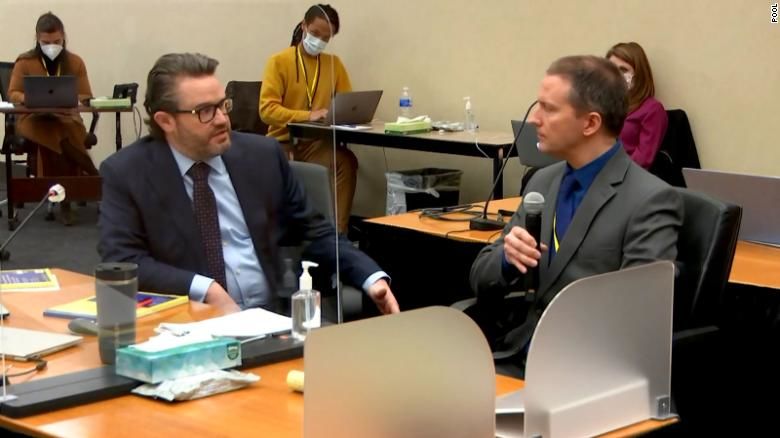 Defense attorney Eric Nelson (left) explained to Derek Chauvin that he
has the right not to testify at trial on Thursday, April 15, 2021.
After the defense rested its case, prosecutors called Dr. Martin Tobin, the pulmonologist who testified last week, to take the stand again for a short rebuttal against the defense's medical expert.
The former Minneapolis Police officer's defense team called seven witnesses in their attempt to acquit Chauvin on charges of murder and manslaughter. A police use-of-force expert testified Tuesday that Chauvin's restraint of Floyd was "justified," and a forensic pathologist testified Wednesday that Floyd's cause of death was "undetermined," saying his underlying heart issues were the main causes.
"In my opinion, Mr. Floyd had a sudden cardiac arrhythmia, or cardiac arrhythmia, due to his atherosclerosis and hypertensive heart disease ... during his restraint and subdual by the police," said Dr. David Fowler, a forensic pathologist who retired as Maryland's chief medical examiner at the end of 2019.
Fowler also put forth a novel argument that carbon monoxide from the squad car's exhaust may have contributed to Floyd's death -- a theory that he admitted he could not support with any data or test results.
Prosecutors told the court on Thursday morning they just became aware the night before of the results of "blood gas readings" that showed Floyd's carbon monoxide levels were normal. However, Judge Peter Cahill said the test results would not be allowed because they had advance notice that Dr. Fowler would bring up his carbon monoxide theory. He warned that any discussion of the carbon monoxide blood test would lead to a mistrial.
"It's untimely to give the notice (this morning) and would prejudice the defense by the late disclosure, even if it's not due to bad faith," Cahill said.
In his rebuttal on Thursday, Tobin said that the carbon monoxide theory is proven wrong by a different blood test, thereby avoiding the judge's concerns.
That test showed Floyd's blood oxygen saturation was 98%, meaning his carbon monoxide level could at most be 2% -- which is within the normal range.
Several other defense witnesses have testified about Floyd's drug use, particularly during a prior arrest in May 2019 in which he ingested opioids as police approached him in a vehicle.
Together, the witnesses furthered the defense's three main arguments in the case: that Floyd died due to drug and health problems, that Chauvin's use of force was ugly but appropriate, and that a hostile crowd of bystanders distracted Chauvin.
The prosecution rested its case Tuesday morning after calling 38 witnesses over 11 days. Prosecutors sought to prove that Chauvin used excessive and unreasonable force when he kneeled on Floyd's neck and back for nine minutes and 29 seconds last May. Their case relied heavily on multiple videos of Chauvin's actions, analysis by policing experts criticizing Chauvin's actions, and medical testimony determining Floyd died due to the restraint.
Chauvin, 45, has pleaded not guilty to second-degree unintentional murder, third-degree murder and second-degree manslaughter charges.
The defense's two main experts
Fowler's analysis focused on every issue except Chauvin's restraint of Floyd in the prone position.
He cited Floyd's narrowed coronary arteries, known as atherosclerosis, and his enlarged heart due to his high blood pressure, or hypertension. Floyd's fentanyl and methamphetamine use, a tumor known as a paraganglioma, and the carbon monoxide were other significant conditions that contributed to his death, Fowler said.
Meanwhile, he ruled out positional asphyxia as a cause.
"Positional asphyxia, as the term is used in court today, is an interesting hypothesis and unsupported by any experimental data," he testified. He said Floyd's death should have been classified as "undetermined," rather than a homicide, because there were so many competing causes.
The testimony cut at the prosecution's argument that Floyd's primary cause of death was low oxygen due to Chauvin's restraint of a handcuffed Floyd in the prone position -- known as "positional asphyxia."
Five separate medical experts, including a cardiologist and a pulmonologist, said that Chauvin's restraint caused Floyd's death. To get a guilty verdict, prosecutors have to prove that Chauvin's actions were a "substantial causal factor" in Floyd's death.
In cross-examination, prosecuting attorney Jerry Blackwell sharply questioned Dr. Fowler, repeatedly cutting off the doctor's attempts to offer longer answers.
Fowler was unable to identify the point at which Floyd suffered his "sudden" cardiac arrest, and he said he did not notice that Floyd's voice grew thicker and quieter as time went on. He also said he agreed that Floyd should have been given immediate medical attention on scene.
The doctor's analysis contradicted much of what the prosecution's experts said last week.
Hennepin County Medical Examiner Dr. Andrew Baker, who conducted Floyd's autopsy, testified last week that the police restraint was the primary cause of death, and he listed Floyd's heart disease and fentanyl use as other significant conditions. He described the paraganglioma as an "incidental" tumor that didn't have anything to do with his death. None of the doctors mentioned carbon monoxide as having any role.
Dr. Jonathan Rich, a cardiologist who testified for the prosecution on Monday, said Floyd's heart showed no evidence of injury at all.
On Tuesday, a use-of-force expert said Chauvin was justified in kneeling on Floyd for over nine minutes and did not use deadly force.
"I felt that Derek Chauvin was justified and was acting with objective reasonableness, following Minneapolis Police Department policy and current standards of law enforcement in his interactions with Mr. Floyd," said Barry Brodd, a former police officer.
Much of Brodd's testimony starkly contradicted the prosecution's policing experts and Minneapolis Police Chief Medaria Arradondo, who said Chauvin's actions were "in no way, shape or form" within department policy, training, ethics or values.
On cross-examination, Brodd conceded that a reasonable officer in Chauvin's position would have known that Floyd had eventually stopped breathing, had no pulse and was not resisting. Chauvin did not change his position from on top of Floyd despite that knowledge, Brodd testified.