

El Salvador gangs: Mass arrests bring calm but at what price?
For decades, the MS13 and the 18th Street Gang dumped victims' bodies in ditches and streams, on roadsides and wasteland across the notoriously dangerous district of the capital, San Salvador.
These days, though, the only war being waged is by the government.
Following a weekend of extreme gang violence in March last year, El Salvador's young and media-savvy president, Nayib Bukele, imposed a state of exception - an emergency measure under which several constitutional rights were suspended and police were granted wide-ranging powers of arrest.
Since then, some 66,000 people have been detained.
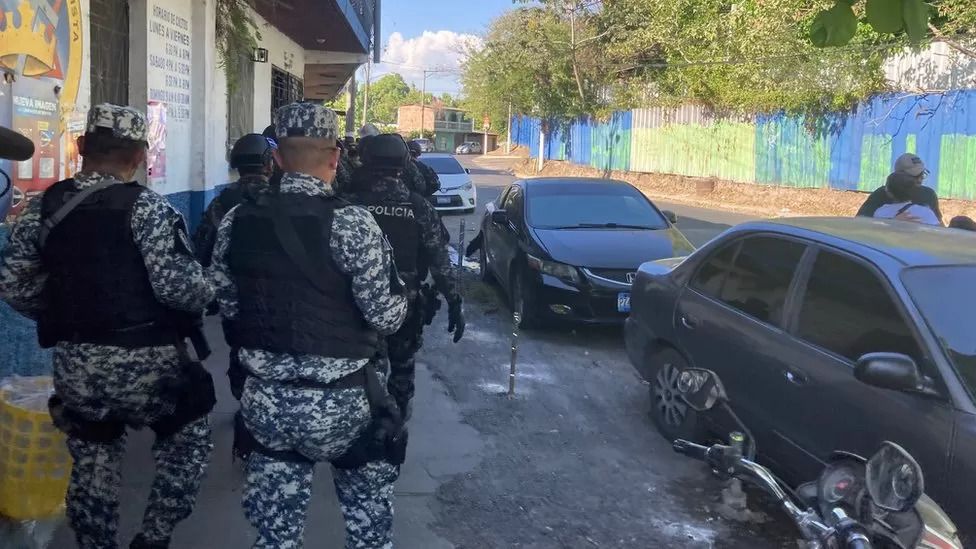 Police and soldiers are much more visible since the state of emergency was declared
In Soyapango, a joint police and military operation sweeps through the backstreets as a helicopter whirrs overhead.
Some officers carry out search warrants at specific addresses while others randomly stop young men in the streets, checking them for gang tattoos and criminal records.
"On a scale of one to ten, it's a twelve," jokes one local resident when asked how much calmer the neighbourhood has become over the past year. "It's incredibly quiet."
Not prepared to give his real name, such is the ingrained fear of speaking about gangs, "Joel" says his neighbourhood is unrecognisable under the tighter security conditions: "Things were so bad here before, so ugly."
"This [area] was run by the MS-13. If we went into the neighbourhood next to ours, run by the 18th Street [gang], you might never come back. Now we can come and go as we please," he added.
The government's heavy-handed approach enjoys more than 90% support with the Salvadorean public, exhausted after years of gang intimidation and extortion.
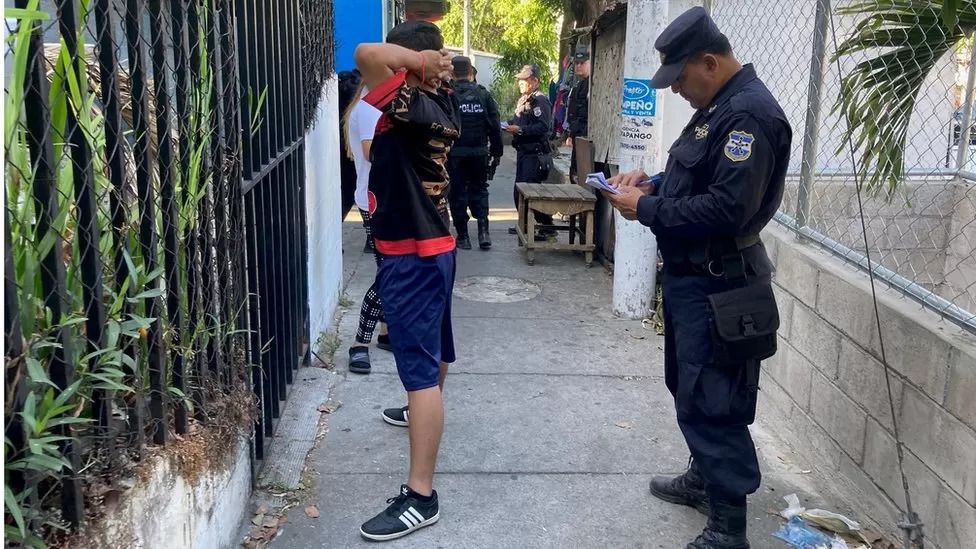 Document checks and searches are a common occurence
While most Salvadoreans applaud the ruthless new policy, it has not brought peace for everyone. Thousands of people with no discernible link to gang activity have also been swept up in the dragnet of arrests.
Far from the capital's urban neighbourhoods, in the dusty village of La Noria, a young tractor driver, José Duval Mata, was among them.
Soon after the state of exception was imposed, soldiers entered his community and stopped him on his way home.
They took his telephone and accused him of "unlawful association", a catch-all term under which tens of thousands have been detained for alleged gang affiliation.
His mother, Marcela Alvarado, has not seen or heard from him since and is desperate with worry.
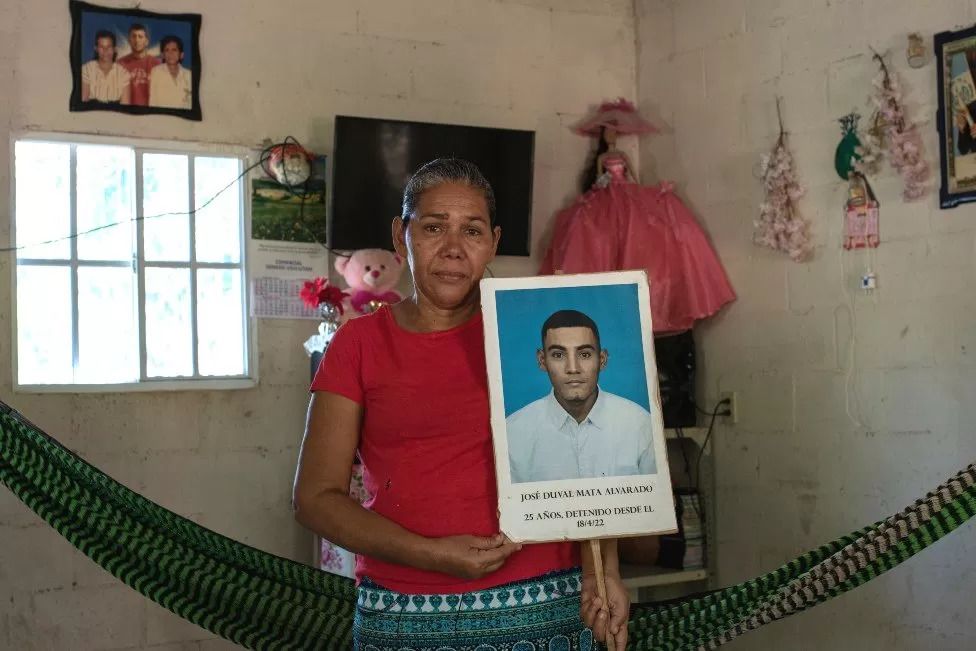 Marcela Alvarado's son has been under arrest since April 2022
"You hear so many things: that they're torturing them in there, that they hit them," she says between sobs.
"When my son was imprisoned, I went to the jail and spent 18 days outside, with a crowd of people. And you'd hear their cries coming from inside: 'Help us, help! I can't take any more!' That caused me so much pain in my heart."
Ms Alvarado says her son's only legal proceeding, so far, was a mass hearing with 360 other inmates. They were all sentenced to an initial six months in prison - a sentence which has subsequently been extended.
Before the hearing, Ms Alvarado was advised to bring a stack of documents - from his clean criminal record and high school diploma to a reference from his employer - which attested to his innocence and lack of involvement in gang activity.
She says that the court ignored them all.
José Duval is far from the only one caught in such a Kafkaesque situation.
On the first anniversary of the state of exception, hundreds of families gathered in the centre of San Salvador to demand the immediate release of their relatives who, they say, were arbitrarily detained without cause.
Some have loved ones who died in prison, like Eva Sandoval's sister, Noelia.
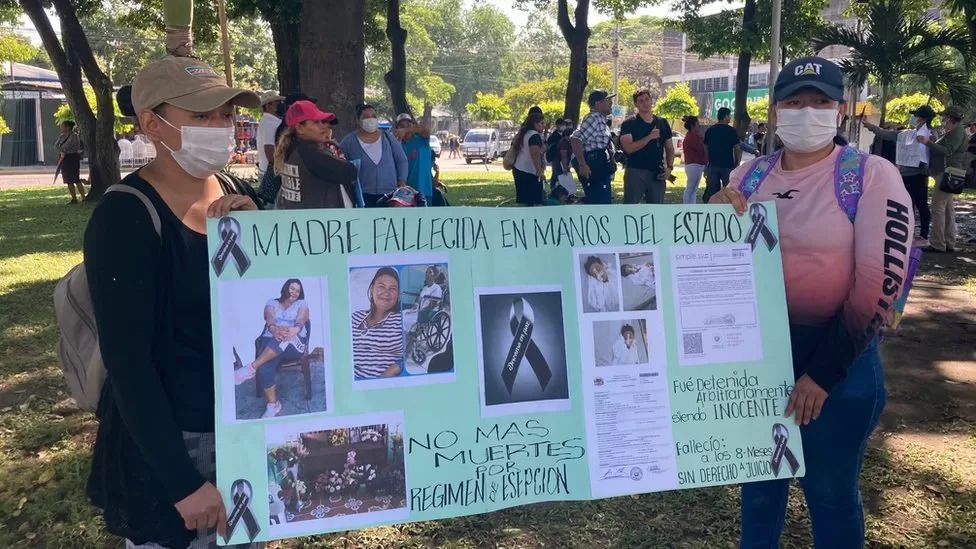 Eva Sandoval (right) was told that her sister Noeli died from a tumour while in custody
"When they took her into custody, she wasn't ill," Eva Sandoval explains. "But then, in February, we learned that she had died, apparently from a cancerous tumour on her nose."
Noelia Sandoval had not been convicted of any gang-related crime at the time of her death.
El Salvador's vice-president, Felix Ulloa, argues that the controversial security plan has brought widespread peace to the country.
"It's not perfect, but it's good. We've done something really good here," he said in an exclusive BBC interview.
Mr Ulloa does acknowledge that thousands of those arrested have probably not committed any gang-related crimes: "It could be (the case). When you have an operation of this size, with so far more than 65,000 people imprisoned, there probably could be some mistakes and some people could have been arrested with no links to the gangs."
He says that the legal system is gradually working through the backlog of cases. "Three thousand people have already been released by the due process of law."
That is of little comfort to Marcela Alvarado, whose son, José Duval, has not even been able to meet his baby son, who was born after his arrest.
Now the bank is threatening to repossess a half-finished house he was building for his family as they cannot keep up the repayments.
Languishing in prison and branded a gang member, his only hope is a judicial system that has so far refused to accept any of the evidence presented in his defence.