EU-AstraZeneca disputed vaccine contract made public
The move, agreed with AstraZeneca, came hours after Commission chief Ursula von der Leyen increased pressure on the firm over its decision to cut supplies.
The contract signed in August contained "binding orders", she told German radio, and called for an explanation.
The vaccine was approved by the EU medicines regulator on Friday.
The EU wanted to publish the contract to bolster its argument that the company had reneged on its commitments.
The company's chief executive, Pascal Soriot, said in an interview earlier this week that the contract obliged AstraZeneca to make its "best effort" to meet EU demand, without compelling the company to stick to a specific timetable.
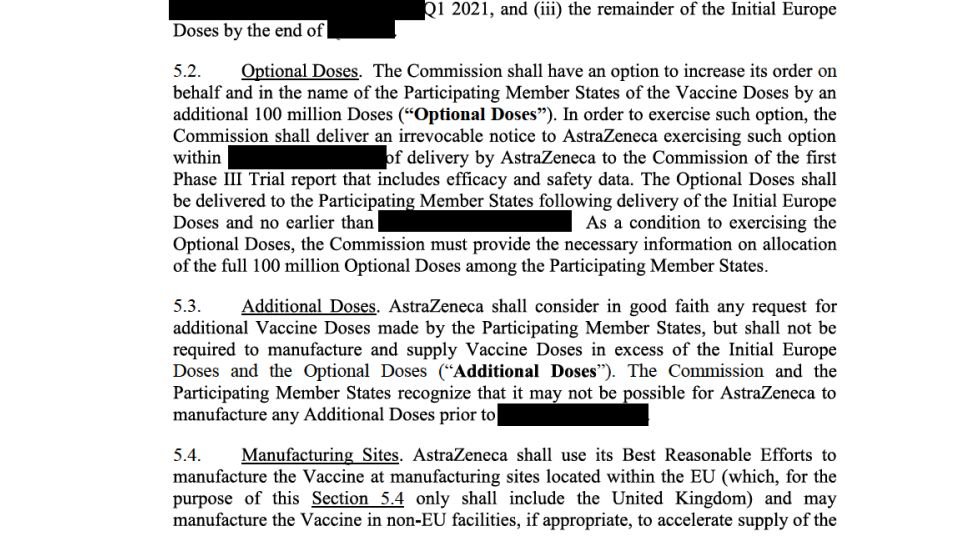
Large sections of the contract have been blanked out - redacted - to protect sensitive information.
These include some paragraphs dealing with costs, guaranteed delivery dates and intellectual property.
What is the issue?
The August deal was for 300 million doses for the EU, to be delivered after regulatory approval, with an option for 100 million more.
But EU sources say they now expect to get only about a quarter of the 100 million vaccines they were expecting to receive by March, a shortfall of about 75 million jabs.
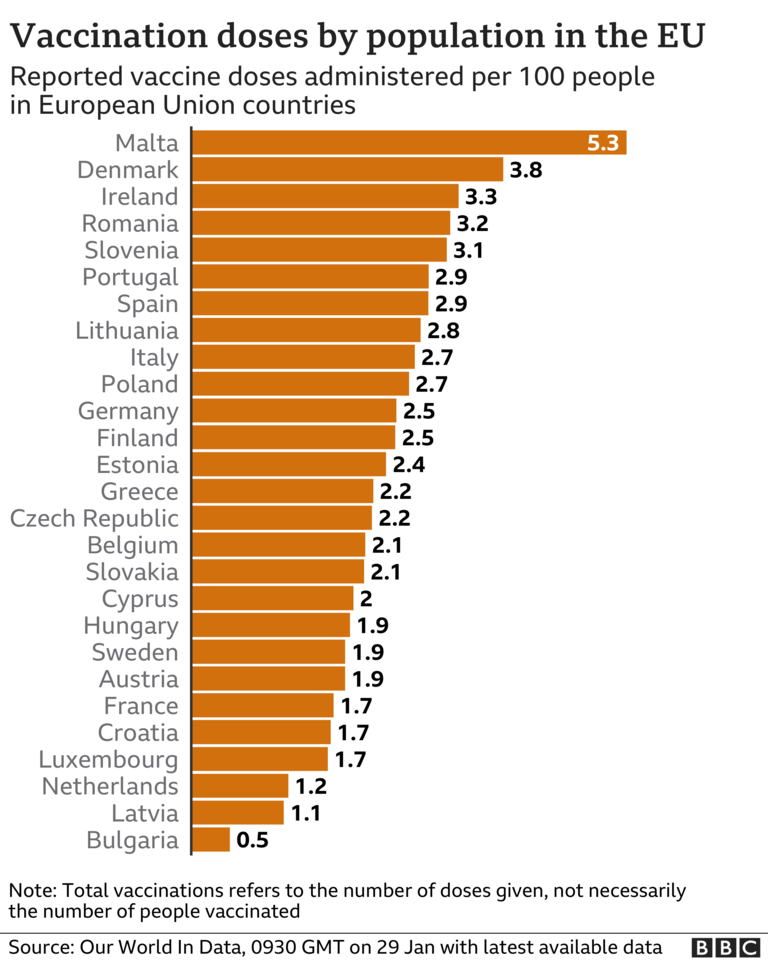
The EU is under pressure after criticism that the pace of vaccinations in several member states has been too slow.
AstraZeneca says the production problems are at its plants in the Netherlands and Belgium.
Supplies of another vaccine, produced by Pfizer-BioNTech, have also dropped due to production issues.
What is the EU saying?
EU officials say AstraZeneca has been asked to send some doses manufactured in the UK to the continent to make up the shortfall, but the company said on Wednesday that its contract for UK supplies prevented this.
An EU source familiar with the talks told the BBC that AstraZeneca's UK facilities were obliged to supply vaccine to the EU.
"This is not an option, it is a contractual obligation… a declaration by AstraZeneca as to where the drug substance manufacturing will take place." The UK plants are not back-up facilities; they are part of the main network, the source added.
"There are binding orders and the contract is crystal clear," Mrs von der Leyen said in Friday morning's radio interview.
"'Best effort' was valid while it was still unclear whether they could develop a vaccine. That time is behind us. The vaccine is there.
"AstraZeneca has also explicitly assured us in this contract that no other obligations would prevent the contract from being fulfilled," she said.
The BBC's Europe correspondent, Gavin Lee, says it may come down to specialist legal interpretation, and some fine tooth-combing, to understand who's right.

AstraZeneca has found itself in a deeply uncomfortable position in this fight over vaccine supply.
The heavily redacted publication - agreed by both sides - of its contract with the EU does not settle the issue of who is at fault.
As one source told me - "Neither side would have published this if either side thought it was legally conclusive. AstraZeneca are working hard to find a solution to a row that serves no-one".
The problem with vaccine production is that it is a biological process that can't be hurried.
A source close to the company said they knew vaccine nationalism was a danger. That's why, they claim, different contracts were tied to separate manufacturing bases. That is disputed by the EU.
So what happens next? The thought of going to court horrifies everyone involved; a needless and unseemly sideshow in the face of the real battle against the virus.
But suggestions that UK manufactured vaccines would be redirected to EU countries were downplayed by company insiders.
One final thought expressed was that while it was convenient for the European Commission to cast AstraZeneca as the villain - that would only work for so long, before member states started directing their displeasure at the Commission itself.
Warning of a 'vaccine war'
A spokesman for UK Prime Minister Boris Johnson would not comment on Friday on any contractual arrangements between the UK and AstraZeneca, or whether they may conflict with the company's agreement with the EU.
The spokesman said only that the UK remained "confident in our supply of vaccines" and that it was committed to its vaccine rollout plan.
But EU Justice Commissioner Didier Reynders has warned of a "vaccine war".
Speaking on Belgian radio, he said: "The EU Commission has pushed to co-ordinate the vaccines contracts on behalf of the 27 precisely to avoid a vaccines war between EU countries, but maybe the UK wants to start a vaccine war?
"Solidarity is an important principle of the EU. With Brexit, it's clear that the UK doesn't want to show solidarity with anyone."
On Friday, the EU confirmed it was introducing export controls on coronavirus vaccines made in the bloc, to try to ease the shortfalls.
Supplies run low in Europe
Vaccinations in parts of Europe are already being held up and in some cases halted because of a cut in deliveries of the Pfizer-BioNTech vaccine:
* In Spain, Madrid and the northern Cantabria region have halted first vaccinations to focus on second doses for at least two weeks
* Regional health authorities in France are delaying vaccination appointments. More than 1.1 million people have received a jab so far
* Vienna's city councillor for health says delivery problems are leading to delays in vaccinations by up to two weeks. "We are really operating in a dramatic form of shortage economy," said Peter Hacker
* The Dutch government was the last in the EU to start a vaccination programme and by the end of January the Netherlands will have had no more than 757,000 doses, mainly from Pfizer. It initially based its strategy on the assumption the AstraZeneca vaccine would be available first.