

Even more evidence shows vaccinated people are unlikely to transmit the coronavirus or get asymptomatic infections
Once effective coronavirus vaccines were authorized and started getting distributed, the crucial question became: Do they stop transmission?
In clinical trials, Pfizer and Moderna showed that their shots prevent symptomatic COVID-19, but they didn't test whether their vaccines prevent asymptomatic cases. Without curtailing symptom-less infections, it's difficult to stop transmission from person to person. But a growing body of evidence suggests that people who get these vaccines don't spread the virus after all.
Pfizer announced Thursday that its vaccine appears to be 94% effective at preventing asymptomatic infections two weeks after people receive their second dose. The study compared unvaccinated people in Israel to those who got the Pfizer shot between January 17 and March 6.
The findings are "particularly meaningful as we look to disrupt the spread of the virus around the globe," Dr. Luis Jodar, Pfizer's chief medical officer, said in a press release.
Vaccinated people may be less contagious if they get infected
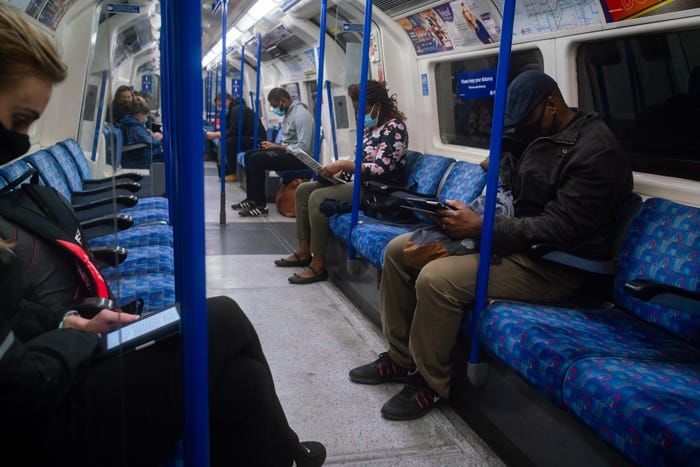 People on the London Underground on September 25, 2020.
So a vaccine should reduce transmission if it can ensure that even those who still get the coronavirus after their shots, whether a symptomatic or asymptomatic case, have a lower viral load than they would otherwise.
A February study from Israel, which has yet to be peer-reviewed, found that starting 12 days after vaccination, the people who got COVID-19 despite getting Pfizer's shots had four times less virus in their bodies.
The researchers looked at more than 1,000 people who'd tested positive for the virus after being fully vaccinated in Tel Aviv. Those people's viral loads in the period from 12 to 28 days after their second dose were four times lower than their viral loads in the first 11 days after vaccination.
Another study from Israel, also not yet peer-reviewed, suggested the Pfizer vaccine reduced viral loads by a factor of up to 20.
Some research suggests viral loads are linked to disease severity, so a patient with a lower viral load is also less likely to have severe COVID-19. That may in part explain why Pfizer's vaccine significantly reduces the chance of symptomatic infection.
Vaccinated people are less likely to develop asymptomatic infections
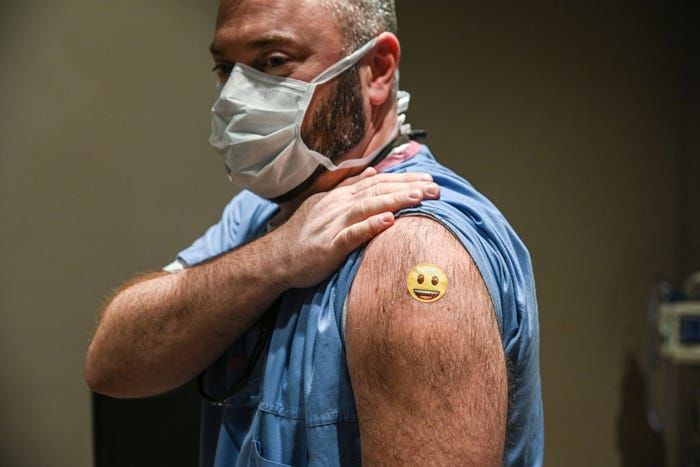 Dr. Jason Smith shows off his bandage after getting vaccinated at the University of Louisville Hospital in Kentucky.
To pinpoint whether vaccines truly reduce spread, it's critical to determine whether the shots prevent asymptomatic COVID-19 cases in addition to symptomatic infections.
Pfizer and Moderna's clinical trials only tested volunteers for COVID-19 if they felt ill. Otherwise, the companies would have had to require regular COVID-19 testing for all tens of thousands of volunteers. So at first, neither company could say whether their vaccines prevent asymptomatic cases.
But Moderna did test trial volunteers on the day they got their second shots. And the findings suggested that there were fewer asymptomatic infections among participants who'd received the real vaccine than among those who got a placebo. Just 14 people of the 14,000-plus in the trial's vaccine group had asymptomatic cases that day, compared to 38 of the similarly sized placebo group.
That's a 61.5% drop, according to Marm Kilpatrick, a disease ecologist at the University of California, Santa Cruz. He wrote on Twitter last month that the data suggests Moderna's vaccine blocks about 91% of transmission.
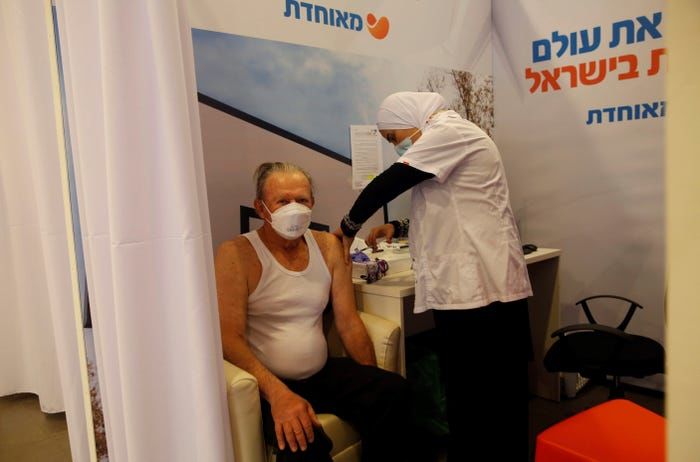 A man receives a COVID-19 vaccine at a health services center in Rehovot, Israel, on January 14, 2021.
Animal studies offer similar findings: An October paper found that the Moderna vaccine prevented the coronavirus from replicating in the nose, throat, and lungs of rhesus macaques four weeks after they'd been vaccinated. If the viral particles can't copy themselves, it's unlikely an infected host will pass on particles to others.
Before the Pfizer findings announced Thursday, a preliminary study published in The Lancet found the shot to be at least 85% effective at preventing any type of infection — symptomatic or asymptomatic. That study looked at more than 23,000 healthcare workers across hospitals in the UK.
Additionally, a recent study found that people who'd received at least one dose of a mRNA vaccine — from either Pfizer or Moderna — were 72% less likely to test positive for an asymptomatic infection 10 days after their shot, relative to unvaccinated people. The research looked at more than 39,000 Americans.
Johnson & Johnson's trial data on asymptomatic infections also seems promising. The company tested blood samples from almost 3,000 participants for coronavirus antibodies 71 days after they'd been vaccinated. (The presence of antibodies suggests participants had been infected even if they didn't show symptoms.) Only two vaccinated people tested positive, whereas 16 people who'd received a placebo did, according to data released last month from the Food and Drug Administration.
That suggests J&J's vaccine may be 74% effective against asymptomatic infections, though the FDA noted that more data is needed to be sure.
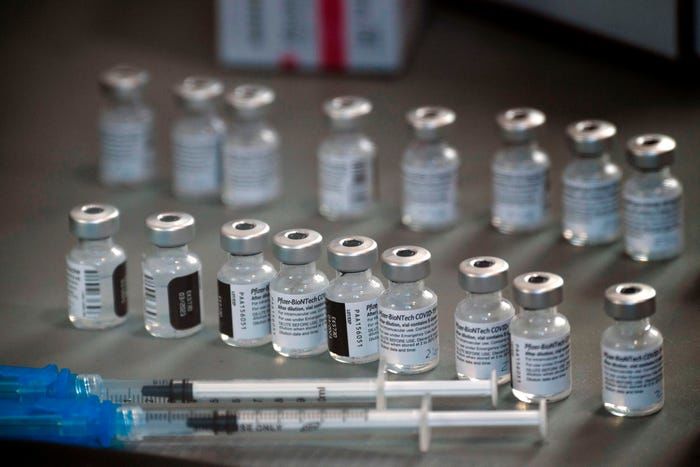 Vials of the Pfizer-BioNTech COVID-19 vaccines at Renown Health in Reno, Nevada on December 17, 2020.
Even the Oxford-AstraZeneca vaccine, which is still in clinical trials in the US, may reduce asymptomatic infections.
A February Oxford study, which has yet to be peer reviewed, found that among people who received just one dose, the number of positive COVID-19 tests — among both symptomatic and asymptomatic study participants — fell by 67%.