

Facial recognition beats the Covid-mask challenge
That can be frustrating - but although masks have undoubtedly thwarted the facial-recognition industry, the technology has also adapted.
It may sound strange but wearing a mask does not necessarily stop a computer from identifying someone.
And there are even examples of the pandemic being used as an excuse to use facial recognition.
Less accurate
Last year, as people began to increasingly wear masks around the world, the prevailing view was it represented a huge challenge to facial recognition.
It seemed obvious - algorithms designed to analyse faces would be less accurate if part of the face was concealed.
And studies backed this up.
The National Institute of Standards and Technology (NIST) tested 89 commercial facial-recognition algorithms - and found a 5-50% error rate in matching faces with digitally applied masks to photos of the same person.
'That's Orwellian'
But some facial-recognition technologies still work pretty well on those wearing a mask.
In January, a US Department of Homeland Security "controlled-scenario test" found one with a 96% success rate - although the results "varied greatly between systems".
"Based on these results" the department said, "organisations that need to perform photo ID checks could potentially allow individuals to keep their masks on, thereby reducing the risk of Covid-19 infection."
And although some police forces are using facial recognition less - London's Metropolitan Police, for example, has not conducted a facial-recognition test for over a year - it is still being used, even, reportedly, at Black Lives Matter protests last summer.
"Even if the use of this technology is temporarily interrupted... that doesn't obviate the threat that this technology poses both in the short and the long term," Michael Kleinman, from Amnesty International, told BBC News.
"Anyone walking in front of a camera where police departments are running facial recognition - their face can be captured and they can be identified. That's Orwellian."
'Touchless experience'
In the private sector, it is harder to tell whether the use of facial recognition has decreased over the past year - there is no directory, no list of when and where it is used.
But on Monday, it was announced Disney World was to trial facial-recognition technology for a month.
Its system takes an image of a customer's face and converts it into a unique number, which is associated with the form of admission used for entry into the theme park.
The idea is to cut waiting times, with Disney saying it wants a more "touchless experience".
And crucially, the technology does not require guests to take off their masks.
Uncovered areas
Even before the pandemic, research had been under way on how facial recognition could work with masks.
In Japan, NEC had been working on a system for people who wear masks because of allergies.
And in January, it announced one it said was 99.9% accurate.
It works out whether someone is wearing a mask and then focuses on the uncovered areas, such as the eyes and forehead.
And the company wants to sell it for security checks in office buildings and other facilities.
"Touchless verification has become extremely important due to the impact of the coronavirus," NEC told Reuters.
So once again, the pandemic, rather than hindering facial recognition, is being used as a reason to use it.
"Early on in the pandemic, we thought one of the very few silver linings could be the decline in facial-recognition technologies - but we've absolutely found that it's the opposite," Ella Jakubowska a campaign officer at pressure group European Digital Rights, says.
"The pandemic has unfortunately provided cover for companies to push out to what are effectively mass-surveillance infrastructures, under the guise of public health.
"A lot of companies have seen it almost [as a] challenge to develop technologies that can even more incisively identify people in public."
Strict rules
It has also been announced facial recognition will be used at the Olympics, due to start this July in Japan.
It is not yet clear what for - but there will be strict rules restricting shouting and singing, and foreign visitors will be unable to attend.
Already, the technology had been used to check whether people were wearing masks at sporting events, the Japan Times reported.
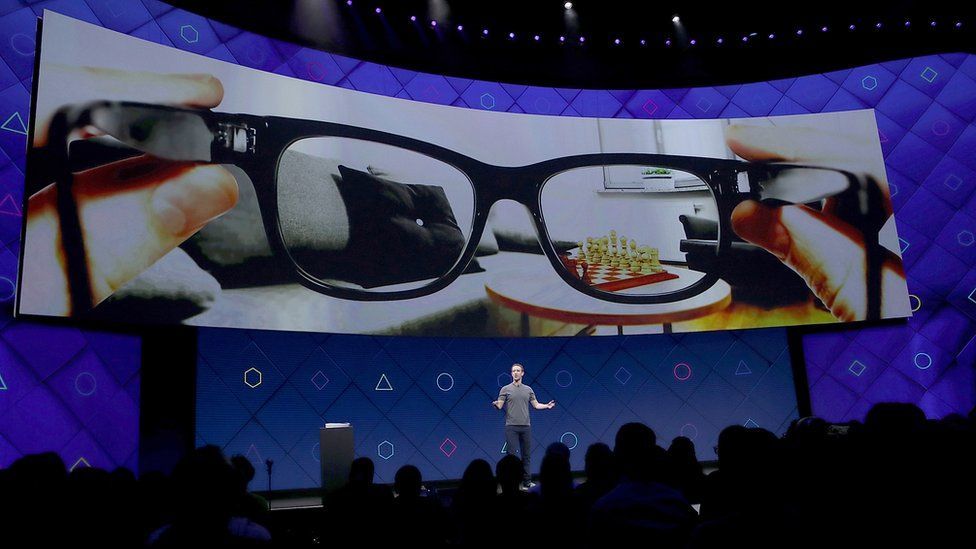
Facebook too is reportedly considering building facial recognition into its upcoming smart glasses, despite privacy activists' concerns it could be used by stalkers.
Facial recognition remains hugely controversial - and those controversies will remain, whether or not masks are being worn.