

Has Colombian left’s time come at last as ex-rebel closes in on presidency?
He began his political career in the ranks of a Colombian guerrilla army, has survived assassination attempts and served as senator and mayor of Bogotá. When he appears before throngs of adoring supporters in squares across the country, he does so flanked by bodyguards with bulletproof shields.
And after Sunday’s election, Gustavo Petro, 62, could become the first ever leftwing president of Colombia, a country ruled since independence by conservative elites and plagued for decades by political violence.
“If we want to open an era of peace in Colombia, we need to bring down the regime of corruption,” Petro said from a bulletproof podium at the closing rally of his campaign in Bogotá. “I’m certain that on Sunday we will change Colombia’s history.”
Petro and his running mate, Francia Márquez, – who is already making history as the first black female vice-presidential candidate – are the frontrunners of a fistful of candidates running in the elections on Sunday.
“The right has always governed this country and it’s always done so with corruption and violence,” said Arturo Romero, at the rally in Bogotá’s historic Plaza Bolívar. Around him, people drank beer and waved flags of the M-19, the onetime rebel group to which Petro belonged. Onstage, a salsa band played.
“We need something new,” the 58-year-old said. “This country will be broken if we don’t change.”
Petro has long rattled political elites with his progressive policy proposals and sharp tongue. He was the runner-up in the 2018 election, when he was defeated by the conservative Iván Duque, but quickly emerged the frontrunner in this campaign.
His main rival this time is Federico Gutiérrez, the former mayor of Medellín, who is widely seen as representing the rightwing status quo, although a third candidate, the populist Rodolfo Hernández, has recently surged in the polls. If no candidate wins with more than half of the vote, a runoff will be held in June.
If Petro does win, it would mark another victory for Latin America’s left, which has recently come to power in Chile, Honduras, and Peru.
The immediate backdrop of the vote is an unprecedented wave of protest that shook Colombia last year, and for many of those who participated in that wave of dissent, the election is a continuation of the same struggle.
The protests – which were met with widespread police brutality – began over an unpopular tax reform but quickly morphed into a howl of outrage against inequality, and politicized a generation of young voters.
Gareth Sella, a 25-year-old videographer and director, is one of them. He lost the sight in his left eye after being struck by a police rubber bullet during a demonstration, and sees a clear line between that wave of unrest and the presidential vote.
“In Colombia what they call democracy is actually having all the power concentrated on one side,” said Sella, at a cafe in Bogotá, wearing sunglasses to cover his scarred eye. “We have to make a stand because it’s been 200 years of the same and we can’t go backwards now.”
Sella was fed up with Colombia’s entrenched poverty, which has been horribly exacerbated by the pandemic, and said that until now, he had felt excluded from politics.
“Something is not right in this country, and we could all see it,” Sella said. “People are going hungry in their homes.”
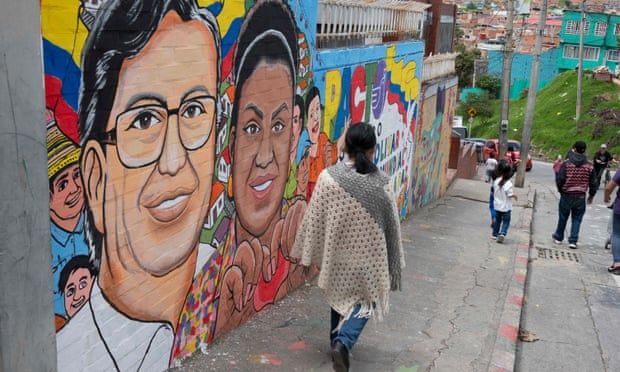 A mural depicting Gustavo Petro and vice-presidential candidate Francia Márquez, in Ciudad Bolívar, Bogotá.
For most of the 20th century, political power in Colombia involved power-sharing deals – sometimes explicit – between rightwing and centre-right parties. Meanwhile leftwing parties were tarnished by association with the many rebel groups fighting against the Colombian state. Decades of vicious civil war between guerrillas, state forces and their paramilitary allies killed more than 260,000 people and displaced 7 million.
When the country’s main guerrilla army – the Revolutionary Armed Forces of Colombia (Farc) – laid down its weapons after a 2016 peace deal, many hoped that the deal would finally open up a space for non-violent progressive activists.
But the peace process remains fragile. The government has been accused of failing to make good on promises to demobilised fighters, and violence continues to dog the countryside, where dissident factions who ignored the peace deal continue to battle with drug militias and the army. Seventy-nine local activists and social leaders have been murdered this year alone.
Petro is an outspoken supporter of the peace deal, while Gutiérrez is thought to be a skeptic.
“Petro is the only candidate who can bring Colombia the peace it desperately needs,” said Ana Milena Andrade, 40, at the campaign rally in Bogotá. “We’re tired of the corruption, the massacres, the dead social leaders.”
Petro was last month forced to suspend part of his campaign amid reports of an assassination plot. And the threat of violence has loomed large in a country where four presidential candidates have been killed since the 1980s.
One of those was Carlos Pizarro, a leader of the M-19 rebel group Petro once belonged to. Pizarro led the group through a peace process from militant insurgency to legal politics in 1990 but was shot dead on a commercial flight, amid a frenzy of violence against leftist activists and former rebels which claimed thousands of lives.
Pizarro’s daughter, María José Pizarro, a senator-elect from Petro’s coalition, said that political violence remains endemic in Colombia, making Petro’s polling success even more striking.
“There has long been persecution and extermination of the left in our country, and it’s resurged during the last decade,” said Pizarro. “It’s always been difficult for us in Colombia, compared with the left elsewhere in Latin America.”
And though Petro may boast diehard support from swaths of the country, he is hardly without critics. His tenure as mayor of Bogotá was pockmarked with scandal, and he was briefly removed from office over a procurement scandal his allies say was politically motivated. His high-handed style has also alienated others, and he is no stranger to gaffes and incendiary remarks.
“He would be a debacle as president, just as he was when he was mayor,” said Diana Rodríguez, 50, a media manager from Bogotá who plans to vote for Gutiérrez. “My two daughters are about to go to university, but if Petro wins, I’m thinking I’ll have to send them abroad.”
Rodríguez is not alone in her fear. Billboards across the country liken Petro to Hugo Chávez, the Venezuelan strongman who led his country from democracy to dictatorship via economic ruin. It is a line of attack that resonates in Colombia, where more than 1 million Venezuelans have sought refuge.
Others have accused Petro of secretly planning to expropriate private property, which he has repeatedly denied on the campaign trail. Gutiérrez, meanwhile, has made “saving Colombia’s democracy” from Petro a central talking point in stump speeches.
Sergio Guzmán, the director of Colombia Risk Analysis, a consultancy, said Petro’s opponents are most worried about his economic policies. He has pledged to halt oil exploration and to stop fracking in the country.
“That anxiety is trickling into markets,” Guzmán said. “Of course people are worried about other issues too, but the main one is economic anxiety.”
But those at the rally in Bogotá say the only things they are worried about are Petro’s safety or a failure to displace rightwing politics from the presidential palace in Sunday’s vote.
“The right means violence and corruption,” said Romero, as the sun began to set on a crowd of tens of thousands, shortly before Petro took to the stage. “That’s why we must win.”