
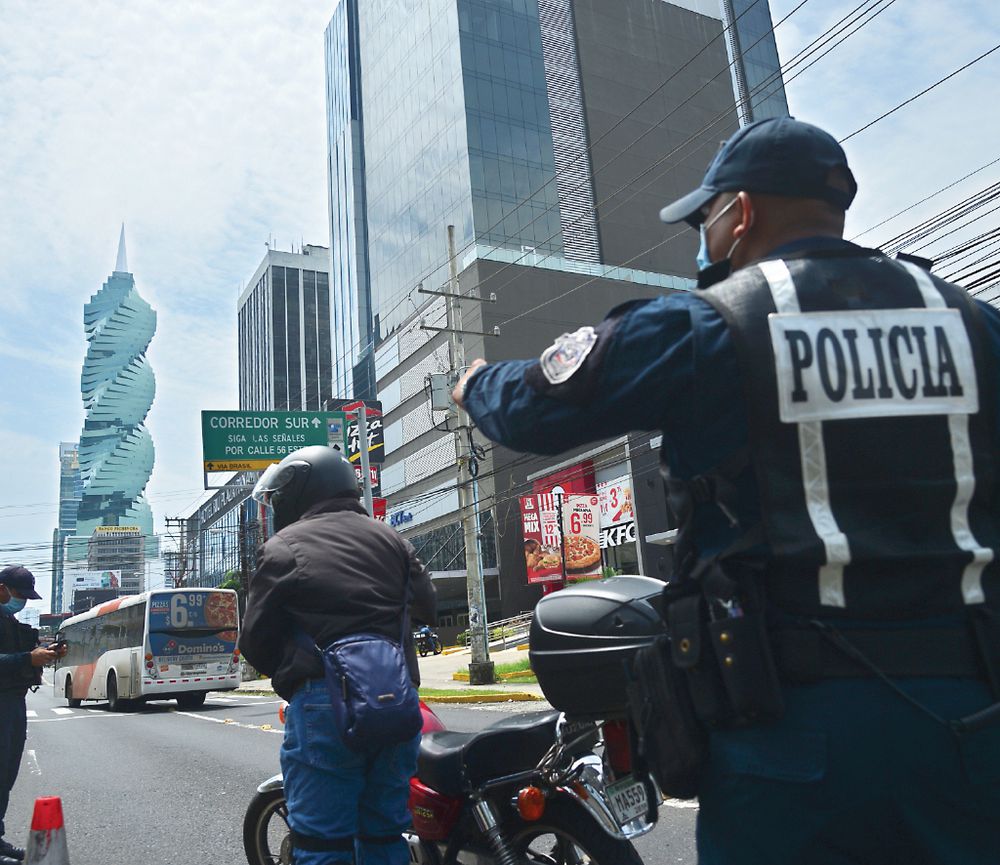
Is Panama turning into a 'Police State' under COVID?
During the first days of the health crisis, a scene drew attention: men in camouflaged uniforms, combat boots, and weapons of war, took the main roads of the capital. They were members of the National Border Service and the National Air Naval Service, who were summoned by the senior staff of the State security forces to "guarantee order."
Some questioned the strategy on the grounds that it promoted "a police state." Others recalled the military dictatorship past of the ruling Democratic Revolutionary Party (PRD). The debate began on the scope, and how far the powers of the uniformed men should go to enforce the provisions of the curfew, in force in the country since March 18. Do they respect the fundamental guarantees of the population? Are human rights taken into account? Is everyone treated the same? Are there privileged?
The noise that complaints and denunciations have made about the excess of police force in protests and minor cases suggests that the guarantees established in the Constitution (Title III) and in provisions of international law on the use of the police are not always taken into account. It says that law enforcement officials, in the performance of their duties, will use non-violent means to the extent possible before resorting to the use of force and firearms. They will only use them when other means prove ineffective.
Arbitrary detentions, beatings, repression, and verbal attacks are part of the methods that, according to the complainants, members of the public force, especially the National Police, have used against civilians in recent months. Two cases recently set off alarms: the arrest of two women for kissing, and the beating of a taxi driver.
When a kiss becomes a crime
After thousands of homophobic acts, they did not read us our rights and they held us in the San Francisco barracks for more than an hour without explanation. Between crisis and annoyances Marian asked for explanations and no one inside the barracks gave her an answer. According to them, she was not detained. But she couldn't leave either. After a long time they deigned to tell the two women that they were going to prosecute them because one of them disrespected the guard, and the women were handcuffed like criminals to the justice of the peace in Bella Vista, because the one in San Francisco was closed. Marian Margoth Artruz wrote on her Twitter account the events when she was arrested with her partner Dani, on the afternoon of Wednesday, September 2, when they kissed in their own vehicle in a parking lot in Paitilla. According to the police officer who arrested them, it was an "immoral act".
'Proven injuries'
The police stopped me. I was driving my taxi through the Bethany area. At the moment of stopping me they take out weapons. I get out of the car, they handcuff me. More officers arrive. I am scared by all the issues that were happening in the United States and that they kill you here too, I throw myself to the ground face down. An officer from a patrol gets out and, without saying a word, smashes my head against the pavement. At that moment I lose consciousness, in addition to three molars. They apparently fracture my face, and I have a fractured eardrum. All these are proven injuries” The story was told by a young taxi driver through a video he shared on social networks.
These two cases join dozens of similar stories. The LGTBIQ+ population, for example, has been one of the great victims of excess force these days. Human Rights Watch has made two calls on the government of Laurentino Nito Cortizo to protect the dignity and human rights of transgender people, who have been discriminated against and attacked by members of the security forces and business security personnel. Last April, the New York-based organization documented nine specific cases of violation of rights in this sector, and last July another six.
Miranda comments
What says National Police, the institution with the highest number of complaints? In the two cases mentioned, they promised investigations, and affirmed that they respect human rights, and the integrity and dignity of the people.
What is the institution's policy for the treatment of these cases? La Prensa consulted the entity. They sent a few words from Jorge Miranda, director of the National Police, with a speech similar to the one that the entity gave in the cases described above. Miranda assured that they are respectful of human rights, and of the guarantees of each one of the people who live in the country, and that they have clear and defined procedures to deal with situations that occur in the street.
“We are an institution of almost 20 thousand units. They are on the street, trying to carry out work aimed at maintaining peace, order, and the security of each of the citizens. We have procedures. We are respectful of rights. We make great efforts to refresh this knowledge, aware that due to the situation in the country [... ] we are more likely to have conflicting procedures. We are doing work so that our units have fresh knowledge about human rights and respect for the Constitution and the law," Miranda says.
From 2015 until last June, the entity's Directorate of Professional Responsibility has processed 1,131 complaints only for police abuse. While 4,500 members face disciplinary proceedings.
The legal process
The process against a police officer comes to life when Article 64 of Executive Decree 204 of September 3, 1997 is invoked. The director or deputy director evaluates the complaint to determine if it merits an investigation by a disciplinary board. The person under investigation can make use of all the tools that the law allows to defend himself. But it remains in the entity while the process advances. Between 2015 and 2020, 143 police officers have been dismissed for different cases, including police abuse.