

Is the US’s gun problem becoming Canada’s gun problem?
On a spring evening in 2020, a gunman disguised as a police officer and armed with semi-automatic weapons began a shooting rampage in rural Nova Scotia that left 23 dead.
Days after Canada’s worst mass shooting, the prime minister, Justin Trudeau, promised swift action, announcing an immediate ban on about 1,500 makes and models of military-grade and “assault-style” weapons in the country.
“These weapons were designed for one purpose and one purpose only: to kill the largest number of people in the shortest amount of time. There is no use and no place for such weapons in Canada,” he said. “Effective immediately, it is no longer permitted to buy, sell, transport, import or use military-grade assault weapons in this country.”
Trudeau’s actions prompted minimal debate and were met with relatively little political resistance – in stark contrast to the United States, where the latest mass shootings have once again highlighted the calcified nature of the gun control debate in a country unwilling or unable to confront firearms violence.
But experts and gun control advocates caution that Canada’s relatively strict laws do not fully shield it from violence of the kind that is rampant in the United States.
A nation where hunting is common, Canada has one of the world’s highest per-capita gun ownership rates. According to the 2018 Small Arms Survey, there are an estimated 34.7 firearms per 100 people. Canada still trails far behind its southern neighbour, both in gun ownership rates and firearms-related incidents.
Part of that is credited to a gun ownership regime that mandates extensive background checks and requires that guns be kept locked and unloaded. There are no comparable “open carry” laws in the country, gun owners must be licensed and all handguns and most semi-automatic weapons must be registered with the Royal Canadian Mounted Police.
“When you consider us next to the United States, which is so heavily armed that it’s almost unbelievable, we look pretty good. But compared to other democratic countries, there’s much more we could be doing to address gaps in the system,” said Ken Price, a gun control advocate whose daughter Samantha was injured in a 2018 mass shooting in Toronto that killed two and left 13 injured.
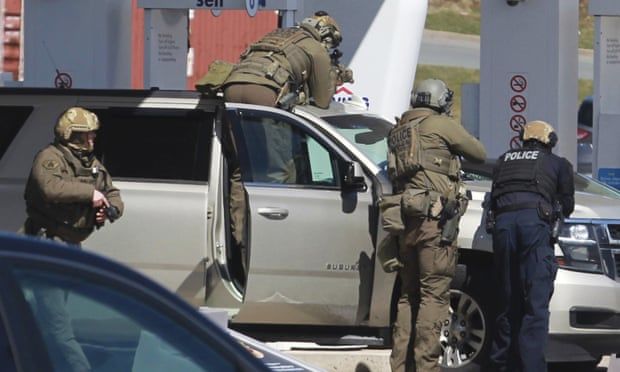 Royal Canadian Mounted Police officers
surround a suspect at a gas station in Enfield, Nova Scotia, on 19 April
2020 after Canada’s worst mass shooting.
And the 2020 Nova Scotia shooting joined a list of incidents proving that even Canada’s relatively tight restrictions haven’t shielded it entirely from the horrors of gun violence.
In 1989, a gunman targeted women at Montreal’s École Polytechnique, killing 14 and wounding another 14.
In 2017, a young man entered a Quebec City mosque with a semi-automatic rifle and a pistol, killing six and injuring 19. Even the man behind the Toronto van attack that left 10 dead was inspired by an American mass shooter.
But unlike tragedies in the United States, these events are largely isolated – and have prompted changes to the country’s firearms rules.
After the massacre at the École Polytechnique, parliament passed laws that led to the creation of a nationwide gun registry. And Trudeau’s ability to ban certain weapons with little political opposition highlights the different way guns are perceived by much of the Canadian public.
“The second amendment plays a big role in the arena of US public discourse. Americans, in general, are suspicious of the state restricting their freedoms or telling them what they can and can’t do,” said Jooyoung Lee, an associate professor of sociology at the University of Toronto’s Center for the Study of the United States.
But advocates like Price say gaps in the Canadian system remain, allowing events like the Nova Scotia shooting to happen.
Neighbours had previously raised concerns over the behaviour of shooter Gabriel Wortman, to the point that police had previously investigated him. Officers also knew he had a history of domestic abuse and owned a number of firearms.
“You don’t just need legislation to tell you what kinds of guns and ammunition you can own. You also need institutions to have the ability to educate and to intervene,” said Price. “Police should be able to move swiftly and take weapons away when they suspect there’s a risk.”
And while the headlines often focus on mass shootings, the majority of shootings in Canada involve handguns in large urban centres.
“The bulk of the incidents are happening in racially marginalized communities. So in Canada, marginalized people bear the brunt of gun violence, just like they do in the United States,” said Lee.
A recent survey found that a majority of Canadians, particularly those in urban centres, worried gun violence was increasing in their communities – a reality reflected in data from Statistics Canada. Firearms incidents in 2020 were double that of 2010.
While straw purchasing and gun store thefts are a problem in Canada – the gun that wounded Price’s daughter was stolen from a location halfway across the country – experts say a significant number of firearms come into Canada illegally across the border from the United States.
“Increasingly, in many ways America’s gun problem is becoming Canada’s gun problem,” said Lee. “Even though the US has become an international poster child of gun control laws gone awry, there’s a lot more commonality here in Canada than people might be willing to admit.”