

Magic mushrooms show promise in treatment for depression, study says
Magic mushrooms have a long and rich history. Now scientists say they could play an important role in the future, with their active ingredient a promising treatment for depression.
The results from a small, phase two clinical trial have revealed that two doses of psilocybin appears to be as effective as the common antidepressant escitalopram in treating moderate to severe major depressive disorder, at least when combined with psychological therapy.
“I think it is fair to say that the results signal hope that we may be looking at a promising alternative treatment for depression,” said Dr Robin Carhart-Harris, head of the centre for psychedelic research at Imperial College London and a co-author of the study.
Carhart-Harris said psilocybin was thought to work in a fundamentally different way to escitalopram. While both act on the brain’s serotonin system, he said escitalopram seemed to work by helping people tolerate stress more easily.
“With a psychedelic it is more about a release of thought and feeling that, when guided with psychotherapy, produces positive outcomes,” he said, adding participants given psilocybin had often reported feeling they had got more fully to the root of why they were depressed.
However, Carhart-Harris cautioned against seeking out magic mushrooms – a class A drug in the UK – for DIY treatment.
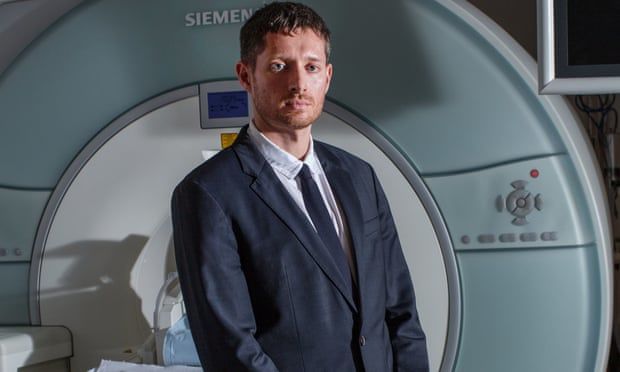 Dr Robin Carhart-Harris, co-author of the
study: ‘The results signal hope that we may be looking at a promising
alternative treatment for depression.’
“That would be an error of judgment,” he said. “We strongly believe that the … psychotherapy component is as important as the drug action.”
The £1m trial builds on previous work by the team exploring how psilocybin affects the brain, and an earlier clinical trial in which the drug helped alleviate treatment-resistant depression in 12 patients.
Over the six-week trial, 30 out of 59 adults with moderate to severe major depressive disorder were randomly allocated to receive two 25mg doses of psilocybin three weeks apart – a dose that Carhart-Harris said was high enough to produce the kind of experiences often described as existential or even “mystical”. The day after the first dose of psilocybin, this group began a daily placebo.
The other 29 participants were given two very low, or “inactive”, doses of psilocybin three weeks apart. This was to ensure any differences in outcomes between the groups would not simply be down to the expectation of being given psilocybin. The day after the first dose of psilocybin, this group began a daily dose of escitalopram, the strength of which increased over time.
Each psilocybin session – which lasted six hours, including a three- to four-hour “trip” for those on the high dose – was supervised by at least two mental health professionals, with the participants lying on their back, propped up by pillows and listening to emotionally evocative neoclassical music.
All participants received psychological therapy the day after a psilocybin session, as well as a phone or video call in the week after the first dose.
The results, published in the New England Journal of Medicine, reveal that after six weeks both groups showed, on average, a decrease in the severity of depressive symptoms, according to scores from a questionnaire completed by the participants. However, this reduction did not differ significantly between the two groups.
“Psilocybin therapy, as we predicted, works more quickly than escitalopram,” said Carhart-Harris.
He added that results from other scales were “tantalisingly suggestive of potential superiority of psilocybin therapy” not only for depression but other aspects of wellbeing. He warned the findings were not conclusive as the team did not take into account the number of comparisons being made.
However, the team noted that 57% of patients in the high-dose psilocybin group were judged to be in remission for their depression by the end of the six weeks, compared with 28% in the escitalopram group, while neither group had serious side-effects.
While the team said the results were promising, others said the study was not big enough to draw firm conclusions. Among other limitations, the majority of participants were white, middle-aged, highly educated and male, while participants may have been able to guess which treatment they received and there was no group given a placebo and therapy alone.
Anthony Cleare, professor of psychopharmacology at King’s College London, said the study provided “some of the most powerful evidence to date that psychedelics may have a role to play in the treatment of depression”.
However, he said far more data was needed before drugs such as psilocybin could be used outside of research, adding they would not replace existing treatments for depression.