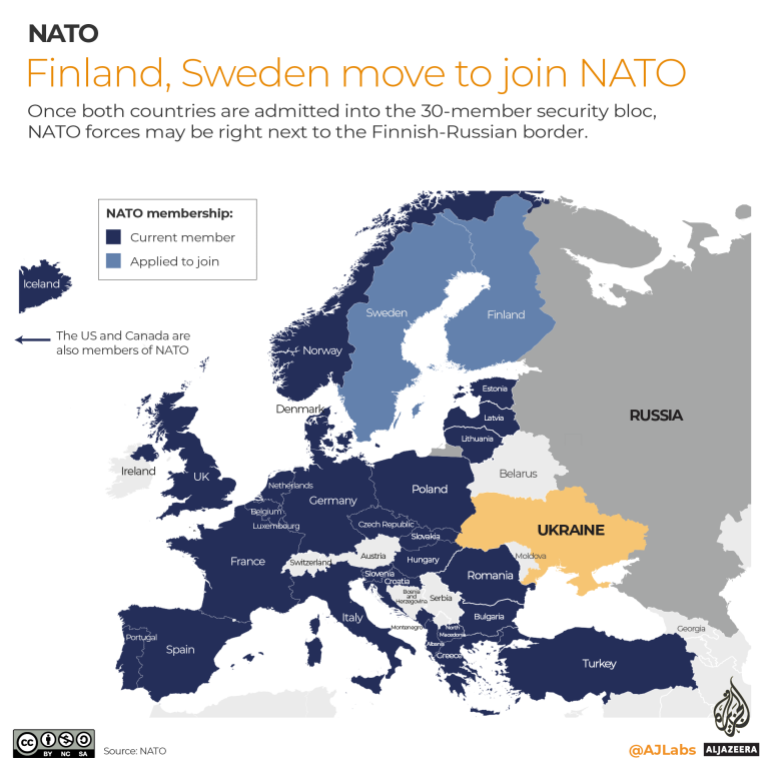
Map: What will NATO look like with Finland and Sweden included?
Finland and Sweden have formally submitted applications to join NATO, the world’s most powerful military alliance, in a move that will redraw the geopolitical map of northern Europe.
The decisions by the two historically neutral countries come in response to Russia’s invasion of Ukraine, now in its 84th day.
However, in order for the Nordic countries to join the 30-member alliance, all other NATO members must unanimously agree to admit them.
While Turkey has expressed reservations against their joining, Ankara is not expected to stand in their way.
NATO history and eastward expansion
The North Atlantic Treaty Organisation (NATO) was founded in 1949 by 12 member states – Belgium, Canada, Denmark, France, Iceland, Italy, Luxembourg, the Netherlands, Norway, Portugal, the United Kingdom and the United States – and was established to curb Soviet expansion and encourage political integration in Europe in the aftermath of World War II.
The 30-member alliance is meant to guarantee political and military protections, and allow European and North American nations to discuss security concerns.
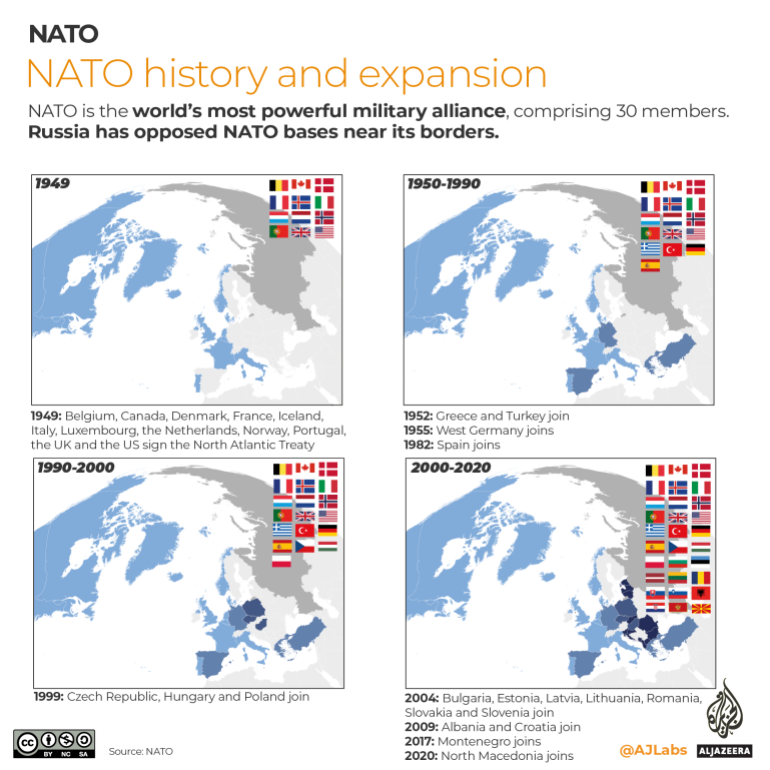
In recent years, Russian President Vladimir Putin has sought guarantees from NATO that it would halt its eastern expansion and end military cooperation with Ukraine and Georgia, which are not members.
In February, Putin said Russia’s “special operation” in Ukraine was a means to stop NATO’s growth, which he perceives as an encroachment.
NATO military operations
Article 5 of the NATO treaty states the principle of collective defence as being at the core of NATO’s founding pact. This clause means that an attack against one ally is considered an attack against all members.
Some of NATO’s notable military operations include a naval blockade and air campaign during the Bosnia war, which lasted from 1992 to 1995.
In 1999, NATO launched an air campaign to compel Serbian leader Slobodan Milosevic to pull his forces out of Kosovo and end the conflict there.
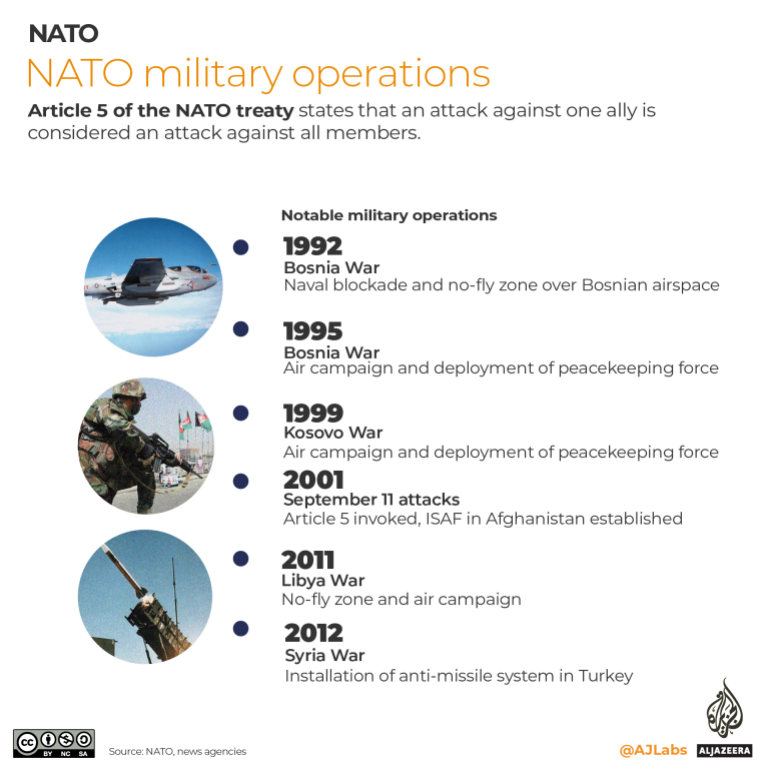
Following the September 11, 2001 attacks on the United States, NATO invoked Article 5 for the first time and joined US and UK forces to fight the Taliban in Afghanistan.
Over the 20-year war, 50 NATO and partner nations contributed forces to the missions in Afghanistan. At its peak in 2011, nearly 140,000 US and allied forces were in the country.
Throughout the Russia-Ukraine war, Ukrainian President Volodymyr Zelesnkyy has requested that NATO establish a no-fly zone over Ukraine – an idea the alliance has rejected on the basis of it escalating the conflict into a global one.
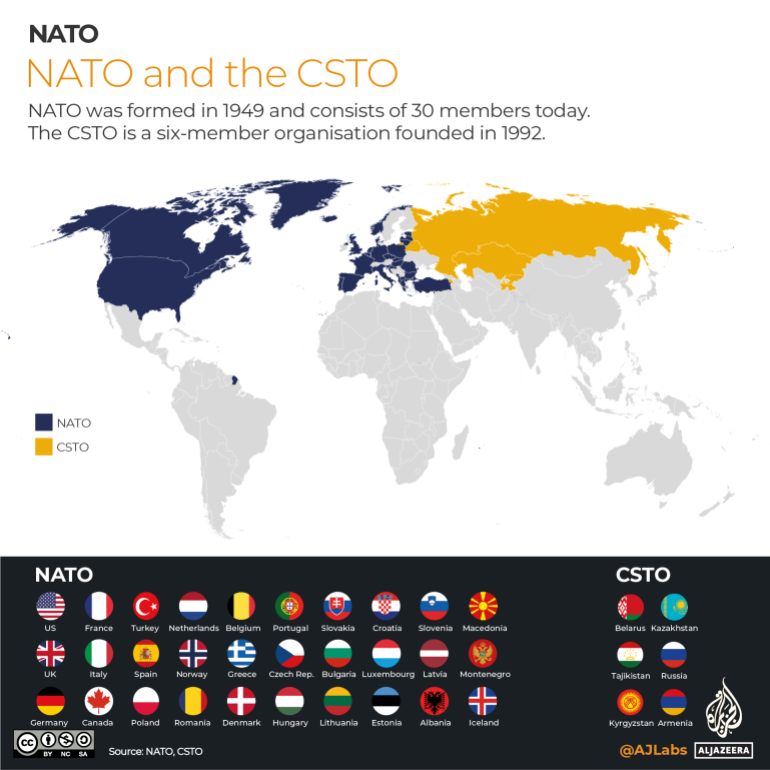
NATO and the CSTO
On Monday, Belarusian President Alexander Lukashenko urged the Russian-led Collective Security Treaty Organisation (CSTO) to unite following Finland and Sweden’s NATO bids.
The CSTO was formed in 1992 with Armenia, Kazakhstan, Kyrgyzstan, Russia, Tajikistan and Uzbekistan signing the first treaty. In 1993, Azerbaijan, Belarus and Georgia joined. The treaty came into force in 1994.
Currently, it is formed of six member countries: Russia, Armenia, Belarus, Kazakhstan, Kyrgyzstan and Tajikistan.
Similar to Article 5 of the NATO pact, Article 4 of the CSTO states that aggression against one state party is seen as aggression against all members.
As a result, participating states can support the aggressed state with provisions such as military aid.
NATO’s military expenditure
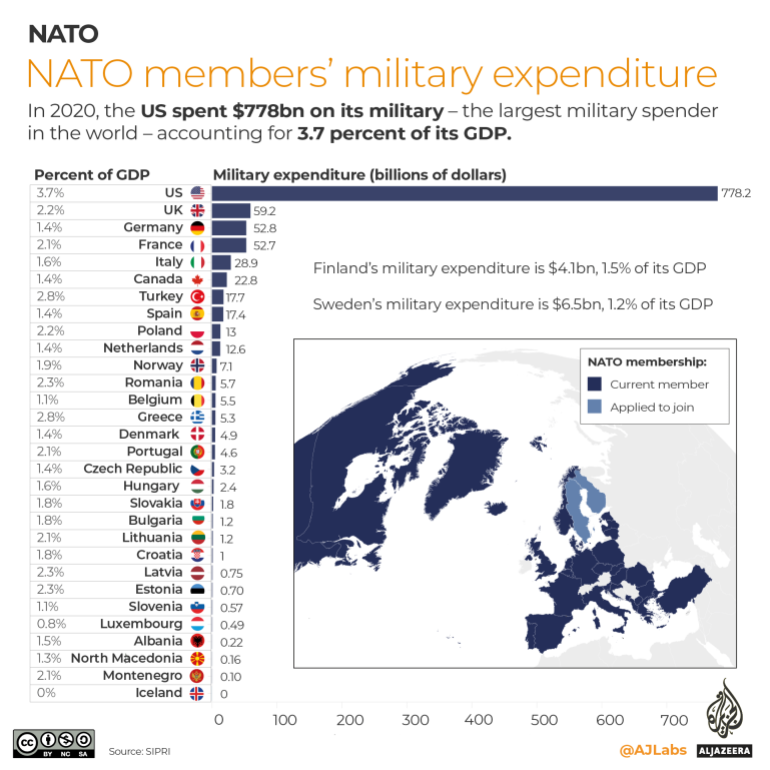
In 2020, the US spent $778bn on its military – the largest military spender in the world – according to the Stockholm International Peace Research Institute (SIPRI), accounting for 3.7 percent of the country’s gross domestic product (GDP).
Among NATO members, the UK is the second-highest military spender, with $59.2bn spent on its military in 2020, accounting for 2.2 percent of its GDP.
Iceland does not have a military of its own and so its military expenditure is zero.
In 2020, Finland spent $4.1bn on its military, accounting for 1.5 percent of its GDP, while Sweden spent $6.5bn, 1.2 percent of its GDP.
NATO’s budget
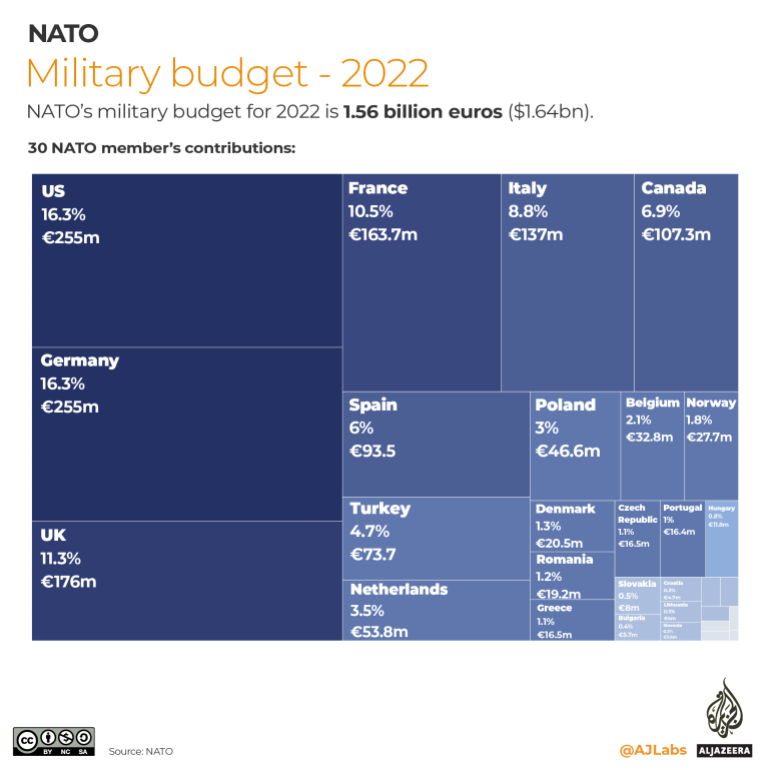
For 2022, NATO’s military budget is set at 1.56 billion euros ($1.64bn). Member countries contribute to the budget based upon a cost-sharing formula derived from the gross national income of each country.
The US and Germany equally contribute the highest percentage, totalling more than 30 percent of the military budget.
What would NATO look like once Sweden and Finland join?
The application process for Finland and Sweden to join NATO could take up to a year. However, once they are members, it would mean that NATO forces could be right next to the Finnish-Russian 1,340km (833-mile) border, in turn extending the NATO-Russia borderlines along the northwest of Russia.
Putin believes the move is an escalation in military tensions. During a televised CSTO meeting, he said the “expansion of military infrastructure” would “provoke our response”.
Bosnia and Herzegovina, Georgia and Ukraine have previously stated their wishes to join NATO. However, following Russia’s invasion of Ukraine, Zelenskyy conceded in March that it was unlikely Ukraine would be able to join NATO.