

‘More than a job’: the food delivery co-ops putting fairness into the gig economy
Cristina González did a lot of waiting in 2018. Back then, the 29-year-old was a courier for the Spanish food delivery platform Glovo in her Basque home town, Vitoria-Gasteiz. She talks about feeling as if she was on standby the whole time: “You’re effectively having to be working constantly.”
While Glovo serves restaurants, customers can also order from supermarkets. This, Gonzalez says, was “a complete shitshow: supermarket orders are really easy to screw up”. If the supermarket did not have an item in stock and González completed the order, she might get a poor rating from the customer because of the missing item. If she turned down the order, González worried that it might affect her score on the platform. “It was very, very stressful.”
Gonzalez is still a courier but is making €10 (£8.70) an hour after tax and social security contributions, more than double her previous wage. She says customers of Eraman, the delivery cooperative she now rides for, are more understanding about minor issues, the jobs are more varied;she despatches as well as delivering, there is better communication, and she feels like she has more control.
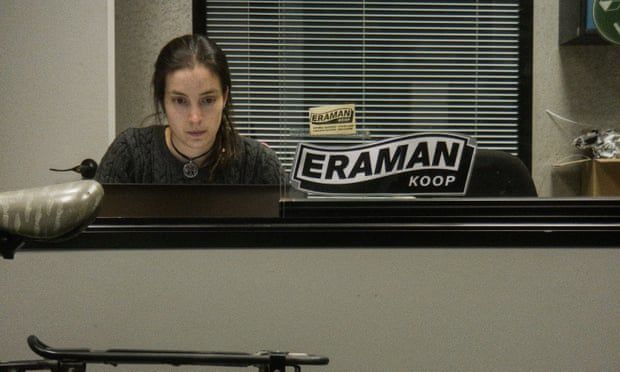 Cristina Gonzelez at work for Eraman.
She could, she says, imagine staying in this version of the gig economy far longer than she might have at Glovo – five to 10 years, she says. “It’s a job, but it’s also more than that. In Eraman you are a link in a chain, a member of a team, in Glovo you are a pawn, the last position in a hierarchy.”
In Berlin, Mattia Carraro experienced a similar trajectory: the 33-year-old courier worked at Deliveroo for two years before joining Khora, a 30-person food delivery collective set up in March last year. Germany offers relatively decent conditions for food delivery couriers – those working for the big platforms are employees with social security generally paid by the hour rather than per delivery as is the case for most couriers in the UK.
While satisfied with the pay, Carraro was bothered by the deep insecurity of the job, “that from one day to the next it might go away”, as well as the anonymity. Deliveroo ceased operations in Germany in 2019 and when Khora came along he signed up. Although his role involves significantly more administration – a two-hour weekly general meeting where decisions are reached via consensus, plus approximately 15 hours of unpaid managerial duties a week – Carraro feels happier working as part of a cooperative.
“For me, it’s OK to earn less money but to work in an environment that always makes me feel good, where I know problems are going to be solved and we’re all friends. This is something we don’t want to do for just a season or until we find something better, but a job you really want to keep and you like.”
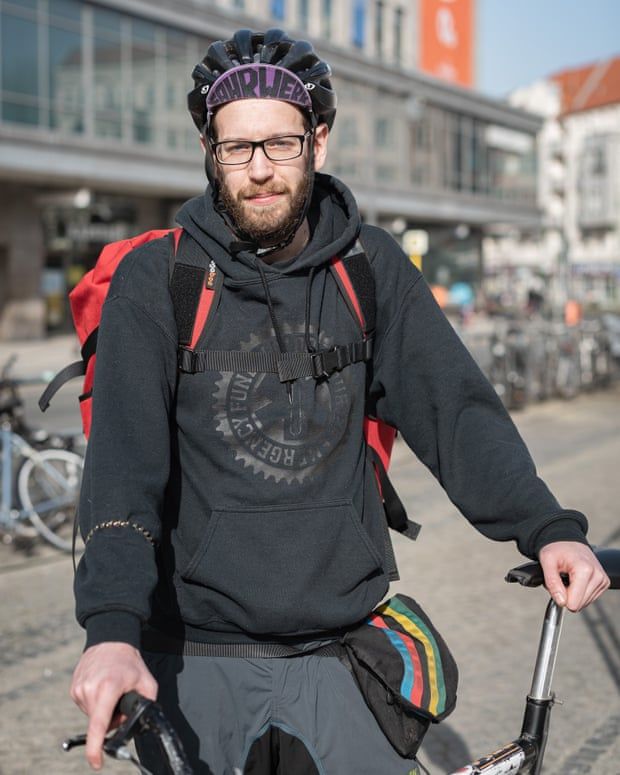 Mattia Carraro of the Khora collective taking a break at Hermannplatz, Berlin.
Carraro doesn’t just do bike deliveries: like other members of the cooperative, he handles some of Khora’s dispatching work. “I go for a nice walk with my dog and eat breakfast outside, then at noon I start work, while chain-smoking, eating yoghurt and popcorn as I dispatch. Then at 10pm my shift is over and I eat properly.”
At different ends of Europe, these cooperatives are worker-led and pride themselves on being democratically governed. Eraman’s co-founder, Paul Iano, 28, says the 10-person cooperative reaches decisions via discussion. “The thing I like to say about cooperatives is that if you’re having to vote on it, you’ve already got a problem.”
But neither venture could exist without the bike delivery software they rely on.
Enter CoopCycle, the brainchild of Alexandre Segura, a computer programmer from Marseille. Back in the spring of 2016, Segura found himself heading to the Place de la République in Paris almost every evening for Nuit debout, a French protest movement that has been compared to Occupy.
Segura helped build a website for the movement and spent much of his time talking about how the gig economy could be exploitative and harmful, and how more of it should be run by the users. “It planted seeds in my mind,” he says.
So, later that year, when his brother-in-law along with thousands of others lost his job as a courier for the Belgian food delivery startup Take Eat Easy, it prompted Segura to start a new venture in his spare time “as an intellectual exercise”.
He says he wanted to reverse-engineer the technology offered by Deliveroo, Uber and other big platforms to empower couriers. The result was a delivery app that offered software and support but required users to fulfil two conditions: they had to be worker-owned and all profits had to be distributed among the worker-owners.
“No CoopCycle, no party,” is how Carraro puts it, telling me that the cost of getting a bespoke delivery app designed would be prohibitively expensive for the average collective.
Recently, the world seems to have started thinking more like Segura does. Spain’s supreme court ruled in September that riders working for Glovo are not self-employed but salaried employees with the right to paid holidays and sick leave. On Tuesday, the country’s Socialist-led cabinet approved a law giving effect to that ruling and a three-month deadline for companies to employ their couriers as staff. Spain’s labour minister, Yolanda Díaz, said the legislation put the country “at the forefront of a technological change that can’t be allowed to outpace employment rights”, adding: “Reconciling technological development with social protection needs to be the password of the future.”
Around the world, at least 40 legal challenges to employment conditions for riders and drivers have been raised against gig economy companies including Uber and Deliveroo.
Deliveroo’s shares plunged 26% in its much-anticipated London stock exchange debut in March, with many investors expressing concerns about the conditions faced by its self-employed riders.
This increased scrutiny came with rolling lockdowns that shut down much of the hospitality industry and sent meal delivery orders through the roof. The Amsterdam-based Just Eat Takeaway reported a 79% increase in orders for the first three months of 2021. And despite its disastrous stock market launch, Deliveroo is reporting a doubling of order volumes in the same period.
Segura’s colleague Adrien Claude says 90% of non-profit food delivery cooperatives have also reported a boost in business during lockdown.
The co-ops say their business model offers a better deal for restaurants as well as riders. Eraman, for example, charges restaurants between 10-20% of the value of the order, while Deliveroo takes 32%, Glovo’s average fee is 35% and Just Eat and Uber Eats’ commission is 36.20%. In Berlin, Khora offers a flexible system which gives restaurant-clients more autonomy than if they were to pay a set percentage.
But whether worker-led delivery co-ops can provide a real alternative to the delivery giants remains to be seen.
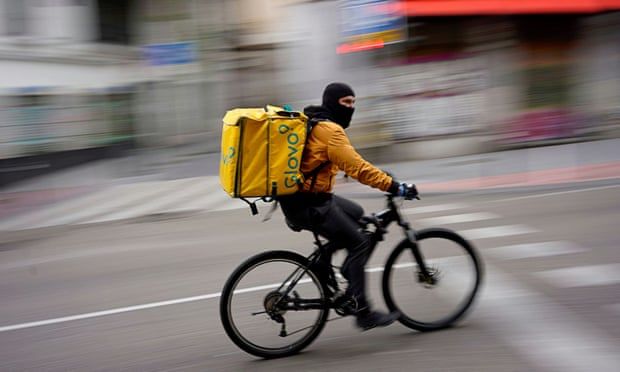 A Glovo food delivery courier in Madrid during the first wave of the pandemic last year.
Prof Vera Trappmann of the University of Leeds, one of the co-authors of Global labour unrest on platforms: the case of food delivery workers, thinks the cooperative model shows us the possibility of a different future – “of alternative ways of dividing up risks and earnings”. A radical change in working conditions for couriers ushered in by Coopcycle seems unlikely, she says. Yet, she believes this amalgamation of digital platforms with worker-led co-ops is here to stay.
“We know that young people especially don’t like working in the bureaucratic, exploitative environments offered by many companies and as such, often opt for self-employment. They’re more prone to questioning the value of working for corporations, and co-ops may become more and more of a home for such people.”
CoopCycle now has 67 co-ops across seven countries in its “federation” and has extended from Europe to Canada and Australia. It is on the cusp of deals with collectives in Argentina and Mexico for the first time, though there is a debate in process over whether motorcycles would be a breach of the federation’s environment-friendly values.
Claude sounds both fired up about the future and gently exhausted. “We’re trying to change the world – it’s tough because we’re human and nothing’s perfect. It probably never will be perfect but we’re trying to make things better by the day.”