

Opinion: Supreme Court mystery thickens
In real life, when Politico published a draft majority opinion last week striking down the half-century old precedent that legalized abortion in America, there was no way to tell how it leaked — or why. The revelation rocked America's political and legal worlds.
Gone was not only court secrecy, but also the assurances from conservative Supreme Court nominees that Roe v. Wade was "settled" law, which led some observers to think that the court doctrine of "stare decisis" — to "stand by things decided" — might prevent the complete overturning of a landmark precedent set in 1973.
As one of the reporters who broke the story, Josh Gerstein wrote, "Supreme Court historians, former law clerks and other court watchers say they cannot recall a previous instance before Monday's publication of a draft opinion in the Mississippi abortion rights case."
"However, in a handful of cases, hints about deliberations have slipped out publicly, including in Roe v. Wade, the landmark abortion-rights precedent that the justices now appear to be on the verge of abandoning." There was even a case more than 100 years ago in which a clerk was prosecuted, but never convicted, of leaking valuable information to traders on Wall Street.
The implications of the ruling are enormous. If a majority on the court erases Roe v. Wade, wrote Jill Filipovic, "For American women, it throws the future into question: What will it mean to live in a country that has made it clear it doesn't see you as an equal citizen — that doesn't recognize the most basic, intimate right to decide what happens inside your own body?"
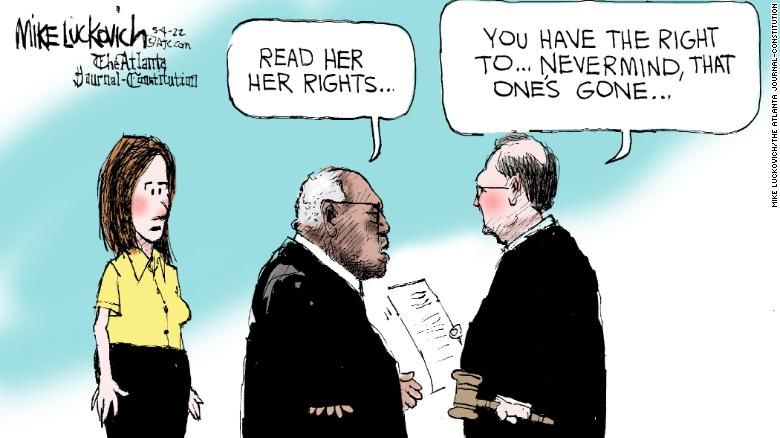
"And the conservative movement won't stop there," Filipovic predicted. Advocates on the right will challenge the court's landmark rulings legalizing contraception and same-sex marriage.
"It was never just about abortion. It's about the broader and much more radical cultural shift the reactionary American right wants: A return to traditional gender roles, with men occupying the public, economic and political spheres; women dependent on men and at home with children; and LGBTQ people pushed back into the shadows."
Alice Stewart wrote that the draft decision, if it becomes final, would vindicate conservatives who reluctantly voted for Donald Trump because of his focus on appointing judges opposed to Roe v. Wade. But, she observed, "What the left ignores is that overturning Roe won't end all debates about abortion. It will, however, take the authority over decisions about abortion policy away from unelected federal officials and place it where it belongs — in the hands of elected state representatives.
"National surveys show that a majority of Americans say abortion should usually occur within the first trimester. And many voters favor the limitations that Mississippi is seeking to put into place."
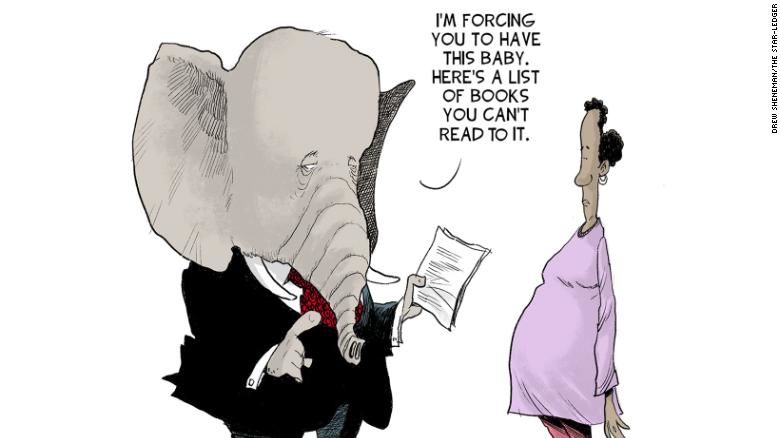
How we got here
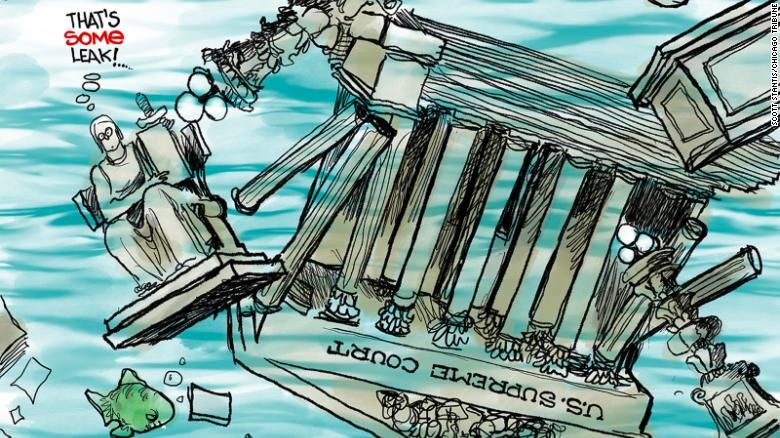
In Latin America, some abortion restrictions are being lifted. In Ireland, two thirds of the voters opted to remove that nation's abortion ban in a 2018 referendum.
Yet the US appears headed in the opposite direction, wrote Frida Ghitis. The Supreme Court leak "added to the impression around the world that the US, long a bastion of individual freedom, is becoming a more conservative country by the day." In reality, though, "The engine driving this change is not a more conservative country. Instead, it is a more dysfunctional political system."
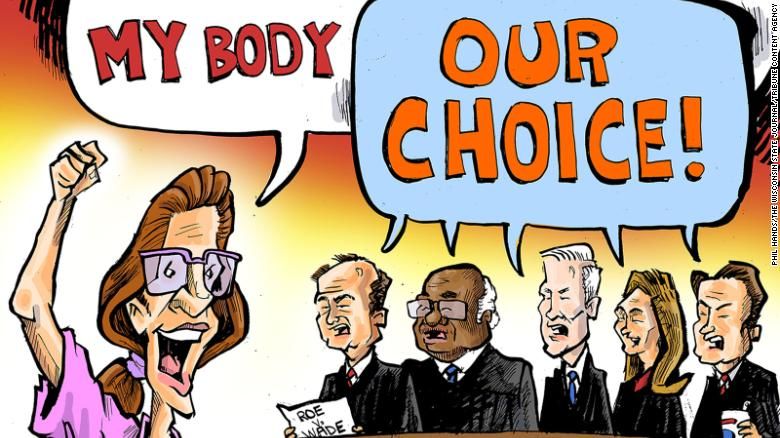
"The American people have consistently told pollsters that they want the freedom guaranteed under Roe v. Wade to remain in place," Ghitis noted. But the power a minority can wield through the Senate and the Electoral College enables it to control policy for the nation.
America already "has the highest maternal mortality rate in the industrial world," wrote Nicole Hemmer. "Even before Covid-19 spiked maternal mortality in the US, rates were still on the rise, especially among Black women. If — and it is probably now when — the court overturns Roe, the combination of less-regulated abortion services and more girls and women being forced to carry pregnancies to term will ensure an even higher number of pregnancy-related deaths in the US."
In the New York Times, Ross Douthat examined rival scenarios accounting for the leak — that it came from the left or the right — and concluded that "a key implication of Alito's draft — and of arguments marshaled for generations by Roe's critics — is that treating the judiciary as the main arbiter of our gravest moral debates was always a mistake, one that could lead only to exactly the kind of delegitimization that we see before us now."
Victory Day?
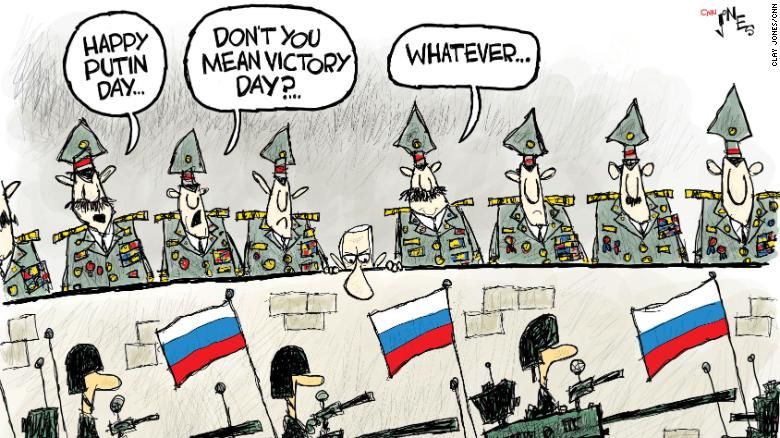
Monday is the day Russia commemorates victory over Nazi Germany in 1945. Pundits have predicted either that President Vladimir Putin will claim victory over Ukraine or that he will use the day to rally support for a wider war.
Retired US Army Major General Mike Repass, former leader of the US Special Operations Command in Europe, told Peter Bergen that he expects the war to grind on for "at least two years. But we can't let it get into a stalemate. If it gets into a stalemate, Putin's going to claim success followed by a brutal occupation of the Ukrainian territory that he controls."
Back from a trip to Poland and western Ukraine, Repass said "Ukraine still needs a lot of help" and "NATO is moving too slow."
As Dr. Ira Helfand and Michael Christ wrote, "Putin issued the latest in a series of nuclear threats when he warned of a 'lightning-fast' response if any nation intervened in Ukraine. While the United States hasn't put its forces on higher alert, the Biden administration has adopted a more confrontational stance toward Russia in recent weeks." A Wall Street Journal column by Seth Cropsey was headlined, "The US Should Show It Can Win a Nuclear War."
"What are they thinking? If there's one thing we know about such a conflict, it is as President Ronald Reagan and Soviet leader Mikhail Gorbachev said in a joint statement in 1985, "(A) nuclear war cannot be won and must never be fought," wrote Helfand and Christ.
"The US and Russia currently have some 3,000 strategic nuclear warheads pointed at each other, according to the Federation of American Scientists. A 2002 study showed that if only 300 Russian warheads got through to cities in the United States, 77 million to 105 million people would be killed in the first afternoon..."
"Food production would crash, triggering a global famine that would destroy modern civilization," according to a study published in the journal Science Advances."
After the Soviet Union developed nuclear weapons in the 1950s, wrote former US Defense Secretary William S. Cohen and former Sen. Gary Hart, "Our strategic planners began to think about survival of the nation following a nuclear exchange between our two countries. The umbrella for this planning came to be known as 'continuity of government' -- an effort to address the question of who, and under what authority, would run our country if tens of millions of Americans and government structures were to perish in a nuclear attack?"
The result was the creation of a series of little-understood emergency powers vested in the President. Cohen and Hart noted that "The ones of notable concern, particularly to those of us who desire to protect our constitutional rights, have included the suspension of habeas corpus and national elections, silencing of the press, censorship of information, various forms of martial law, the detention and arrest of individuals designated as terrorists or enemies of the state — and much more..."
The "very secrecy of presidential plans of action keeps the American people, including their elected representatives, in the dark about extra-constitutional powers that would-be authoritarians among us might use to suppress our freedoms — not for the sake of survival but in pursuit of raw political power."
Orwell

Putin's insistence that his war on Ukraine is just a "special military operation" is one of the latest signs that the English writer George Orwell remains relevant 72 years after his death, noted Laura Beers. "If it becomes impossible even to say that Russia should not have invaded Ukraine, internal political opposition to the war ceases to be a viable proposition," she wrote.
"Much of Orwell's writing, and particularly his final novel '1984,' was preoccupied with the importance of speaking the truth and the risk to both individuals and societies when states attempt to censor and manipulate speech."
Putin has based his rationale for invading Ukraine partly on the claim the Russians are de-Nazifying the country. Last week, Russian Foreign Minister Sergey Lavrov took that to new depths by falsely saying that Hitler had "Jewish blood" and contending that Ukrainian President Volodymyr Zelensky's Jewish heritage "does not negate the Nazi elements in Ukraine."
Anthony D. Kauders, a historian specializing in German-Jewish history, wrote, "Lavrov's comments are a familiar rhetorical device in the arsenal of Jew-baiters then and now... Russian propaganda today is all about spreading falsehoods and misrepresentations, so much so that lack of commitment to consistency is the only reliable feature of Moscow's communications at the present time."
Red elephant
During the final round of the Palos Verdes Championship, Golf Channel reporter Jerry Foltz asked "world No. 3 golfer Lydia Ko why a physical therapist had rushed onto the course to treat her," Holly Thomas noted. "Smiling, Ko said: 'It's that time of the month,' explaining that she has problems with her back when she has her period. Foltz, clearly stumped, mumbled, 'Uh, thanks.'"
It pointed up "two glaring oddities: First, that female sports stars spend roughly a quarter of their time with a physical handicap, yet are expected to stay quiet about it, and second, how wild it is that in 2022, a male reporter was flummoxed by the mention of something that happens every few weeks to approximately half the people he knows. Yet, as absurd as the reporter's reaction was, it's not surprising that he was thrown..."
"Periods have been shrouded in mystery for generations — the red elephant lingering in the room, while the adjacent general knowledge of how our bodies work became better-understood and more openly shared with younger people."
Trump's influence
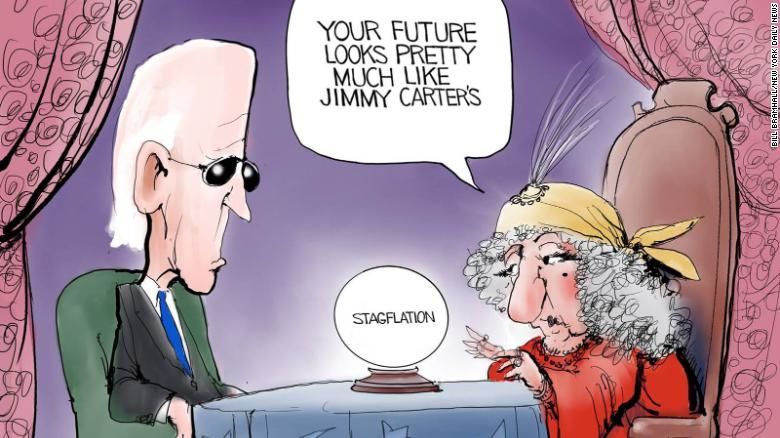
Former President Donald Trump passed the first test of his influence in the May Republican primaries — J.D. Vance, his preferred candidate for the nomination for Senate in Ohio, won.
"While Vance received only about a third of all the votes cast in the Republican Senate primary — suggesting there are limits to Trump's influence — in a tight race, with five well-funded candidates, it's tough to argue Trump's endorsement didn't, in the end, make all the difference for Vance," observed Paul Sracic. "This is made even more impressive by the fact that Trump had to essentially help Vance overcome the venture-capitalist-turned-author's own words, which were sharply critical of Trump back in 2016."
In Georgia, the news for Trump wasn't so favorable — a special grand jury was convened in the wake of his post-election phone call to Secretary of State Brad Raffensberger, asking him to "find 11,780 votes" so that he could nullify President Joe Biden's victory in that state.
Legal analyst Elie Honig wrote that "the key will be establishing Trump's criminal intent. His defenders likely will argue that he genuinely believed he had won the Georgia election (despite all evidence to the contrary) and that he merely wanted to ensure a full and fair vote count. But prosecutors will focus on Trump's use of the word 'find.' If Trump truly believed he had won, and had received more votes than Joe Biden, why would he need Raffensperger to 'find' votes? And why precisely 11,780 votes — exactly one more than Biden's margin of victory?"
Don't miss:
AND...
Mom's Day
Kirsten Powers' mother "claims I started yelling at her almost as soon as I had exited the birth canal. This is obviously hyperbole, but probably only slightly. We could not have been more temperamentally different and fought constantly."
So it's hard for Powers to wake up on Mother's Day and "jealously watch women across Instagram and Facebook posting pictures and paeans to their 'best friends' and 'perfect' mothers."
Their "relationship was so tumultuous that most people — including me — assumed that after I went away to college it would end. It nearly did, but in my mid-20s we went to family counseling and forged a fragile peace that was threatened many times over the years though miraculously held," wrote Powers.
Then, while writing a book on grace in 2020, Powers saw the relationship "through a different frame."
"In my mind's eye, I had an image of my 20-something unmarried mother facing an unplanned pregnancy while pursuing her PhD in anthropology. My body was flooded with empathy. I thought of how she was forced into a more conventional life than she wanted by the expectations (and laws) of society and her Catholic parents. By the time she figured out she was living someone else's life, she had two children and a husband. In another era she would have had neither."
"I realized also that throughout my childhood, she was also dealing with Olympian levels of stress as she worked as a trailblazing archaeologist and professor leading the way for future women... Rather than being wrapped up and tied with a perfect bow, this story ends with something different: acceptance and appreciation for what we did have, grace for what we did not and gratitude for the years we have left to try and live a different and imperfect story."