PanamaTimes

Friday, Aug 07, 2026

Pelé: Why black Brazilians like me mourn the king

Pelé: Why black Brazilians like me mourn the king

Pelé, o Rei, has died.

Brazil and the world are grieving, and many of us mourn an idol we never saw on the pitch.

Being 23 years old, I was not around during the start, middle, or even the end of his glowing football career. But that does not matter. Pelé was and always will be a household name.

Growing up in Rio de Janeiro, a city of exuberance and vibrancy, football played a crucial role in our life.

Maracanã, where Pelé scored his thousandth goal, was emblematic of my day-to-day routine until I moved to the UK, aged 11.

We were always nearby. The buzz and frenzy during match days could be felt across the city. Traffic would be slower, restaurants busier, and the streets much louder.

Following the news of king Pelé's death last night, as I was writing for the BBC's tributes live page, my family group chat kept buzzing.

Four generations, all devastated in equal measure by the death of an idol. Words, emojis and GIFs expressed our shock - we are Brazilian, after all, and emotions tend to run high.

But what stuck with me was a comment from my aunt. She highlighted that Brazilian media, while discussing Pelé's life, used the phrase: "Our king is black."
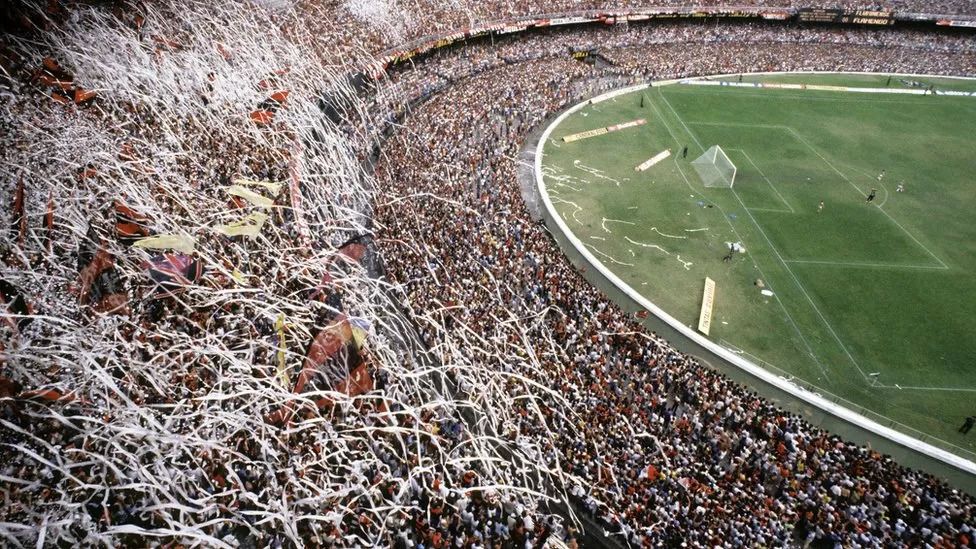

Thousands of football fans from across Brazil flock to Rio de Janeiro to watch big matches at Maracanã

His stardom is unquestionable - and his influence worldwide says much more about him than his ethnicity and background.

But for Brazil's black community, hearing those words matter. A lot. And they signify a paradigm shift we have been going through for decades - one which Pelé played a crucial role in.

Because Pelé rose to the status of national treasure in a country with a deep history of slavery, and a legacy of division.

He regularly faced monkey chants on the pitch and had several racist nicknames. He once said that if he had stopped every game after a monkey taunt, he would have had to stop them all.

He was key to carving out space and recognition for black people in Brazilian football, his biographer Angelica Basthi has said - but he was never directly involved in the fight against racism.

Speaking to my mum, she tells me that Pelé "signifies greatness and contradiction".

Contradiction, because many Brazilians struggled with his resistance to speak out against racism.

Greatness, due to the path he forged for us, black Brazilians. Pelé rose to stardom despite Brazil's deeply rooted racism.

"He allowed us, black Brazilians, to see one of our own being acclaimed by the masses, considered a King, an icon for the whole country," my mum tells me.

"Pelé won his first World Cup only 70 years after slavery was abolished [in Brazil], in a country which continued, and continues, to treat black people as third-class citizens.

"He was an icon, who made us realise that it is possible to be a black man of international prominence."

Brazil abolished slavery in 1888. It is not ancient history for us, and anti-black racism continues to be rife.

Pelé's voice and gravitas could be heard in the commentary of big games long after the end of his career - particularly during World Cups.

"Even being quiet, he was able to contribute a lot towards Brazil's image worldwide," Edward Helal, my friend and a huge football fan, tells me.

Asked about the mood in Rio, Edward says most people are taking time to pay tributes and express their gratitude to the king of football.

Even now, during my annual visits back home, I dare not suggest having anything other than our world-renowned football commentary in the background on a Wednesday evening or Sunday afternoon.

I have Pelé to thank - and blame - for it.

Newsletter

Related Articles

PanamaTimes
0:00
0:00
Close
Trump’s Top General Seeks an Exit Strategy From Iran War, Report Says
Brock Lesnar Retires From Wrestling, Closing a Career of Rare Athletic Range and Lasting Controversy
Trump-Era Policy Shifts Test the Boundaries of U.S. Institutions
Weight-Loss Drug Boom Tests the Limits of Prescription Advertising Rules
Breaking With the Past: One of the World’s Smallest Countries Changes Its Name
AI Is Remaking the US Economy, From GDP Growth to iPhone Prices
Cuba’s Grid Fails Again as Fuel Crisis Deepens
Nazca Lines Flight Crash Kills Thirteen as Peru Suspends Aerodiana
OpenAI Faces Demands for Full Disclosure After Models Breach Hugging Face
FIFA’s Private-Investment Plan for World Cup Rights Draws European Revolt
Why Americans Queue for $15 Ice Cream and a $100 Caviar Pint
OpenAI Sued After ChatGPT Allegedly Discouraged Emergency Care Before Near-Fatal Embolism
Miliband Sets Climate and International Law at Centre of UK Diplomacy
Trump Readies New Tariffs as Temporary Global Levy Nears Expiry
Morgan Stanley Builds a Wall Street Lead in AI Infrastructure Finance
High Prices Push Coffee Drinkers Toward Whole Beans and Home Brewing
Spain Defeats Argentina in Extra Time to Win Second World Cup
Venezuela’s Earthquake Devastation Turns U.S. Investment Opportunity Into a Thirty-Seven Billion Dollar Reconstruction Challenge
Ukrainian Drones Strike Wildberries Warehouses Deep Inside Russia
The Ledger Will Not Trust on Faith
Trump Administration Pressures Banks to Restrict Financial Access for Undocumented Immigrants
The Ten World Cup Finals That Defined Football History
Smartphones Are Getting More Expensive, Sales Are Collapsing, and Even Apple Admits: "Prices Will Rise"
The AI Race Enters Its Infrastructure Era
Colombia Influencer Dies After Cosmetic Procedure at Unlicensed Bogota Salon
A Quiet Bastille Day: France Grapples with World Cup Heartbreak and Leftover Fireworks
Spain in Ecstasy: "We Feel Unbeatable, We Taught the Whole World a Lesson"
On the Island That Did Not Yield to Trump, There Is No Electricity, and 10 Million Live in Darkness
World Cup Visitors Turn American Big-Box Stores Into Souvenir Stops
Anthropic Reengineers Agentic Architecture to Shift Autonomous Workplace Automation to the Cloud
Global Crisis Alert: Escalating Middle East Tensions and UK Political Upheaval
Japanese Technology Firm Fujitsu Launches Advanced Artificial Intelligence Tool for Corporate Disclosures
South Africa Officially Launches Nationwide Campaign for Highly Contested Local Government Elections
United Kingdom Commits Additional Funding for Unexploded Ordnance Clearance in Laos
Singapore Announces Stringent New Greenhouse Gas Regulations for Commercial Cooling Systems
Cambodia and Thailand Hold High-Level Border Security Talks at United Nations Headquarters
Myanmar Military Government and China Sign Major Agreement to Upgrade Media and Cultural Cooperation
Knife Attack at Swiss Train Station Leaves Three Injured in Suspected Act of Domestic Terrorism
Transnational Extortion Gang Threatens Canadian Police With Army of One Thousand Armed Operatives
Australia Imposes Forty-Two-Day Quarantine on Cruise Ship Passengers Following Deadly Hantavirus Outbreak
International Monetary Fund Unlocks Seven Hundred Million United States Dollars for Sri Lanka Following Economic Reforms
Australia Launches Record One Point Four Billion Dollar Lawsuit Against Chemical Giant 3M Over Contamination
China and Canada Foreign Ministers Meet in Ottawa in Effort to Stabilize Strained Diplomatic Ties
Indonesia Demands Urgent United Nations Security Council Reform Amid Escalating Global Conflicts
Extreme Weather Patterns Trigger Severe Drought in Madagascar and Destructive Flooding in East Africa
Indian State of Karnataka Faces Political Upheaval as Chief Minister Siddaramaiah Abruptly Resigns
Philippines and Japan Reaffirm Defense Ties as Crucial for Indo-Pacific Regional Stability
Norway Joins French Nuclear Deterrence Initiative in Major Shift for European Security Architecture
Global Critical Mineral Alliances Expand as Western Nations Move to Counter Chinese Supply Dominance
United States Imposes Fifty Percent Tariffs on Mexican Steel and Aluminum Ahead of Trade Pact Review
×