Trump Announces U.S. Large-Scale Strike on Venezuela, Declares President Maduro and Wife Captured
President Donald Trump announced on January 3, 2026 that the United States had carried out a “large-scale strike” against Venezuela and that Venezuelan President Nicolás Maduro and his wife, Cilia Flores, had been captured and flown out of the country.
It is the first such direct intervention by the US in Latin America since the invasion of Panama in 1989
In a post on his Truth Social platform early Saturday morning, Trump wrote:
“The United States of America has successfully carried out a large scale strike against Venezuela and its leader, President Nicolas Maduro, who has been, along with his wife, captured and flown out of the Country. This operation was done in conjunction with U.S. Law Enforcement. Details to follow.
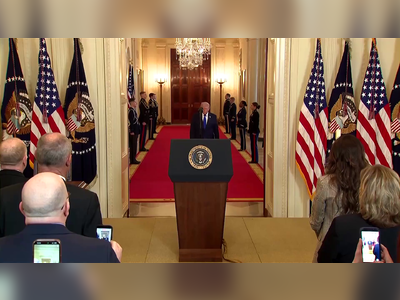
There will be a News Conference today at eleven A.M., at Mar-a-Lago.
Thank you for your attention to this matter!
President DONALD J. TRUMP”.
This message has been widely published and confirmed by multiple outlets covering the unfolding situation.
Explosions and reports of low-flying aircraft were heard over Caracas and surrounding regions in the early hours of the morning.
Witnesses and residents described blasts near major military installations and power outages affecting parts of the capital and adjacent states.
Venezuelan authorities immediately condemned the operations as an act of “military aggression,” declaring a national emergency and urging citizens to mobilize in defence of their sovereignty.
Vice President Delcy Rodríguez, citing Venezuelan state media, demanded independent proof of life for both Maduro and Flores and stated that their location and condition remained unknown.
Venezuelan Defence Minister Vladimir Padrino López released a video message saying Venezuela will resist the presence of any foreign troops and that U.S. strikes had hit civilian areas, with the government collecting information about casualties.
He vowed to oppose what he characterised as a violation of Venezuelan territorial integrity.
The announcement and associated military action represent a sharp escalation in United States–Venezuela relations, which have been strained for months by U.S. accusations that Maduro’s government facilitates drug trafficking and poses a threat to regional stability.
Prior to this operation, the United States had increased naval and military deployments in the Caribbean, targeted suspected drug-smuggling vessels, and authorised covert actions.
Venezuela’s government and its allies have condemned these steps, accusing Washington of seeking regime change and the seizure of natural resources.
Despite the strong language of the U.S. announcement and Trump’s description of the strike as successful, independent confirmation of Maduro’s capture and current status has not yet been provided by neutral third-party observers.
The Pentagon and U.S. Southern Command have thus far deferred comment to the White House, while Venezuela’s official statements challenge the legality of the action under international law.
The situation remains fluid, with potential implications for diplomatic relations across the Western Hemisphere, international security norms, and the legal frameworks governing the use of force.
International reaction has been mixed, with some governments condemning the U.S. action and others urging restraint and de-escalation.
This moment signifies one of the most consequential developments in recent U.S.-Venezuela history, underscoring how geopolitical tensions, narcotics policy, and questions of sovereignty intersect in crises that can reverberate far beyond national borders.