PanamaTimes

Friday, Aug 07, 2026

Portugal should apologise for role in slave trade, says its president

Portugal should apologise for role in slave trade, says its president

Marcelo Rebelo de Sousa makes rare acknowledgement of centuries of forced transportation of millions of Africans

Portugal’s president, Marcelo Rebelo de Sousa, has said his country should apologise and take responsibility for its role in the transatlantic slave trade, the first time a leader of the southern European nation has suggested such a national apology.

From the 15th to the 19th century, 6 million Africans were kidnapped and forcibly transported across the Atlantic by Portuguese vessels and sold into slavery, primarily to Brazil.

But so far Portugal has rarely commented on its past and little is taught about its role in slavery in schools.

Rather, the country’s colonial era, which subjugated countries including Angola, Mozambique, Brazil, Cape Verde and East Timor as well as parts of India, is often perceived as a source of pride by most Portuguese.

Speaking on Tuesday at Portugal’s annual commemoration of the 1974 “Carnation” revolution, which toppled the country’s dictatorship, Rebelo de Sousa said the country should go beyond just an apology, though he did not offer up any specifics.

“Apologising is sometimes the easiest thing to do: you apologise, turn your back, and the job is done,” he said, adding the country should “assume responsibility” for its past to build a better future.

Rebelo de Sousa made the remarks after the Brazilian president, Luiz Inácio Lula da Silva, who was in Portugal on his first visit to Europe since assuming the office, addressed the Portuguese parliament. Brazil gained independence from Portugal in 1822.
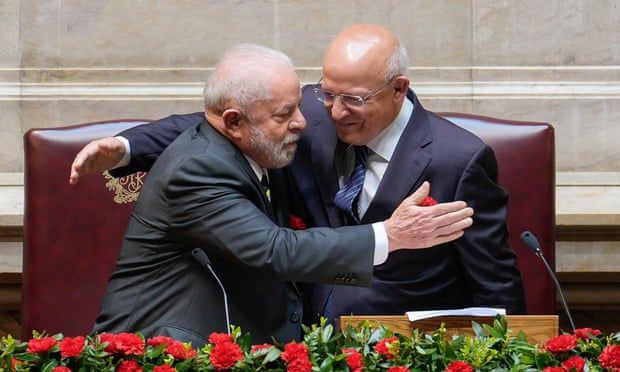
Brazil’s president, Luiz Inácio Lula da Silva, (l) greets Augusto Santos Silva, president of the Portuguese parliament, on the last day of his state visit to Portugal on 25 April.


He said the colonisation of Brazil also had positive factors, such as the spread of Portuguese language and culture.

“[But] on the bad side, the exploitation of Indigenous people … slavery, the sacrifice of the interests of Brazil and Brazilians,” he said.

Europe’s top human rights group previously said Portugal had to do more to confront its colonial past and role in the transatlantic slave trade in order to help fight racism and discrimination today.

Newsletter

Related Articles

PanamaTimes
0:00
0:00
Close
Trump-Era Policy Shifts Test the Boundaries of U.S. Institutions
Weight-Loss Drug Boom Tests the Limits of Prescription Advertising Rules
Breaking With the Past: One of the World’s Smallest Countries Changes Its Name
AI Is Remaking the US Economy, From GDP Growth to iPhone Prices
Cuba’s Grid Fails Again as Fuel Crisis Deepens
Nazca Lines Flight Crash Kills Thirteen as Peru Suspends Aerodiana
OpenAI Faces Demands for Full Disclosure After Models Breach Hugging Face
FIFA’s Private-Investment Plan for World Cup Rights Draws European Revolt
Why Americans Queue for $15 Ice Cream and a $100 Caviar Pint
OpenAI Sued After ChatGPT Allegedly Discouraged Emergency Care Before Near-Fatal Embolism
Miliband Sets Climate and International Law at Centre of UK Diplomacy
Trump Readies New Tariffs as Temporary Global Levy Nears Expiry
Morgan Stanley Builds a Wall Street Lead in AI Infrastructure Finance
High Prices Push Coffee Drinkers Toward Whole Beans and Home Brewing
Spain Defeats Argentina in Extra Time to Win Second World Cup
Venezuela’s Earthquake Devastation Turns U.S. Investment Opportunity Into a Thirty-Seven Billion Dollar Reconstruction Challenge
Ukrainian Drones Strike Wildberries Warehouses Deep Inside Russia
The Ledger Will Not Trust on Faith
Trump Administration Pressures Banks to Restrict Financial Access for Undocumented Immigrants
The Ten World Cup Finals That Defined Football History
Smartphones Are Getting More Expensive, Sales Are Collapsing, and Even Apple Admits: "Prices Will Rise"
The AI Race Enters Its Infrastructure Era
Colombia Influencer Dies After Cosmetic Procedure at Unlicensed Bogota Salon
A Quiet Bastille Day: France Grapples with World Cup Heartbreak and Leftover Fireworks
Spain in Ecstasy: "We Feel Unbeatable, We Taught the Whole World a Lesson"
On the Island That Did Not Yield to Trump, There Is No Electricity, and 10 Million Live in Darkness
World Cup Visitors Turn American Big-Box Stores Into Souvenir Stops
Anthropic Reengineers Agentic Architecture to Shift Autonomous Workplace Automation to the Cloud
Global Crisis Alert: Escalating Middle East Tensions and UK Political Upheaval
Japanese Technology Firm Fujitsu Launches Advanced Artificial Intelligence Tool for Corporate Disclosures
South Africa Officially Launches Nationwide Campaign for Highly Contested Local Government Elections
United Kingdom Commits Additional Funding for Unexploded Ordnance Clearance in Laos
Singapore Announces Stringent New Greenhouse Gas Regulations for Commercial Cooling Systems
Cambodia and Thailand Hold High-Level Border Security Talks at United Nations Headquarters
Myanmar Military Government and China Sign Major Agreement to Upgrade Media and Cultural Cooperation
Knife Attack at Swiss Train Station Leaves Three Injured in Suspected Act of Domestic Terrorism
Transnational Extortion Gang Threatens Canadian Police With Army of One Thousand Armed Operatives
Australia Imposes Forty-Two-Day Quarantine on Cruise Ship Passengers Following Deadly Hantavirus Outbreak
International Monetary Fund Unlocks Seven Hundred Million United States Dollars for Sri Lanka Following Economic Reforms
Australia Launches Record One Point Four Billion Dollar Lawsuit Against Chemical Giant 3M Over Contamination
China and Canada Foreign Ministers Meet in Ottawa in Effort to Stabilize Strained Diplomatic Ties
Indonesia Demands Urgent United Nations Security Council Reform Amid Escalating Global Conflicts
Extreme Weather Patterns Trigger Severe Drought in Madagascar and Destructive Flooding in East Africa
Indian State of Karnataka Faces Political Upheaval as Chief Minister Siddaramaiah Abruptly Resigns
Philippines and Japan Reaffirm Defense Ties as Crucial for Indo-Pacific Regional Stability
Norway Joins French Nuclear Deterrence Initiative in Major Shift for European Security Architecture
Global Critical Mineral Alliances Expand as Western Nations Move to Counter Chinese Supply Dominance
United States Imposes Fifty Percent Tariffs on Mexican Steel and Aluminum Ahead of Trade Pact Review
European Union and China Head Toward Major Trade Conflict Over Clean Technology Exports
United States Economic Growth Severely Downgraded to One Point Six Percent as Stagflation Fears Mount
×