PanamaTimes

Tuesday, Oct 27, 2026

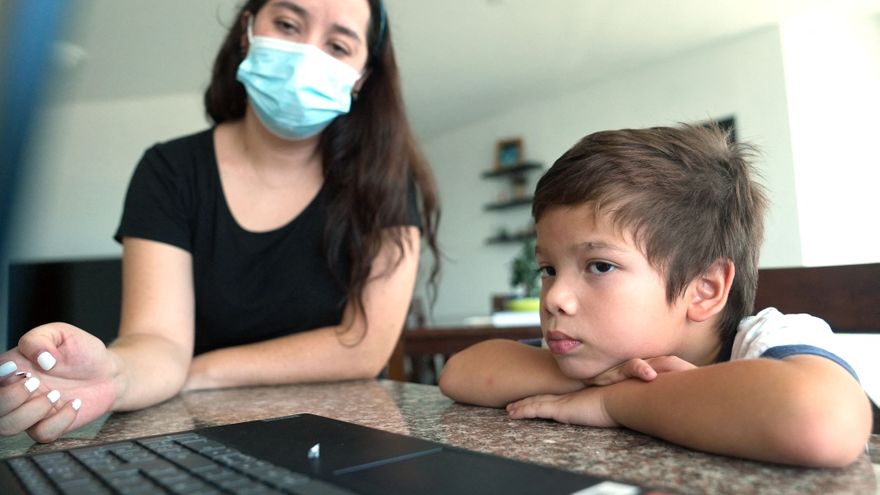
Ana María ayuda a su hijo Rafael, de cinco años, con sus clases virtuales

Prolonged School closings challenge the patience of parents and children in Panama

Yoselin was left without a nursery. Brithany is suspended from virtual classes. Rafael still resists studying in front of the computer while Santiago has a teacher at home, outside the formal system. In Panama, children, and their parents, suffer more and more with the prolonged closure of schools.

Érica Luna, a Nicaraguan immigrant, is 29 years old and the mother of Yoselin, 3. They live in the San Isidro neighborhood, on the outskirts of Panama City, where houses with zinc roofs emerge from the hills full of vegetation. Her husband works all day and she, due to the pandemic, stopped cleaning houses.

She chose to work in a market in the neighborhood. "The pandemic has transformed us a lot. I used to take the girl to a nursery, now it's not possible. There are times when I have to bring her here to the place where I work," she explains.

READ ALSO: Unicef: It's not possible that shopping centers are open but not Schools

Érica periodically collects material that the public nursery gives her. But Yoselin spends most of her time with her mother's cell phone, with a video game, until she falls asleep on a cardboard, at her mother's feet at the fruit stand.

Latin America is the region that has spent the longest time without face-to-face classes, according to Unicef. Panama, like Ecuador and Peru, still do not receive students in their schools in 2021.

According to Unicef, at least 3 million children in the region will never return to classrooms, after this prolonged closure that began in 2020, when the pandemic broke out. Keeping the closure this year will have serious consequences.

In Santa Rita, another suburban neighborhood, 8-year-old Brithany attends occasional virtual classes from her mother Milena Mendosa's prepaid cell phone, who sometimes has to leave the girl with a neighbor while she works in a market or cleaning houses.

Sometimes virtual classes are canceled. Others, the cell phone signal weakens and it becomes difficult to hear the lesson. Then I have to go out with my daughter, says Milena, a single mother.

I feel that it is an extra burden. They are giving too many brochures, they pressure one too much, I feel that it is something very difficult because it is one more job, Mendosa considers about the material she receives to deepen her daughter's education at home.

Panama has 4.2 million inhabitants and, according to official figures for 2021, some 890,000 are schoolchildren.

Panamanian Krystal Pérez is the mother living in Santiago. Detecting her son's boredom in front of a screen, she organized together with other mothers to remove them from private school and have a teacher teach them at home.

"That was what saved the education of our children, because 5, 6, 7 hours on the screen were not going to work for us," she explains, while his son attends the teacher with half a dozen children, in an apartment of a high-rise building in Punta Paitilla, in the urban area of ​​Panama City.

French Carolina Castillón, Leonor's mother, is also a member of this group. "We left the system at once. The school left us alone, there was no other option," she confesses.

In San Francisco, another urban neighborhood in the capital, Rafael, 5, is still part of the resistance and receives classes on the computer. But his mother, Ana María Areiza, won't take this much longer.

"I miss my son coming back from school telling me stories. He sees his friends on the computer and he doesn't recognize them. He no longer has to tell me," she confesses.

The child needs other humans to learn the behavior and qualities of the culture in which he lives. Not being with others delays the child and can generate behavior problems, explains pediatrician and neonatologist Enrique Ruidíaz.

Unicef ​​mentions studies that explain that schools are not the main contagion point for covid-19, and that with health measures, classes can restart.

It cannot be possible for restaurants to open, for shopping centers to open and for schools not to open, says Ruth Custode, specialist for Latin America at UNICEF in Panama.

The Minister of Education of Panama, Maruja Gorday, says that she "endorses" the call of Unicef ​​and that the reopening is near.

The reopening, expected in April, will be gradual, progressive and safe to the extent that we advance in vaccination and that the health authorities urge us to initiate a closer process, we are ready to do so, he explained to the AFP News.

Meanwhile, Brithany, who likes English and already knows how to count to 1,000, sums up the sentiment of her generation: "I want this to end."

Newsletter

Related Articles

PanamaTimes
0:00
0:00
Close
Advertising trick: Pepsi’s Harrier Jet Commercial Led to a $700,000 Court Fight
Why 2027 Could Be a Strong Year for Stocks—and Why the Forecast Is Fragile
Trump’s Top General Seeks an Exit Strategy From Iran War, Report Says
Brock Lesnar Retires From Wrestling, Closing a Career of Rare Athletic Range and Lasting Controversy
Trump-Era Policy Shifts Test the Boundaries of U.S. Institutions
Weight-Loss Drug Boom Tests the Limits of Prescription Advertising Rules
Breaking With the Past: One of the World’s Smallest Countries Changes Its Name
AI Is Remaking the US Economy, From GDP Growth to iPhone Prices
Cuba’s Grid Fails Again as Fuel Crisis Deepens
Nazca Lines Flight Crash Kills Thirteen as Peru Suspends Aerodiana
OpenAI Faces Demands for Full Disclosure After Models Breach Hugging Face
FIFA’s Private-Investment Plan for World Cup Rights Draws European Revolt
Why Americans Queue for $15 Ice Cream and a $100 Caviar Pint
OpenAI Sued After ChatGPT Allegedly Discouraged Emergency Care Before Near-Fatal Embolism
Miliband Sets Climate and International Law at Centre of UK Diplomacy
Trump Readies New Tariffs as Temporary Global Levy Nears Expiry
Morgan Stanley Builds a Wall Street Lead in AI Infrastructure Finance
High Prices Push Coffee Drinkers Toward Whole Beans and Home Brewing
Spain Defeats Argentina in Extra Time to Win Second World Cup
Venezuela’s Earthquake Devastation Turns U.S. Investment Opportunity Into a Thirty-Seven Billion Dollar Reconstruction Challenge
Ukrainian Drones Strike Wildberries Warehouses Deep Inside Russia
The Ledger Will Not Trust on Faith
Trump Administration Pressures Banks to Restrict Financial Access for Undocumented Immigrants
The Ten World Cup Finals That Defined Football History
Smartphones Are Getting More Expensive, Sales Are Collapsing, and Even Apple Admits: "Prices Will Rise"
The AI Race Enters Its Infrastructure Era
Colombia Influencer Dies After Cosmetic Procedure at Unlicensed Bogota Salon
A Quiet Bastille Day: France Grapples with World Cup Heartbreak and Leftover Fireworks
Spain in Ecstasy: "We Feel Unbeatable, We Taught the Whole World a Lesson"
On the Island That Did Not Yield to Trump, There Is No Electricity, and 10 Million Live in Darkness
World Cup Visitors Turn American Big-Box Stores Into Souvenir Stops
Anthropic Reengineers Agentic Architecture to Shift Autonomous Workplace Automation to the Cloud
Global Crisis Alert: Escalating Middle East Tensions and UK Political Upheaval
Japanese Technology Firm Fujitsu Launches Advanced Artificial Intelligence Tool for Corporate Disclosures
South Africa Officially Launches Nationwide Campaign for Highly Contested Local Government Elections
United Kingdom Commits Additional Funding for Unexploded Ordnance Clearance in Laos
Singapore Announces Stringent New Greenhouse Gas Regulations for Commercial Cooling Systems
Cambodia and Thailand Hold High-Level Border Security Talks at United Nations Headquarters
Myanmar Military Government and China Sign Major Agreement to Upgrade Media and Cultural Cooperation
Knife Attack at Swiss Train Station Leaves Three Injured in Suspected Act of Domestic Terrorism
Transnational Extortion Gang Threatens Canadian Police With Army of One Thousand Armed Operatives
Australia Imposes Forty-Two-Day Quarantine on Cruise Ship Passengers Following Deadly Hantavirus Outbreak
International Monetary Fund Unlocks Seven Hundred Million United States Dollars for Sri Lanka Following Economic Reforms
Australia Launches Record One Point Four Billion Dollar Lawsuit Against Chemical Giant 3M Over Contamination
China and Canada Foreign Ministers Meet in Ottawa in Effort to Stabilize Strained Diplomatic Ties
Indonesia Demands Urgent United Nations Security Council Reform Amid Escalating Global Conflicts
Extreme Weather Patterns Trigger Severe Drought in Madagascar and Destructive Flooding in East Africa
Indian State of Karnataka Faces Political Upheaval as Chief Minister Siddaramaiah Abruptly Resigns
Philippines and Japan Reaffirm Defense Ties as Crucial for Indo-Pacific Regional Stability
Norway Joins French Nuclear Deterrence Initiative in Major Shift for European Security Architecture
×