
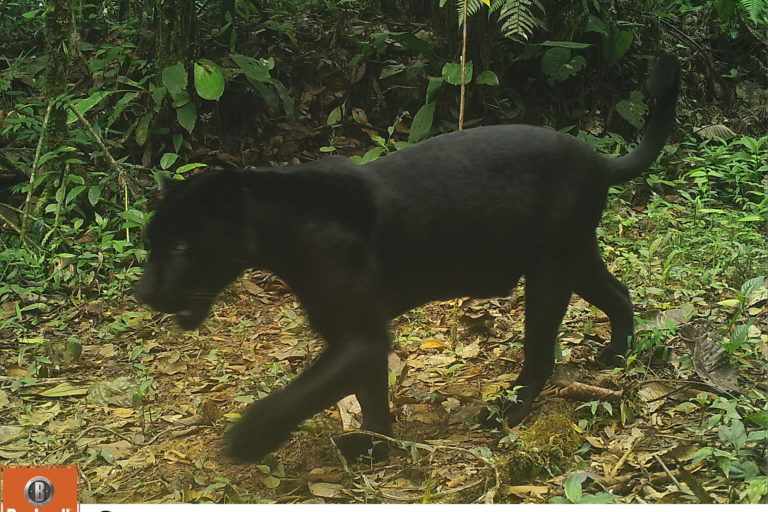
Rare black jaguars caught on camera in Panama
The camera trap that captured this video is one of 75 that have been installed in the Mamoní Valley by the Kaminando—Habitat Connectivity Initiative, which is leading a study on the habitat and ecology of the jaguar (Panthera onca). The project also aims to determine the density of the jaguar population in this part of the Isthmus of Panama.
The surprising roar of a jaguar can be heard in this camera trap video. Video courtesy of Kaminando—Habitat Connectivity Initiative.
But the jaguar’s roar is far from being the only surprising thing recorded by the camera traps. During the four years that these conserved forests in the Mamoní Valley have been monitored, two melanistic jaguars have been recorded on video. Melanism is a genetic variation in which the bodies of some individuals of certain species have more melanin, giving them a black color. In jaguars and leopards, such individuals are better known as black panthers.
Videos recorded by camera traps show a variety of wildlife. Video courtesy of Kaminando—Habitat Connectivity Initiative.
“Two melanistic jaguars have been documented in our study in Panama. Additionally, I know of another three records of melanistic jaguars that have been reported by biologists in the country,” says Kimberly Craighead, president and co-founder of Kaminando—Habitat Connectivity Initiative. The project spans more than 22,000 hectares (54,400 acres), about the size of metro Boston, including protected areas in the Mamoní Valley.
Studying melanistic jaguars
“Our hypothesis is that melanism occurs more frequently in humid forests. We have followed a female melanistic jaguar for several years. We believe that last year she had children and that one of them is melanistic,” Craighead says.
Since 2016, the camera traps installed by the Kaminando project have captured images of at least 15 individual jaguars. Video courtesy of Kaminando—Habitat Connectivity Initiative.
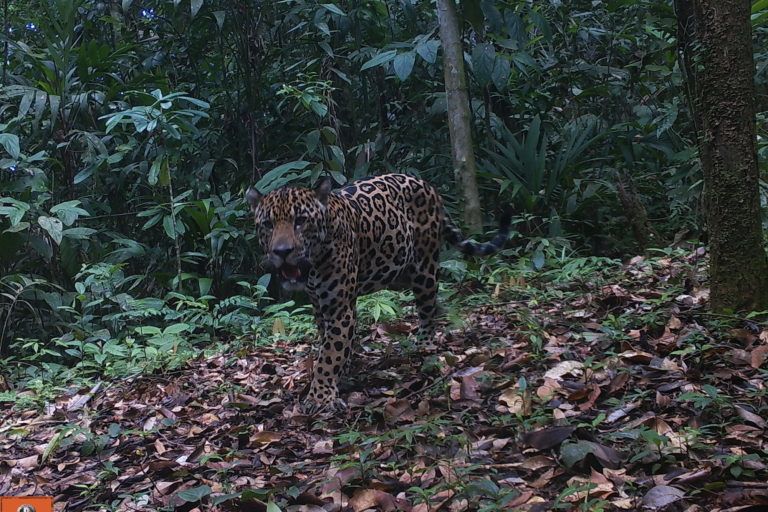
Since the project began in 2016, the camera traps have captured images of at least 15 individual jaguars. This number is important within Panama because, according to Craighead, this area of the country has a low density of the big cats.
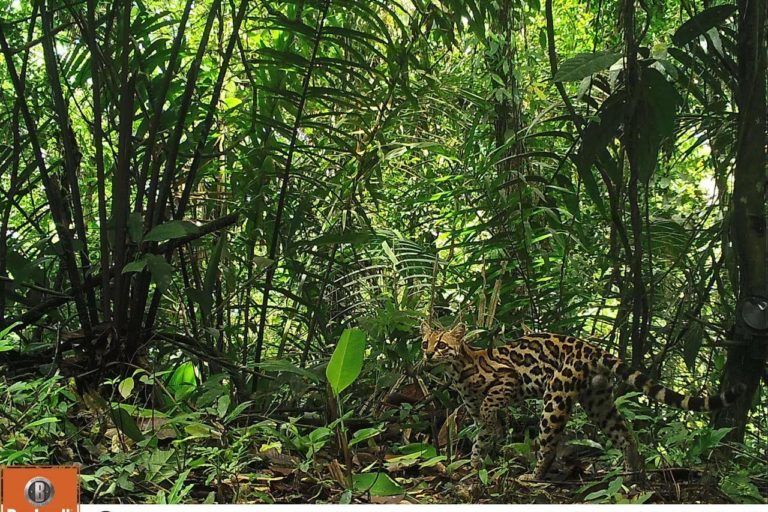 Other felines, such as the oncilla (Leopardus tigrinus), also live in
the Mamoní Valley Reserve. Image courtesy of Kaminando—Habitat
Connectivity Initiative.
Craighead says the habitat of jaguars in Panama is fragmented and that the species is exposed to illegal hunting and the trafficking of body parts. “Panama is not an exception to the threats,” she says.
Craighead and her Kaminando co-founder, Milton Yacelga, published the results of their camera trap observations in the IUCN’s Cat Specialist Group publication Cat News in 2019. The first of three key findings is that melanistic and non-melanistic jaguars move around within the same environment. One of the camera traps captured an image of two jaguars, one of them melanistic.
The camera traps have also captured images of other species living in the forests of Panama. Video courtesy of Kaminando—Habitat Connectivity Initiative.
The second finding is that non-melanistic jaguars are more active during the day, while melanistic jaguars appear more frequently at night. “[N]octurnal activity may have adaptive relevance in the cloud forest,” they wrote.
The third finding from Craighead and Yacelga’s observations is that melanistic jaguars don’t have a clear preference for a particular type of forest: both primary and secondary forests exist in the study area.
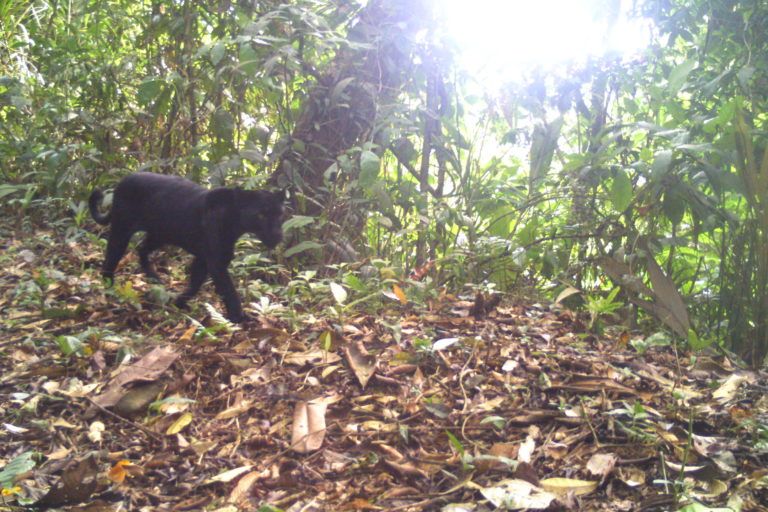
A final point in the study concludes that melanism is strongly associated with particular environmental factors, such as humidity, forest density, and temperature. Therefore, they posit, the distribution of melanism is not random.
José Luis Mena, director of the species initiative at the Wildlife Conservation Society (WCS) in Peru, says melanistic jaguars have also been found in Ecuador, Bolivia, Peru, Colombia and Costa Rica. “It is part of the genetic variability of jaguars. Melanism is a recessive genetic trait in jaguar populations, and it is present in several mammal species,” Mena says.
The puma is another big cat that lives in Panama. Video courtesy of Kaminando—Habitat Connectivity Initiative.
Mena also references a 2017 chapter by Brazilian researcher Lucas Gonçalves da Silva in the book Big Cats.
One of the conclusions of that study is that melanism in jaguars “was totally absent from open and periodically flooded landscapes.” In forested areas, however, melanistic jaguars were found to make up 10% of the population, according to the study.
The forests on the Isthmus of Panama are home to a high level of biodiversity. Video courtesy of Kaminando—Habitat Connectivity Initiative.
Gonçalves da Silva’s study points in a similar direction to that of Craighead and Yacelga. “The analyses of the environmental predictors suggest a relevant role for factors such as moisture and temperature. These observations support the hypothesis that melanism in big cats is not a neutral polymorphism (influenced by natural selection), leading to a nonrandom geographic distribution of this coloration phenotype,” the chapter concludes.
A forest filled with biodiversity
Gabriel Salazar has worked with the Kaminando project for three years and was one of the people responsible for installing the camera traps in the Mamoní Valley. On more than one occasion, he has seen the wild cats that inhabit the forest. His most vivid memory is of a particular night when, while camping in the forest and accompanying a scientist, he found himself in front of a jaguar that was observing him.
Tayras walk in front of a camera trap. Video courtesy of Kaminando—Habitat Connectivity Initiative.
“That night, we were searching for frogs when I heard a slight noise. I turned on my flashlight and there it was: a big jaguar on a rock, staring at me intently,” Salazar says. “I started to call the professor; I wanted him to take photos. He was petrified and told me to get away, and that the jaguar was going to get me. But I kept watching it; several minutes had already passed before the professor realized what was happening. If it had wanted to attack me, it would have done so from the start.”
Salazar has come across other wild cats while walking through the forests of Panama, where he is now a tour guide. He had an equally close encounter with a puma (Puma concolor), which he followed on foot for about 50 meters (164 feet). “Every time I stopped, the puma also stopped walking,” Salazar says.
Five feline species inhabit the forests on the Isthmus of Panama. Video courtesy of Kaminando—Habitat Connectivity Initiative.
Salazar says he has learned to live alongside the animals, but before installing the camera traps, he was afraid of big cats. “Our grandparents told us that the jaguars and pumas could eat us, but when I started to live with them, I realized that was a lie. They do not attack,” he says.
In addition to the big cats, Salazar has also seen anteaters, tapirs, and peccaries. He has only seen melanistic jaguars in images obtained by the camera traps. “Once, three jaguars went past, one after another. There was a female jaguar in front and the other two were behind her; one of them was melanistic,” Salazar says, referring to a captured image.
Little information exists about the jaguars of Panama. Video courtesy of Kaminando—Habitat Connectivity Initiative.
“We have studied the greater part of Mamoní Valley, which is approximately 11,700 hectares [about 28,900 acres]. Currently, there are 75 camera stations, and so far, we have identified 15 jaguars, which includes resident and migrant animals,” Craighead says.
The camera traps involved in the Kaminando project have captured images of 31 species of wild mammals in this area of Panama. Video courtesy of Kaminando—Habitat Connectivity Initiative.
The Kaminando project’s camera traps have registered five species of wild cats found in Panama — jaguar, puma, ocelot (Leopardus pardalis), margay (Leopardus wiedii) and jaguarondi (Herpailurus yagouaroundi) — in addition to 31 species of wild mammals.
Craighead says the Kaminando research aims to explain how elements of the landscape influence the presence, dispersion, and density of the jaguars. All of this abundance is surrounded by highly degraded areas. “There is a lot of pressure from human activity in the area adjacent to our study location,” Craighead says.
External pressures put at risk the habitat of the jaguar and other species in Panama’s forests. Video courtesy of Kaminando—Habitat Connectivity Initiative.
“Panama is a country with a lot of commercial activity and many roads, and a consequence of that is the loss of the jaguars’ habitat,” says Mena, who also heads the Department of Zoology at the Vera Alleman Haeghebaert Museum of Natural History at Ricardo Palma University in Peru.
Mena says there are at least four subpopulations of jaguars in Panama, one of which lives on the border with Costa Rica. “Panama is one of the countries with a critically threatened jaguar population,” he says. He adds that in Central America, there are several concentrated jaguar populations, which is why he encourages cross-border efforts to conserve the species.
Citations:
Yacelga, M., & Craighead, K. (2019). Filling the gap — Melanistic jaguars in Panamá. Cat News, 70, 39-41.
Da Silva, L. G. (2017). Ecology and evolution of melanism in big cats: Case study with black leopards and jaguars. Big Cats. doi:10.5772/intechopen.69558
Banner image of a melanistic jaguar in Panama, courtesy of Kaminando—Habitat Connectivity Initiative.
This article was first reported by Mongabay’s Latam team and published here on our Latam site on Nov. 26, 2020.