PanamaTimes

Saturday, Oct 24, 2026

Retail sales plunge as consumer confidence 'nears financial crisis all-time low'

Retail sales plunge as consumer confidence 'nears financial crisis all-time low'

The data, coupled with a closely-watched reading of consumer confidence, prompts a dive in the value of the pound and places the Bank of England in a tricky position as it decides whether to hike interest rates for a fourth consecutive time.

The pound has fallen sharply after several pieces of data raised fears of a slump ahead for UK economic growth, driven by surging inflation.

The market mood turned ugly when the Office for National Statistics (ONS) reported a 1.4% monthly decline in retail sales in March, led by a big drop in demand for online purchases.

There was little sign for optimism among retailers, except for the owners of garden centres and DIY shops, though the data did suggest that COVID-weary consumers shifted discretionary spending towards hospitality and attractions instead as the weather improved.

Economists had expected a 0.3% decline in sales month-on-month - and sterling dived by more than 1.5 cents against the dollar, to an 18-month low of $1.28, as investors fretted over the prospects for economic growth ahead.
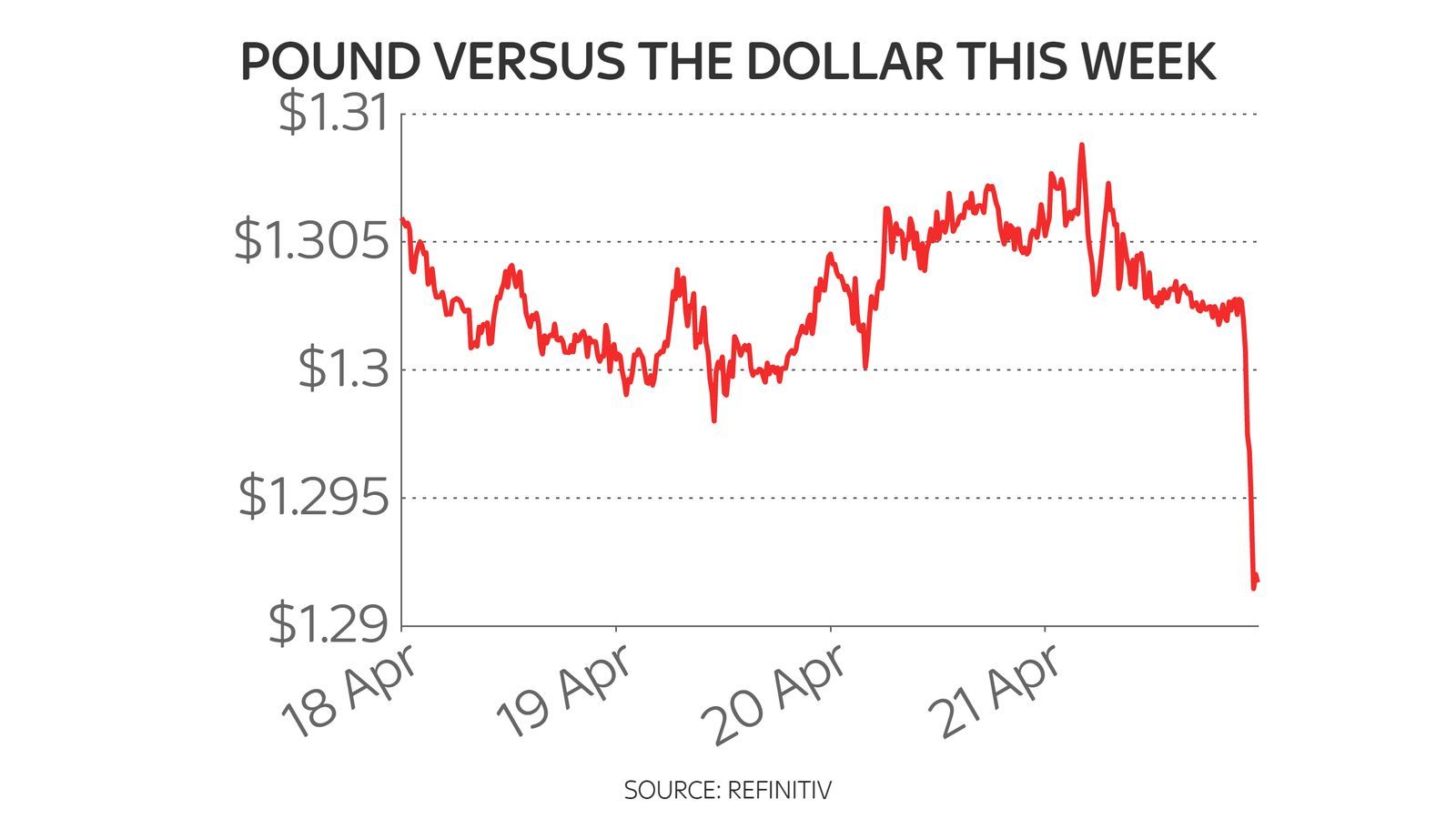

The UK currency was also more than one cent off against the euro.

Adding to the gloom was data from a survey of purchasing managers showing the slowest rise in private sector output for three months in April - with record inflationary pressures and war in Ukraine hitting demand.

A closely-watched measure of consumer confidence, also covering April, delivered its second-lowest reading since records began nearly 50 years ago.

It suggests that consumer spending, the biggest contributor to the UK's GDP, is at risk of being choked off as families fret over rising bills for everyday goods and services.

ONS Director of Economic Statistics Darren Morgan said of the retails sales data: "Retail sales fell back notably in March with rises in the cost of living hitting consumers' spending.

"Online sales were hit particularly hard due to lower levels of discretionary spending.

"Fuel sales also fell substantially, with evidence suggesting some people reduced non-essential journeys, following record high petrol prices, while food sales continued to fall, dropping for the fifth consecutive month."

It all makes for worrying reading at the Bank of England.

The GfK consumer confidence index, derived from a survey, came in at -38 - worse than economists had expected and just shy of the all-time low seen in 2008 as the global financial crisis was gathering pace.

The responses were registered at a time when we learned that inflation had hit a 30-year high of 7%.

It is forecast by the Office for Budget Responsibility to climb above 9% after the unprecedented surge in the energy price cap in April - and rises in other household bills such as mobile, water and broadband are reflected in the calculations.

The price cap is currently expected to rise further - by up to £500 - in October when the additional effects of Russia's invasion of Ukraine are included, while the retail sector expects price rises to intensify throughout 2022.

GfK reported a sharp decrease in consumers' intentions to make major purchases.

All the data will be taken into account by rate-setters at the Bank, who have signalled more caution on rising rates ahead after lifting Bank rate to 0.75% at their last meeting.

They will be anxious not to choke off economic growth through rising interest rates, which are intended to stop rising inflation expectations, such as wage hikes, rather than rising prices as the inflation has been caused by factors outside their control including energy and food costs.

Inflation, while not demand-led, is nevertheless proving more sticky and persistent than policymakers had expected and financial markets still forecast a 0.25% rate hike at the next meeting of the monetary policy committee in two weeks' time.

That is because the inflationary fires have been stoked by Russia's war against Ukraine.

However, Bank governor Andrew Bailey admitted on Thursday that policymakers were walking a tight line between tackling inflation and avoiding recession.

That is because raising borrowing costs to help ease inflationary pressures could prove counterproductive with millions of mortgage holders - those on tracker or standard variable deals - already paying more.

Russ Mould, investment director at AJ Bell, said of the situation: "The ONS' retail sales data is a wake-up call that life is going to be tough for shops - virtual or physical - in the coming months.

"Once those vastly increased energy bills hit the doormat and households take time to reassess their financial situation, there is every chance that retail sales could get even worse," he wrote.

Newsletter

Related Articles

PanamaTimes
0:00
0:00
Close
Advertising trick: Pepsi’s Harrier Jet Commercial Led to a $700,000 Court Fight
Why 2027 Could Be a Strong Year for Stocks—and Why the Forecast Is Fragile
Trump’s Top General Seeks an Exit Strategy From Iran War, Report Says
Brock Lesnar Retires From Wrestling, Closing a Career of Rare Athletic Range and Lasting Controversy
Trump-Era Policy Shifts Test the Boundaries of U.S. Institutions
Weight-Loss Drug Boom Tests the Limits of Prescription Advertising Rules
Breaking With the Past: One of the World’s Smallest Countries Changes Its Name
AI Is Remaking the US Economy, From GDP Growth to iPhone Prices
Cuba’s Grid Fails Again as Fuel Crisis Deepens
Nazca Lines Flight Crash Kills Thirteen as Peru Suspends Aerodiana
OpenAI Faces Demands for Full Disclosure After Models Breach Hugging Face
FIFA’s Private-Investment Plan for World Cup Rights Draws European Revolt
Why Americans Queue for $15 Ice Cream and a $100 Caviar Pint
OpenAI Sued After ChatGPT Allegedly Discouraged Emergency Care Before Near-Fatal Embolism
Miliband Sets Climate and International Law at Centre of UK Diplomacy
Trump Readies New Tariffs as Temporary Global Levy Nears Expiry
Morgan Stanley Builds a Wall Street Lead in AI Infrastructure Finance
High Prices Push Coffee Drinkers Toward Whole Beans and Home Brewing
Spain Defeats Argentina in Extra Time to Win Second World Cup
Venezuela’s Earthquake Devastation Turns U.S. Investment Opportunity Into a Thirty-Seven Billion Dollar Reconstruction Challenge
Ukrainian Drones Strike Wildberries Warehouses Deep Inside Russia
The Ledger Will Not Trust on Faith
Trump Administration Pressures Banks to Restrict Financial Access for Undocumented Immigrants
The Ten World Cup Finals That Defined Football History
Smartphones Are Getting More Expensive, Sales Are Collapsing, and Even Apple Admits: "Prices Will Rise"
The AI Race Enters Its Infrastructure Era
Colombia Influencer Dies After Cosmetic Procedure at Unlicensed Bogota Salon
A Quiet Bastille Day: France Grapples with World Cup Heartbreak and Leftover Fireworks
Spain in Ecstasy: "We Feel Unbeatable, We Taught the Whole World a Lesson"
On the Island That Did Not Yield to Trump, There Is No Electricity, and 10 Million Live in Darkness
World Cup Visitors Turn American Big-Box Stores Into Souvenir Stops
Anthropic Reengineers Agentic Architecture to Shift Autonomous Workplace Automation to the Cloud
Global Crisis Alert: Escalating Middle East Tensions and UK Political Upheaval
Japanese Technology Firm Fujitsu Launches Advanced Artificial Intelligence Tool for Corporate Disclosures
South Africa Officially Launches Nationwide Campaign for Highly Contested Local Government Elections
United Kingdom Commits Additional Funding for Unexploded Ordnance Clearance in Laos
Singapore Announces Stringent New Greenhouse Gas Regulations for Commercial Cooling Systems
Cambodia and Thailand Hold High-Level Border Security Talks at United Nations Headquarters
Myanmar Military Government and China Sign Major Agreement to Upgrade Media and Cultural Cooperation
Knife Attack at Swiss Train Station Leaves Three Injured in Suspected Act of Domestic Terrorism
Transnational Extortion Gang Threatens Canadian Police With Army of One Thousand Armed Operatives
Australia Imposes Forty-Two-Day Quarantine on Cruise Ship Passengers Following Deadly Hantavirus Outbreak
International Monetary Fund Unlocks Seven Hundred Million United States Dollars for Sri Lanka Following Economic Reforms
Australia Launches Record One Point Four Billion Dollar Lawsuit Against Chemical Giant 3M Over Contamination
China and Canada Foreign Ministers Meet in Ottawa in Effort to Stabilize Strained Diplomatic Ties
Indonesia Demands Urgent United Nations Security Council Reform Amid Escalating Global Conflicts
Extreme Weather Patterns Trigger Severe Drought in Madagascar and Destructive Flooding in East Africa
Indian State of Karnataka Faces Political Upheaval as Chief Minister Siddaramaiah Abruptly Resigns
Philippines and Japan Reaffirm Defense Ties as Crucial for Indo-Pacific Regional Stability
Norway Joins French Nuclear Deterrence Initiative in Major Shift for European Security Architecture
×