PanamaTimes

Thursday, Oct 29, 2026

Scientists Warn Sex Tourists Against Doing It on Canary Islands Dunes Due to Heavy Impact on Nature

Scientists Warn Sex Tourists Against Doing It on Canary Islands Dunes Due to Heavy Impact on Nature

The dunes, which cover over 1,000 acres (4 sq km) of the island off the coast of Africa, have been preserved as a nature reserve since 1987 and are regarded as one of Spain's finest natural assets.

Tourists, mainly from the UK, US and Germany, should avoid having sex with strangers on Gran Canaria's famous sand dunes behind the bushes because of the detrimental effect on the landscape, new research by the Beach and Dune Systems (BEADS) Laboratory of Flinders University and the Group of Physical Geography and Environment of the Institute of Oceanography and Global Change (IOCAG-ULPGC) revealed.

According to the research, so many individuals visit the Canary Islands to engage in unlawful open-air sex on the dunes that uncommon species and bushes are being wiped out. The researchers have found nearly 300 favorite spots, especially among gay tourists, on the enormous expanse of sand on the island's south side.
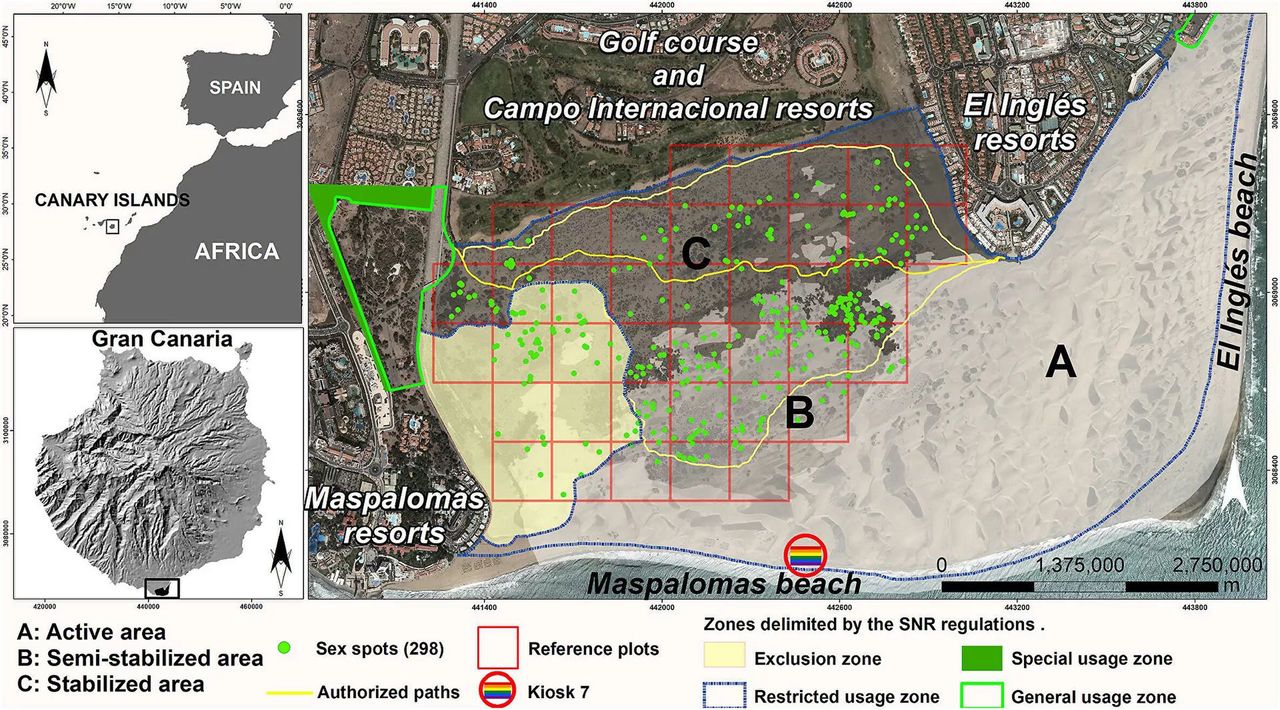
Fig. 1. Study area. Location of the sex spots (green points) on referenced plots used for fieldwork (red array), mainly located in the stabilized (C) and semi-stabilized (B) areas of the dunefield, kiosk 7 (red circle), authorized paths (yellow lines) and usage zones delimited by the DMSNR regulations.


Researchers have been doing a thorough investigation regarding the impact of so-called "cruising," which entails anonymous sexual encounters in public areas, and in this case, on the dunes, and came to the conclusion that intercourse had a direct impact on the dunes as well as eight native plant species, three of which are endemic.

The findings were published in a study titled "The Five S's: Sand, Sun, Sea, and Sex with Strangers." The researchers add out that dunes and coastal beaches are examples of open public settings where these sexual acts are extensively practiced, to the point where they've been labeled as the 'Four S' by the paper (sand, sun, sea and sex).

All of the sites where sexual encounters occurred were found and recorded by the specialists. Further, they gathered data on the size and internal distribution of these areas, as well as the type of sexual activity, their location, the vegetation coverage and type, and the environmental repercussions or lack of management efforts.

According to the study, the overall space occupied by the 298 sexual meeting sites is 5,763.85 m2. These sex locations are linked to the protected area's distance from authorized trails, the existence of dense forest, and vegetation-stabilized dunes (nebkhas). The larger the location, the higher the number of individuals who use it, as well as the likelihood that it is a low-lying location with little vegetation and a lot of trash.
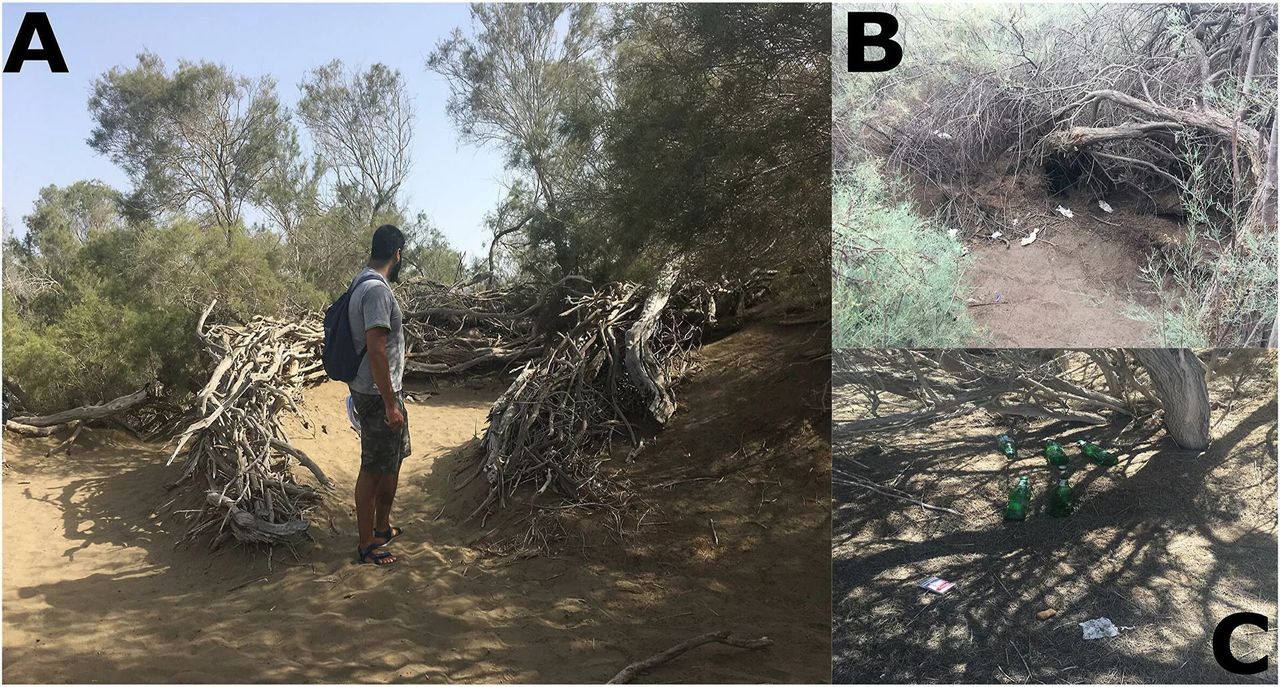
Fig. 6. Cut vegetation and waste associated with the cruising activity in the sex spots. A. Sex spot example built using native (protected) vegetation cut down to build a ‘nest’ B. Toilet spot next to a sex spot and waste. C. Waste inside a sex spot.


The researchers noted, however, that Maspalomas is not the only coastal dune area in the world that records this type of activity, since similar sites can be found in Australia, France, and Portugal, among other places.

According to the paper, on a practical level, between September 2018 and July 2019, the people who engage in public sex in the Reserve area eradicated 159 of these points and removed, uprooted, and killed 1,244.49 m3 of dry vegetation.

Interestingly, the authors stated that they had no intention of offending the LGBTQ community, and that Gran Canaria has been hospitable to homosexual tourists from all over the world for years, especially for those from the UK, the US, and Germany, who are rather frequent guests on the island.

The stated aim of the research is to provide a better understanding of how "cruising" on the dunes may be managed and the environment safeguarded at a time when environmental concerns are so pressing.

Newsletter

Related Articles

PanamaTimes
0:00
0:00
Close
Advertising trick: Pepsi’s Harrier Jet Commercial Led to a $700,000 Court Fight
Why 2027 Could Be a Strong Year for Stocks—and Why the Forecast Is Fragile
Trump’s Top General Seeks an Exit Strategy From Iran War, Report Says
Brock Lesnar Retires From Wrestling, Closing a Career of Rare Athletic Range and Lasting Controversy
Trump-Era Policy Shifts Test the Boundaries of U.S. Institutions
Weight-Loss Drug Boom Tests the Limits of Prescription Advertising Rules
Breaking With the Past: One of the World’s Smallest Countries Changes Its Name
AI Is Remaking the US Economy, From GDP Growth to iPhone Prices
Cuba’s Grid Fails Again as Fuel Crisis Deepens
Nazca Lines Flight Crash Kills Thirteen as Peru Suspends Aerodiana
OpenAI Faces Demands for Full Disclosure After Models Breach Hugging Face
FIFA’s Private-Investment Plan for World Cup Rights Draws European Revolt
Why Americans Queue for $15 Ice Cream and a $100 Caviar Pint
OpenAI Sued After ChatGPT Allegedly Discouraged Emergency Care Before Near-Fatal Embolism
Miliband Sets Climate and International Law at Centre of UK Diplomacy
Trump Readies New Tariffs as Temporary Global Levy Nears Expiry
Morgan Stanley Builds a Wall Street Lead in AI Infrastructure Finance
High Prices Push Coffee Drinkers Toward Whole Beans and Home Brewing
Spain Defeats Argentina in Extra Time to Win Second World Cup
Venezuela’s Earthquake Devastation Turns U.S. Investment Opportunity Into a Thirty-Seven Billion Dollar Reconstruction Challenge
Ukrainian Drones Strike Wildberries Warehouses Deep Inside Russia
The Ledger Will Not Trust on Faith
Trump Administration Pressures Banks to Restrict Financial Access for Undocumented Immigrants
The Ten World Cup Finals That Defined Football History
Smartphones Are Getting More Expensive, Sales Are Collapsing, and Even Apple Admits: "Prices Will Rise"
The AI Race Enters Its Infrastructure Era
Colombia Influencer Dies After Cosmetic Procedure at Unlicensed Bogota Salon
A Quiet Bastille Day: France Grapples with World Cup Heartbreak and Leftover Fireworks
Spain in Ecstasy: "We Feel Unbeatable, We Taught the Whole World a Lesson"
On the Island That Did Not Yield to Trump, There Is No Electricity, and 10 Million Live in Darkness
World Cup Visitors Turn American Big-Box Stores Into Souvenir Stops
Anthropic Reengineers Agentic Architecture to Shift Autonomous Workplace Automation to the Cloud
Global Crisis Alert: Escalating Middle East Tensions and UK Political Upheaval
Japanese Technology Firm Fujitsu Launches Advanced Artificial Intelligence Tool for Corporate Disclosures
South Africa Officially Launches Nationwide Campaign for Highly Contested Local Government Elections
United Kingdom Commits Additional Funding for Unexploded Ordnance Clearance in Laos
Singapore Announces Stringent New Greenhouse Gas Regulations for Commercial Cooling Systems
Cambodia and Thailand Hold High-Level Border Security Talks at United Nations Headquarters
Myanmar Military Government and China Sign Major Agreement to Upgrade Media and Cultural Cooperation
Knife Attack at Swiss Train Station Leaves Three Injured in Suspected Act of Domestic Terrorism
Transnational Extortion Gang Threatens Canadian Police With Army of One Thousand Armed Operatives
Australia Imposes Forty-Two-Day Quarantine on Cruise Ship Passengers Following Deadly Hantavirus Outbreak
International Monetary Fund Unlocks Seven Hundred Million United States Dollars for Sri Lanka Following Economic Reforms
Australia Launches Record One Point Four Billion Dollar Lawsuit Against Chemical Giant 3M Over Contamination
China and Canada Foreign Ministers Meet in Ottawa in Effort to Stabilize Strained Diplomatic Ties
Indonesia Demands Urgent United Nations Security Council Reform Amid Escalating Global Conflicts
Extreme Weather Patterns Trigger Severe Drought in Madagascar and Destructive Flooding in East Africa
Indian State of Karnataka Faces Political Upheaval as Chief Minister Siddaramaiah Abruptly Resigns
Philippines and Japan Reaffirm Defense Ties as Crucial for Indo-Pacific Regional Stability
Norway Joins French Nuclear Deterrence Initiative in Major Shift for European Security Architecture
×