

Some masks offer far less coronavirus protection than others. Bandanas, scarves, and shields do an especially bad job.
Wearing a face mask has never been more necessary: The US's weekly average of coronavirus cases has reached an all-time high of more than 172,000 per day. Hospitalizations are also peaking at a weekly average of nearly 85,000 per day.
A model from the University of Washington's Institute for Health Metrics and Evaluation predicts that around 212,000 more people could die of COVID-19 from now until March. But if 95% of the country were to wear masks, the model shows, roughly 65,000 of those lives could be spared.
That estimate is based on research from 41 scientific papers, which together suggest that cloth masks — whether homemade or commercially manufactured — can reduce respiratory virus infections among mask-wearers by one-third relative to those without masks.
Indeed, the Centers for Disease Control and Prevention recently updated its guidelines to note that masks offer some protection for the wearer as well as those around you.
"If you're not wearing a mask, if you're not protecting yourself from droplet transmission, you are becoming part of the potential chain of transmission," Rachel Graham, an assistant epidemiology professor at The University of North Carolina at Chapel Hill, told Business Insider.
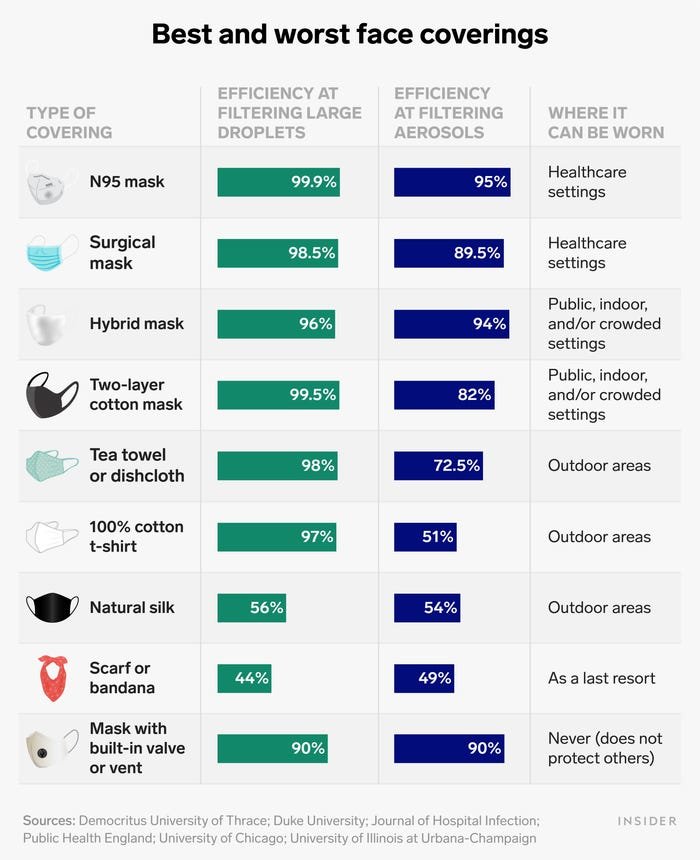
But some face coverings, especially bandanas or scarves, aren't great at filtering respiratory particles. Masks with one-way valves, meanwhile, do a poor job of protecting other,s since they can can expel infectious particles into the surrounding air. That's why the CDC cautions people not to wear them.
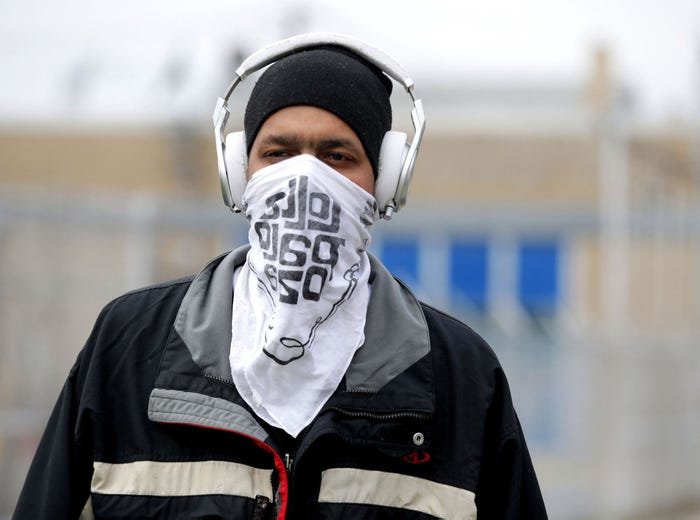
Avoid bandanas and scarves whenever possible
Bandanas and scarves have performed poorly in multiple studies.
In September, Duke researchers found that bandanas reduced the rate of respiratory droplet transmission by a factor of two during normal speech. That makes them less protective than most other materials, including homemade cotton masks.
A June study published in the Journal of Hospital Infection similarly found that a scarf reduced a person's infection risk by 44% after they shared a room with an infected person for 30 seconds. After a full 20 minutes of exposure, the scarf only reduced infection risk by 24%.
The reason is no surprise: Bandanas and scarves aren't tightly sealed around the nose and mouth. That means respiratory droplets can leak out the top or bottom and go on to infect another person.
"Snug-fitting masks made of cotton-polyester blends will generally offer more protection," Scott Gottlieb, the former head of the FDA, recently wrote in The Wall Street Journal. "But even a very good cloth mask may only be about 30% protective; scarf or bandanna, 10% or less."
Face shields aren't a replacement for masks
Face shields can offer a false sense of security. After a July outbreak at a hotel in Switzerland, health officials found that the only people who got sick had worn plastic face shields. Those who wore masks or a combination of a mask and shield were not infected.
The CDC also says face shields aren't a substitute for cloth masks.
"Face shields have large gaps below and alongside the face, where your respiratory droplets may escape and reach others around you," the agency's website reads. "At this time, we do not know how much protection a face shield provides to people around you."

But wearing a shield along with a mask could help protect your eyes. Eyes aren't the main source of coronavirus transmission — people usually get infected via droplets that enter their nose or mouth — the virus can enter the body through any mucous membrane.
A June review in The Lancet found that when it comes to preventing coronavirus transmission, "eye protection is typically under-considered and can be effective in community settings."
Single-layer masks aren't ideal, either
The World Health Organization recommends fabric masks with three layers: an inner layer that absorbs, a middle layer that filters, and an outer layer made from a nonabsorbent material like polyester.
Even two layers are more protective than just one. Studies have shown that face coverings made from a single cotton T-shirt are far less protective than masks with multiple layers. Fabrics that aren't tightly woven — such as dishcloths, tea towels, or any knitted material — can also allow virus droplets to pass in and out.
"If a cloth mask is all you can find, buy a thick one," Gottlieb recommended.
Still, any mask is better than none. Some research even suggests that face masks may help reduce viral inoculum: the dose of virus that people ingest or inhale. When people are exposed to a lower dose, it's possible that their immune system might not react as aggressively, resulting in milder symptoms, according to research from Wayne State University.
In September, CDC Director Robert Redfield called face masks "the most important, powerful public health tool we have."