

Supreme Court's decision in abortion case will affect dozens of states beyond Mississippi
But the owner of the Desert Star Family Planning clinic in Arizona knows the drama unfolding at the Supreme Court over Mississippi’s ban on most abortions after 15 weeks of pregnancy could have immediate consequences for her practice as well.
"With the court's current composition, I am very concerned," said Taylor, an OB-GYN, noting the 6-3 conservative advantage on the high court. "Abortion would be outlawed in Arizona if we lost Roe v. Wade, and I don't think people understand that."
The Supreme Court will hear arguments Wednesday in a major challenge to Mississippi’s 15-week ban. The justices' decision could quickly involve other conservative states that have approved abortion bans in anticipation of a ruling.
Nine states, including Alabama, Arizona, Wisconsin and West Virginia, put abortion bans in place before the Supreme Court established a constitutional right to the procedure in its Roe v. Wade decision in 1973, according to the Guttmacher Institute, a research group that supports abortion rights. An additional eight states, including Idaho, Kentucky and Tennessee, approved "trigger bans" to criminalize the procedure if the court overturns Roe.
Four states, Arkansas, Mississippi, Oklahoma and Texas, have both a pre-Roe ban and a trigger ban on the books, according to Guttmacher.
Exactly how and when those laws would take effect varies by state and will depend a great deal on how the Supreme Court rules. A decision to uphold Mississippi’s 15-week ban but to leave in place the constitutional right to abortion, for instance, would almost certainly create confusion, a flood of lawsuits and legislation, experts said.
"You have to think that these trigger laws will trigger, so to speak, to the extent that there's some ambiguity about the court’s decision,” said Neal Devins, a law professor at William & Mary Law School.
A USA TODAY review of the trigger laws found the potential for ambiguity. Several states permit attorneys general to make a determination about whether the Supreme Court has overruled Roe v. Wade. Missouri permits the governor or the state Legislature, through a vote, to make that determination. Utah permits lawyers for the state Legislature to decide exactly what it is the high court has ruled.
Because the Supreme Court's decision may be something less clear than a black-or-white decision that overrules or upholds Roe, that could leave leeway for officials.
Eight of the trigger laws were approved in 2019 after the Senate confirmed President Donald Trump’s second nominee to the Supreme Court, Associate Justice Brett Kavanaugh. That corresponds with a broader push by conservative states to enact laws restricting the procedure to test the court’s commitment to Roe.
Roe established the right to obtain an abortion through the end of the second trimester, or roughly by the end of the 26th week of pregnancy. A subsequent decision in 1992 ended the trimester framework and ruled people could obtain an abortion until viability, the point when a fetus can survive outside the womb or about 24 weeks.
Roughly half of states have approved laws shortening that 24-week timeframe, most of which have been struck down by lower federal courts. Texas banned most abortions after six weeks of pregnancy – a law that has prompted two challenges pending at the Supreme Court.
Like Mississippi, lawmakers in Louisiana approved a ban on abortion after 15 weeks. Arkansas and Utah approved bans at 18 weeks.
Tennessee and Missouri approved "cascading" bans that attempt to prohibit abortions in two- or four-week increments.
Hillary Schneller, a senior staff attorney at the Center for Reproductive Rights, which represents the clinic in the Mississippi case, said the laws underscore the "kitchen sink approach" that many conservative states take.
"The ultimate goal is just to ban abortion at any point or entirely," she said.
At least 14 states, including California, New York and Illinois, have approved laws protecting the right to abortion. A ruling overturning Roe would create different levels of access depending on the state.
That could be the case even if the Supreme Court doesn't overturn Roe. If the justices uphold Mississippi's law without ruling on whether the constitutional right to an abortion should be nullified, conservative state legislatures will almost certainly move with speed to adopt their own 15-week bans, experts said.
"If they uphold 15 weeks on its face and say that's the new standard, I think we'll see states pass 15-week limits," said Mallory Quigley with the anti-abortion group Susan B. Anthony List. "I think we'll continue to see pro-life advocates and lawmakers at the state level challenge whatever the status quo is going to be."
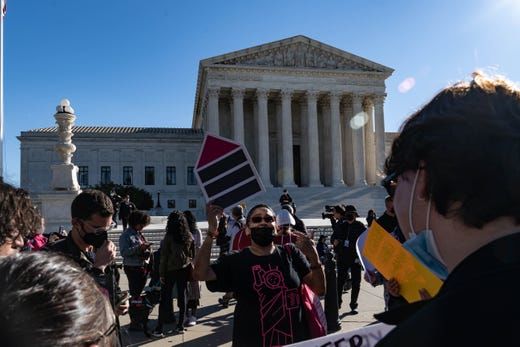 Demonstrators gather outside the Supreme Court on Nov. 1,
2021, as justices hear arguments related to SB-8, the controversial
Texas abortion law limiting procedures to the first six weeks of
pregnancy, and empowering citizens to enforce the law against one
another.
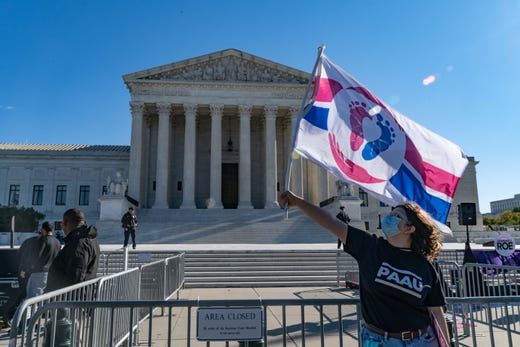 Sonja Morin, 19, of Massachusetts, waves a flag while
protesting with a group called the Progressive Anti-Abortion Uprising
outside the Supreme Court on Nov. 1, 2021, as justices hear arguments
related to SB-8, the controversial Texas abortion law limiting
procedures to the first six weeks of pregnancy.
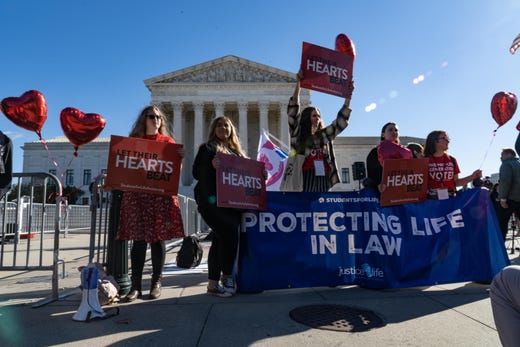 Students for Life Action protest outside the Supreme Court
on Nov. 1, 2021, as justices hear arguments related to SB-8, the
controversial Texas abortion law limiting procedures to the first six
weeks of pregnancy.
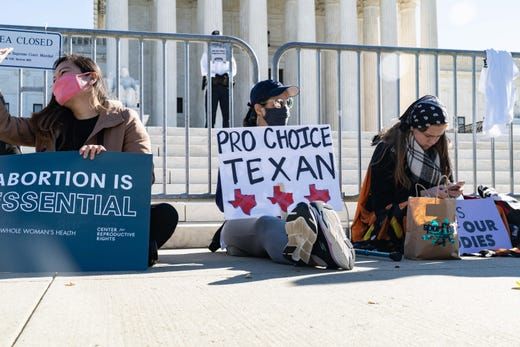 Demonstrators gather outside the Supreme Court on Nov. 1,
2021, as justices hear arguments related to SB-8, the controversial
Texas abortion law limiting procedures to the first six weeks of
pregnancy, and empowering citizens to enforce the law against one
another.
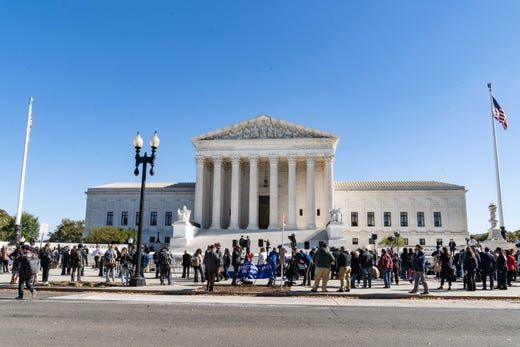 Demonstrators gather outside the Supreme Court on Nov. 1,
2021, as justices hear arguments related to SB-8, the controversial
Texas abortion law limiting procedures to the first six weeks of
pregnancy, and empowering citizens to enforce the law against one
another.
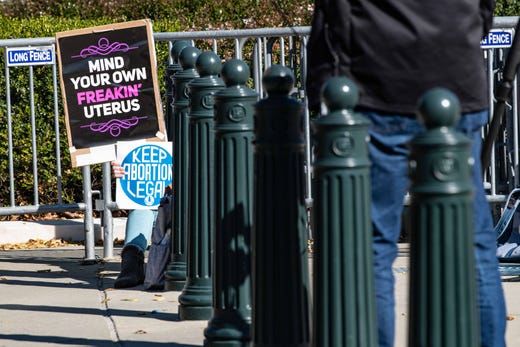 Demonstrators gather outside the Supreme Court as justices hear arguments related to SB-8.
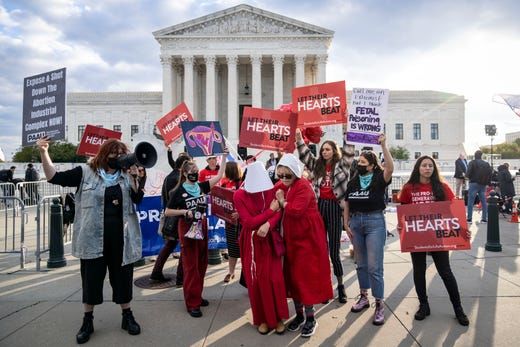 Two pro-choice demonstrators are surrounded by anti-abortion
demonstrators outside the U.S. Supreme Court on Nov. 01, 2021 in
Washington, DC. On Monday, the Supreme Court is hearing arguments in a
challenge to the controversial Texas abortion law which bans abortions
after 6 weeks.
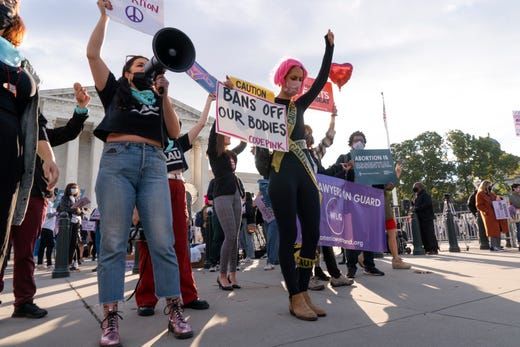 Demonstrators on both sides of the abortion divide rally
outside the Supreme Court on Nov. 1 as arguments are set to begin over
state restrictions on the procedure.
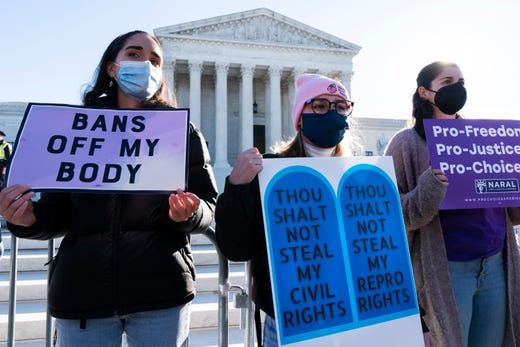 Pro-choice rally outside the Supreme Court on Nov. 1, 2021.
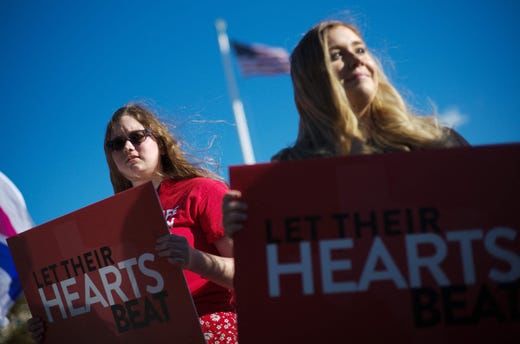 Anti-abortion demonstrators are seen outside of the US Supreme Court in Washington, DC on November 1, 2021.
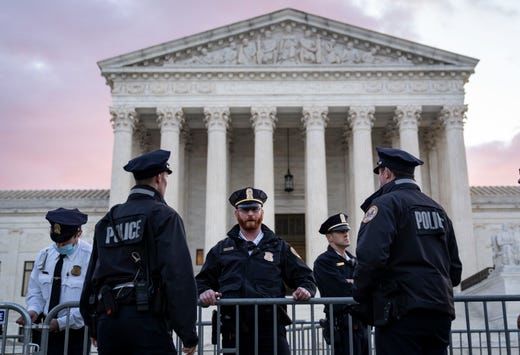 Supreme Court Police officers set up security barricades
outside the U.S. Supreme Court on Monday morning Nov. 1, 2021 in
Washington, DC.
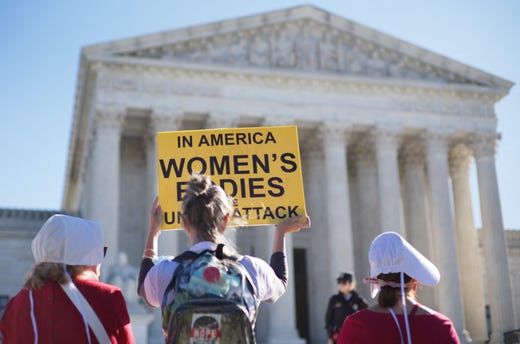 Pro-choice demonstrators are seen outside of the US Supreme Court in Washington, DC on Nov. 1, 2021.
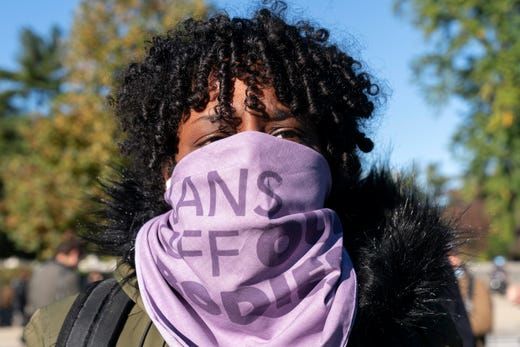 Wearing a bandana saying "bans off our bodies," Bethelehem
Yirga, of Prince George's County, Md., joins a pro-choice rally outside
the Supreme Court, Monday, Nov. 1, 2021, as arguments are set to begin
about abortion by the court, on Capitol Hill in Washington.
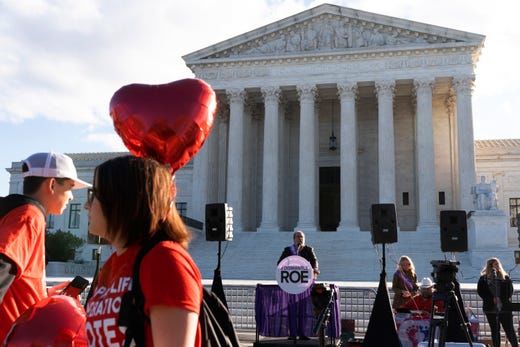 Anti-abortion activists rally outside the Supreme Court,
Monday, Nov. 1, 2021, as arguments are set to begin about abortion by
the court, on Capitol Hill in Washington.
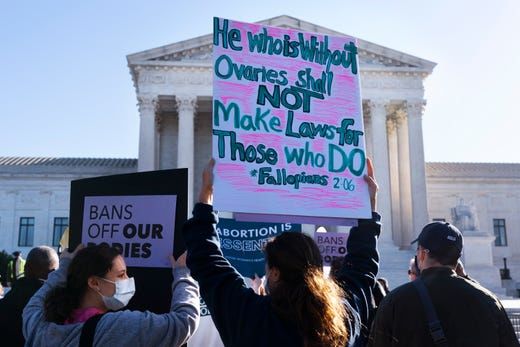 Ava Stevenson, 20, left, of Montgomery County, Md., rallies
for abortion rights with her mother Jenni Coopersmith, center, outside
the Supreme Court, Monday, Nov. 1, 2021, as arguments are set to begin
about abortion by the court, on Capitol Hill in Washington.
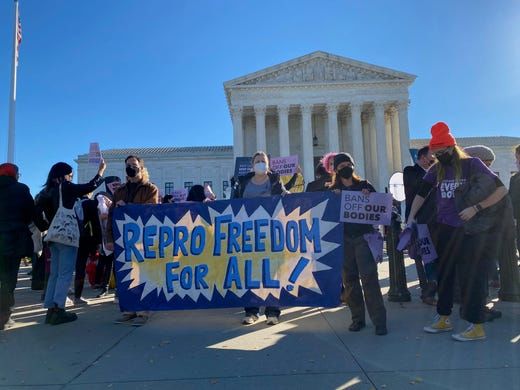 Demonstrators against restricting abortion rights in the
U.S. gather outside the Supreme Court on Nov. 1, 2021 as the justices
hear arguments related to SB-8, the controversial Texas abortion law
limiting procedures to the first six weeks of pregnancy, and empowers
citizens to enforce the law against one another.
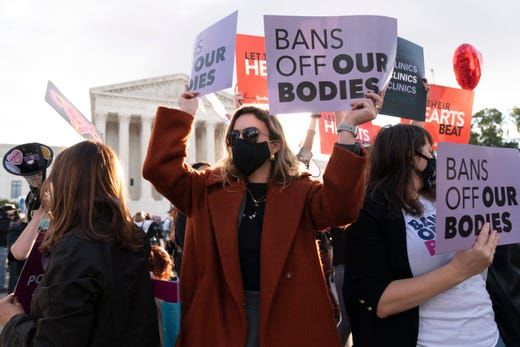 Emily Halvorson, center, of Washington, with Planned
Parenthood, joins groups of pro-choice and anti-abortion activists as
they rally outside the Supreme Court, Monday, Nov. 1, 2021, as arguments
are set to begin about abortion by the court, on Capitol Hill in
Washington.
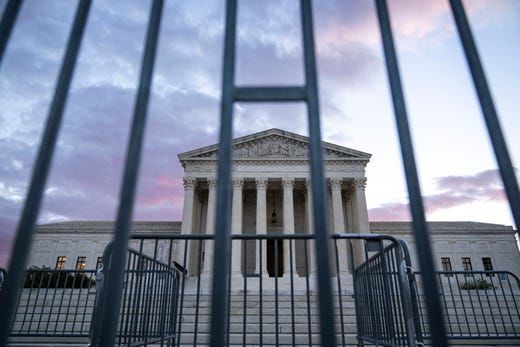 Security barricades stand outside the U.S. Supreme Court on Nov. 1, 2021.