

The anxiety that limits your creative genius
In her non-fiction work Big Magic, Elizabeth Gilbert lists all the fears that can limit the creative process.
“You’re afraid you have no talent. You’re afraid you’ll be rejected or criticised or ridiculed or misunderstood or – worst of all – ignored. You’re afraid there’s no market for your creativity, and therefore no point in pursuing it. You’re afraid somebody else already did it better. You’re afraid everybody else already did it better. You’re afraid somebody will steal your ideas, so it’s safer to keep them hidden forever in the dark.”
Gilbert, an American writer who also wrote bestseller Eat Pray Love, proceeds to list 21 further reasons why fear can derail our inspiration. “Fear is a desolate boneyard where our dreams go to desiccate in the hot sun,” she concludes.
Anyone who has ever had to present their ideas at a group brainstorm may be familiar with these feelings and the paralysing effect they can have on the mind. Yet it is only within the last few years that scientists have started to measure creativity anxiety – and the role it may play in limiting the quality of our ideas.
Importantly, you don’t need to be a professional artist to learn from their findings. There are methods that anyone, in almost any workplace, can use to manage and reduce their creativity anxiety, potentially unleashing more original and innovative thinking.
The creativity anxiety scale
The concept of creativity anxiety comes from the lab of Ian Lyons at the University of Chicago, whose work had focused on people’s fear of numbers. It is well accepted – at least anecdotally – that many people find maths particularly stressful, compared to other academic subjects. This led to the Math Anxiety Scale, which allowed psychologists like Lyons to uncover the causes and consequences of those fears.
While you might expect maths anxiety to arise from lower ability, for example, the effect can work in the other direction: heightened anxiety reduces performance and discourages people from taking steps that could improve their performance. This might help to explain the gender gap in STEM subjects: thanks to a prevailing gender stereotype that women’s brains are less suited to numeracy and analytical thinking, girls are more likely to suffer from maths anxiety than boys, resulting in a kind of self-fulfilling prophecy.
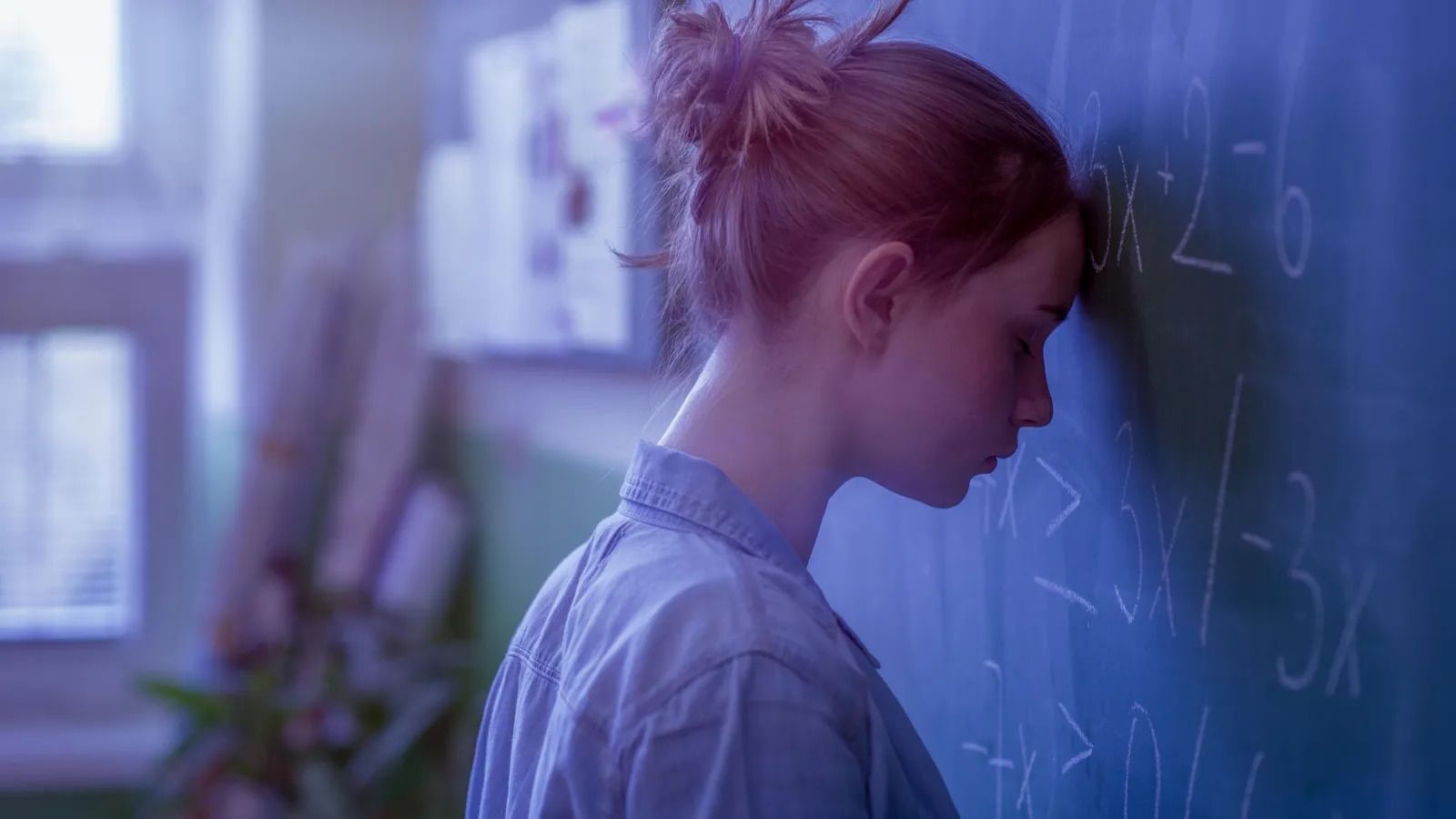 Research has already shown that anxiety over maths can reduce our performance and prevent learning
It was one of Lyons’ graduate students, Richard Daker, who began to wonder whether fears about the creative process could be similarly important for people’s capacity to think originally and innovatively. Working with Lyons and the creativity researcher Adam Green, he first designed a psychological scale in which participants were asked to rate how much various situations would make them feel anxious, from 0 (not at all) to 4 (very much). The situations included:
* Having to come up with a creative solution to a problem
* Having to come up with a unique way of doing something
* Having to think about something from a novel perspective
* Having to improvise
As a comparison, the participants also had to rate the anxiety caused by comparable situations that did not reflect creative thinking, such as:
* Having to solve a problem in the exact way you were taught to do so
* Having to precisely follow an established method of doing something
* Having to think about something according to a fixed system
* Having to carefully follow instructions
Sure enough, Daker found that people’s anxieties about the tasks requiring original thinking and improvising (those in the first batch above) tended to correlate with one another. (So, if someone found improvising stressful, they were also more likely to feel anxious about having to think from a novel perspective or looking for an original way of solving a problem.)
Importantly, however, these ratings were not strongly linked to the participants’ scores for the other, more systematic tasks. This suggests that creativity anxiety is a separate entity triggered by specific situations, rather than reflecting people’s overall stress levels.
The creativity anxiety scores predicted some important life consequences. In general, people with high creativity anxiety were less likely to report significant achievements in areas like visual art, music, writing, drama or gastronomy. “Even controlling for other forms of anxiety, creativity anxiety was predictive of people’s real-world creative achievements,” says Daker.
We're finding that creativity anxiety predicts both how many unique ideas people come up with and how original those ideas are – Richard Daker
In currently unpublished research, he has also conducted laboratory experiments investigating whether the scale can predict people’s creativity. Participants took the “alternative uses task”, for example, in which they were asked to list original ways of employing a simple object such as a brick. “We're finding that creativity anxiety predicts both how many unique ideas people come up with and how original those ideas are,” he says. “It's an initial indication that it affects ‘in the moment’ performance, in addition to their broad creative achievements.”
Intolerance of uncertainty
Daker’s first study of creativity anxiety was published in 2020, and the concept is already generating interest from other scientists, including Ross Anderson, a senior researcher at the education consultancy firm Inflexion, who has recently used the scale to examine teachers’ responses to the pandemic.
Many people – including teachers themselves – may not think of teaching as being inherently creative, but Anderson points out that teachers have to think flexibly and improvise almost every minute of the day, and their lesson plans can be highly inventive. The challenges created by the pandemic – including the rapid move to remote learning – would have tested those abilities to the limit.
Surveying teachers during the school shutdown of spring 2020, he found that creativity anxiety consistently predicted other measures of teachers’ wellbeing. Overall, the teachers with greater creative anxiety tended to report much more stress during this period of uncertainty, for instance, as they struggled with the need to find new and inventive ways to keep the students’ engaged.
 Teachers must innovate constantly, something that's tough on those who worry about the quality of their ideas
Perhaps most importantly, Anderson’s research underlines the fact that creativity anxiety may be a limiting factor in many different kinds of workplaces, besides the traditional arts – making it all the more important to find ways of alleviating those feelings.
Exposure therapy
Some clues to potential treatments may come from previous research on maths anxiety. Daker points to studies of cognitive reappraisal, for example, in which people try to rethink the sense of physical arousal associated with fear or anxiety – such as the racing heart and sweaty palms – as a source of energy or even excitement. “The goal is to make the anxiety helpful to you,” he says. In various experiments, this seems to improve performance at numerical tasks.
Other research has found that “expressive writing” – in which you spend a few minutes describing your feelings in detail, before the stressful event – can soothe those nerves and increase people’s abilities at maths, and it’s feasible that the same strategy could help with creativity.
It may also be helpful to practice creative thinking in a low-stakes environment, Daker suggests. “If you give people practice being creative over time, and increase their comfort with that process, it's likely that the creativity anxiety itself will go down,” says Daker.
Anderson has already seen some signs that creative anxiety can be reduced. In a study currently under peer review, he tested a 14-hour course that educated teachers about their potential to use creativity within their jobs, along with practical exercises. He found that teacher’s creativity anxiety decreased substantially. Once they had learnt that their creativity was malleable and could improve with practice, the need to think originally seemed less daunting.
These are just a few suggestions. “There are potentially multiple possible interventions,” says Lyons. Given his research on maths anxiety, it will be important to tailor the strategies to the person, he says.
It’s likely that a certain level of anxiety will be inevitable in any creative endeavour – to innovate necessarily involves a certain risk of rejection and failure. As Gilbert writes in Big Magic, “Creative living is a path for the brave.” But if we learn to live with those feelings of fear, we may be surprised by what we can achieve.