
The Colombian-Panamanian border: a fundamental problem for migration
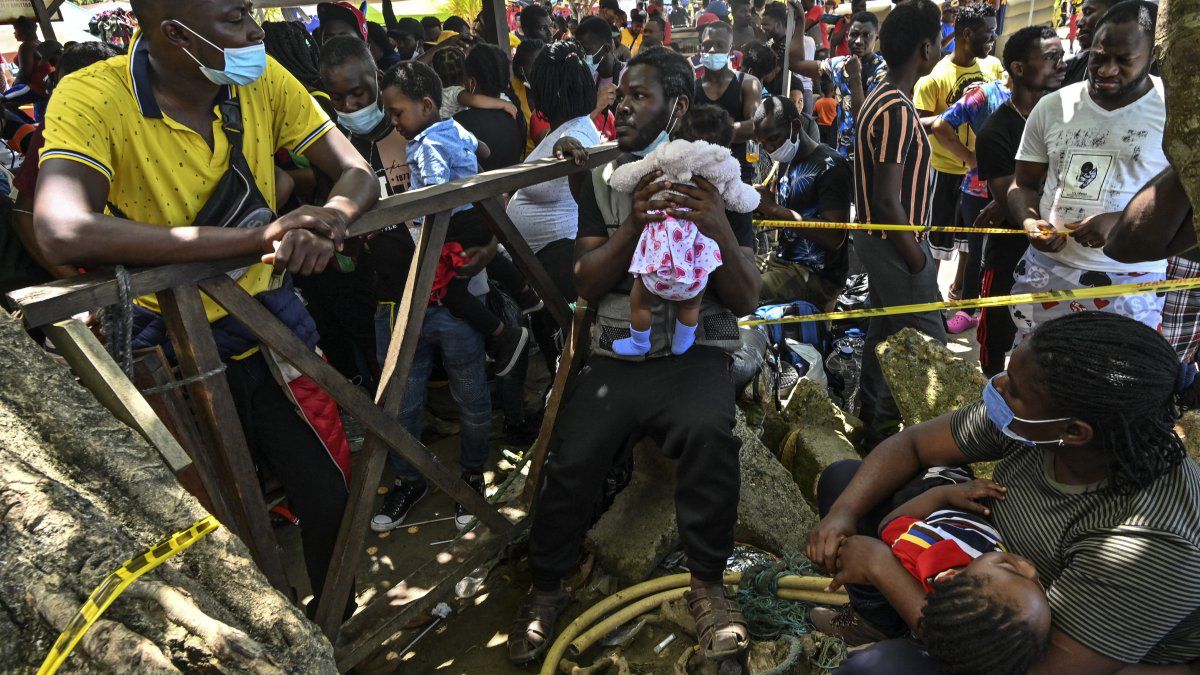
Colombia and Panama have the only border in the entire continent that is not linked by road or a passable road. In the last week, between 10,000 and 15,000 people have been dammed in Necoclí, the first point of the journey through the Darien.
Those who try to seek a better future in another country, although there are no legal ways to do so, do not understand customs, but the closure of borders imposed by the pandemic has created more problems for migration and caused humanitarian crises like the one in the Colombian-Panamanian border.
In the last week, between 10,000 and 15,000 people have been dammed in Necoclí, the first point of the journey through the Darien, the dangerous jungle that separates Colombia from Central America.
This Caribbean municipality is in the east of the Gulf of Urabá and from there the migrants , mostly Haitians, take boats that take them to the other side, to Capurganá, where they undertake -with the hand of traffickers in most cases- the route through the jungle to Panama, with the intention of reaching Mexico, the United States or Canada.
In past months, 300 or 400 migrants used to cross two or three days a week, but for days now the boats, with a capacity for between 50 and 60 passengers, have made several trips in which they take about 800 migrants daily for four or five days. a week.
"It is a number that has not been seen in recent history; the municipality is overwhelmed and a binational humanitarian plan is needed between Colombia and Panama to be able to respond," the director for Colombia of the Norwegian Refugee Council (NRC, in English), Dominika Arseniuk.
SITUATION WORSE BY COVID-19
The arrival of migrants to Necoclí and Capurganá is not new. They used to do it through Turbo and Acandí, two nearby towns, but for a few years this route has been a priority.
The numbers of those who pass through there vary according to the Panamanian or Colombian authorities, but they agree that in 2020, in the midst of the pandemic, they fell drastically, before shooting up again this year.
Until 2016, the majority were Asian or African, but between that year and 2020 the number of Cubans increased and since 2018, Haitians predominate, many of them entire families, including pregnant women and babies, from Chile and Brazil, where they resided until the economic situation made them migrate again.
According to Migración Colombia, more than 25,000 foreigners, the majority Haitians, have entered the country irregularly this year, while Panama counts more than 32,000 (80% Haitians). In 2019, Colombia counted less than 18,000 and in 2020 only 4,000.
"The pandemic has had an impressive impact in terms of migration control," Donna Cabrera, a migration specialist at the Pontificia Universidad Javeriana, explains to Efe.
What used to be a more or less constant flow of people has been altered by quarantines or the impossibility of using means of transport in certain periods of time.
"These are factors that are explaining this variation in what is called the peak in the transit of migrants to the interior of Colombia and particularly in what is happening now," says Cabrera.
Colombia has kept its land, sea and river borders closed since the beginning of the pandemic and reopened them at the end of May, which may also have increased the flow of migrants.
Before the pandemic, Colombia issued a safe-conduct so that migrants could transit through its territory and leave it in 30 days in a regular situation, but with the closure they stopped issuing them and although the borders were reopened, this system has not been resumed.
"At this moment they are not giving them safe-conduct," explains Emigdio Partúz, legal representative of the Acandí Community Council (Cocomanorte), which has great influence on the movement of migrants.
Cocomanorte wants the authorities to remedy the situation because "it is assumed that anyone who provides a service to an irregular migrant is committing a crime", and people from the community have been denounced for human trafficking for "guiding" migrants through from the jungle.
DIFFICULT ROUTE
Colombia and Panama have the only border in the entire continent that is not linked by road or a passable road. They are separated by a lush jungle dangerous due to the fauna, inclement weather and, above all, by those who take advantage of it.
The absence of state institutions on the Colombian side is evident and the area, strategic for drug trafficking, is at the expense of armed groups.
"Some migrants denounced mafias that sell them tourist packages to make the trip from Ipiales in Nariño (south of the country) with costs that reach 300 dollars to cross the border," denounced the Ombudsman, Carlos Camargo.
For his part, Arseniuk assures that "the presence of traffickers has been noticed in the informal crossings between Colombia and Panama, threatening the lives of hundreds of people."
Migrants also face violations of their rights in the jungle: from robberies and extortion to sexual abuse, and since there are no precise numbers on those who cross it, it is not known how many are lost in it.
Six out of ten people who arrive in Puerto Obaldia (Panama) have health problems such as gastrointestinal, skin or respiratory, according to the Panamanian Red Cross.
This week, the two governments recalled "the need to coordinate safe passage," but the Darien jungle continues to be one of the most dangerous parts of the American migration route.
SOURCE: EFE