PanamaTimes

Wednesday, Oct 28, 2026

The Man Photographed With His Foot On Nancy Pelosi’s Desk During The Capitol Riots Will Be Released From Jail

The Man Photographed With His Foot On Nancy Pelosi’s Desk During The Capitol Riots Will Be Released From Jail

Richard Barnett was ordered to remain in jail in January, but a judge ruled Tuesday that his case now was too similar to those of other defendants who were allowed to go home.

Richard Barnett, an Arkansas man photographed with his foot on House Speaker Nancy Pelosi’s desk during the Capitol insurrection, will be allowed to go home as his case goes forward, a judge ruled Tuesday, reversing a January order that had kept him behind bars.

Barnett is one of the most high-profile defendants charged in connection with the Jan. 6 riots to date. The photos of him smiling as he sat in Pelosi’s office went viral, as did a video of him outside the Capitol in which he told a reporter that he’d left a note that read, “Nancy, Bigo was here, you bitch.” At a hearing in late January, a federal judge in Washington, DC, ordered Barnett to remain in jail, concluding that his “entitled behavior ... shows a total disregard for the law and for officials' directives.”

But the legal landscape surrounding the Capitol riot cases has changed in the last three months, and Barnett made another attempt at getting out of jail. This time, citing recent developments in the hundreds of prosecutions filed since his arrest on Jan. 8 and appearing before a different judge, he succeeded. US District Judge Christopher Cooper concluded that prosecutors had failed to show that Barnett posed a specific future threat to public safety that couldn’t be addressed by restrictive release conditions.

Throughout the hearing, Cooper expressed skepticism about arguments Barnett’s lawyer made challenging the strength of the government’s evidence. Cooper said that information presented by prosecutors about Barnett’s apparent connection to the QAnon mass delusion and involvement in QAnon-affiliated demonstrations in which he was armed was “concerning.” But a March opinion from the US Court of Appeals for the DC Circuit, which set the bar higher for pretrial detention for Jan. 6 defendants who aren’t charged with specific acts of violence, ultimately worked in Barnett’s favor, Cooper said; he announced his decision shortly after hearing arguments.
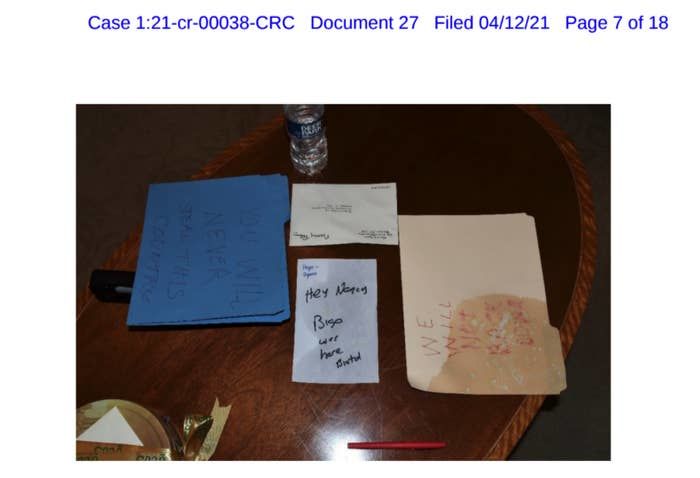
The note Barnett is alleged to have left on Pelosi's desk on Jan. 6.

Barnett’s situation wasn’t different enough from those of the defendants in the DC Circuit case, Eric Munchel and Lisa Eisenhart, Cooper said. Munchel and Barnett were both charged with carrying stun guns into the Capitol, but they weren’t accused of assaulting anyone or destroying property. The government argued that Barnett had tried to conceal evidence — his phone and the walking stick–shaped stun gun he brought to the Capitol were never recovered — but Cooper said at most this indicated “consciousness of guilt” or some risk of flight, not that he was dangerous, which was the standard the government was trying to meet.

Cooper did make clear that he was unimpressed by an argument Joseph McBride, Barnett’s lawyer, made linking the events of Jan. 6 with protests against racism and police brutality the previous year.


“The notion that the events of January 6 were a legitimate or excusable social protest against ruling elites or, worse yet, a reaction to some people in society feeling that they have been unfairly scapegoated for racism is, in a word, absurd,” Cooper said.

Barnett will be released to home detention and prohibited from having any weapons in his home — including stun guns, Cooper noted. The judge warned Barnett that the decision to allow him to go home wasn’t a sign that he’d be lenient if he later pleaded guilty or went to trial and was convicted. Cooper said he’d look at Barnett’s compliance with his release conditions in crafting any sentence. ”Consider this a test, okay?” he said. Barnett, who was appearing remotely from jail for the virtual hearing and had been silent while his lawyer argued, thanked the judge.

It’s the latest setback for the US attorney’s office in Washington since the DC Circuit’s ruling in Munchel and Eisenhart’s case. Prosecutors in some cases have dropped efforts to keep defendants behind bars in the weeks since the appeals court released the opinion, and judges in some cases — but not all — have handed the government losses when prosecutors pressed ahead with seeking detention.

Pretrial detention isn’t supposed to be punishment for a crime that a defendant hasn’t been convicted of yet; judges are only supposed to keep someone in jail if they meet certain criteria, including if they pose a flight risk or danger to the public or risk obstructing the case. Cooper noted that the DC Circuit held in Munchel’s case that participation in the insurrection on its own wasn’t enough to justify detention and that the government hadn’t shown Barnett posed a “concrete danger” any more than others who also believed in QAnon and had access to firearms.

Assistant US Attorney Mary Dohrmann told Cooper that she hadn’t formally extended a plea offer to Barnett but had been in early talks with his lawyer about that possibility. A federal grand jury returned a seven-count indictment against Barnett in late January; Dohrmann said on Tuesday that his estimated sentencing guidelines range for those charges is between 70 and 87 months in prison, although that could change if he ended up pleading guilty and cooperating. The first plea agreement in the Capitol riot cases was revealed earlier this month.

A spokesperson for the US attorney’s office declined to comment. Barnett’s lawyer did not immediately respond to a request for comment after the hearing.

Newsletter

Related Articles

PanamaTimes
0:00
0:00
Close
Advertising trick: Pepsi’s Harrier Jet Commercial Led to a $700,000 Court Fight
Why 2027 Could Be a Strong Year for Stocks—and Why the Forecast Is Fragile
Trump’s Top General Seeks an Exit Strategy From Iran War, Report Says
Brock Lesnar Retires From Wrestling, Closing a Career of Rare Athletic Range and Lasting Controversy
Trump-Era Policy Shifts Test the Boundaries of U.S. Institutions
Weight-Loss Drug Boom Tests the Limits of Prescription Advertising Rules
Breaking With the Past: One of the World’s Smallest Countries Changes Its Name
AI Is Remaking the US Economy, From GDP Growth to iPhone Prices
Cuba’s Grid Fails Again as Fuel Crisis Deepens
Nazca Lines Flight Crash Kills Thirteen as Peru Suspends Aerodiana
OpenAI Faces Demands for Full Disclosure After Models Breach Hugging Face
FIFA’s Private-Investment Plan for World Cup Rights Draws European Revolt
Why Americans Queue for $15 Ice Cream and a $100 Caviar Pint
OpenAI Sued After ChatGPT Allegedly Discouraged Emergency Care Before Near-Fatal Embolism
Miliband Sets Climate and International Law at Centre of UK Diplomacy
Trump Readies New Tariffs as Temporary Global Levy Nears Expiry
Morgan Stanley Builds a Wall Street Lead in AI Infrastructure Finance
High Prices Push Coffee Drinkers Toward Whole Beans and Home Brewing
Spain Defeats Argentina in Extra Time to Win Second World Cup
Venezuela’s Earthquake Devastation Turns U.S. Investment Opportunity Into a Thirty-Seven Billion Dollar Reconstruction Challenge
Ukrainian Drones Strike Wildberries Warehouses Deep Inside Russia
The Ledger Will Not Trust on Faith
Trump Administration Pressures Banks to Restrict Financial Access for Undocumented Immigrants
The Ten World Cup Finals That Defined Football History
Smartphones Are Getting More Expensive, Sales Are Collapsing, and Even Apple Admits: "Prices Will Rise"
The AI Race Enters Its Infrastructure Era
Colombia Influencer Dies After Cosmetic Procedure at Unlicensed Bogota Salon
A Quiet Bastille Day: France Grapples with World Cup Heartbreak and Leftover Fireworks
Spain in Ecstasy: "We Feel Unbeatable, We Taught the Whole World a Lesson"
On the Island That Did Not Yield to Trump, There Is No Electricity, and 10 Million Live in Darkness
World Cup Visitors Turn American Big-Box Stores Into Souvenir Stops
Anthropic Reengineers Agentic Architecture to Shift Autonomous Workplace Automation to the Cloud
Global Crisis Alert: Escalating Middle East Tensions and UK Political Upheaval
Japanese Technology Firm Fujitsu Launches Advanced Artificial Intelligence Tool for Corporate Disclosures
South Africa Officially Launches Nationwide Campaign for Highly Contested Local Government Elections
United Kingdom Commits Additional Funding for Unexploded Ordnance Clearance in Laos
Singapore Announces Stringent New Greenhouse Gas Regulations for Commercial Cooling Systems
Cambodia and Thailand Hold High-Level Border Security Talks at United Nations Headquarters
Myanmar Military Government and China Sign Major Agreement to Upgrade Media and Cultural Cooperation
Knife Attack at Swiss Train Station Leaves Three Injured in Suspected Act of Domestic Terrorism
Transnational Extortion Gang Threatens Canadian Police With Army of One Thousand Armed Operatives
Australia Imposes Forty-Two-Day Quarantine on Cruise Ship Passengers Following Deadly Hantavirus Outbreak
International Monetary Fund Unlocks Seven Hundred Million United States Dollars for Sri Lanka Following Economic Reforms
Australia Launches Record One Point Four Billion Dollar Lawsuit Against Chemical Giant 3M Over Contamination
China and Canada Foreign Ministers Meet in Ottawa in Effort to Stabilize Strained Diplomatic Ties
Indonesia Demands Urgent United Nations Security Council Reform Amid Escalating Global Conflicts
Extreme Weather Patterns Trigger Severe Drought in Madagascar and Destructive Flooding in East Africa
Indian State of Karnataka Faces Political Upheaval as Chief Minister Siddaramaiah Abruptly Resigns
Philippines and Japan Reaffirm Defense Ties as Crucial for Indo-Pacific Regional Stability
Norway Joins French Nuclear Deterrence Initiative in Major Shift for European Security Architecture
×