
The bills vetoed on moratoriums
The National Assembly sent the President five bills that addressed issues related to moratoriums and sanitary measures on the national emergency that the country maintains due to the coronavirus pandemic, however, three of those initiatives were vetoed by the President of the Republic, Laurentino Cortizo, considering that they are unconstitutional.
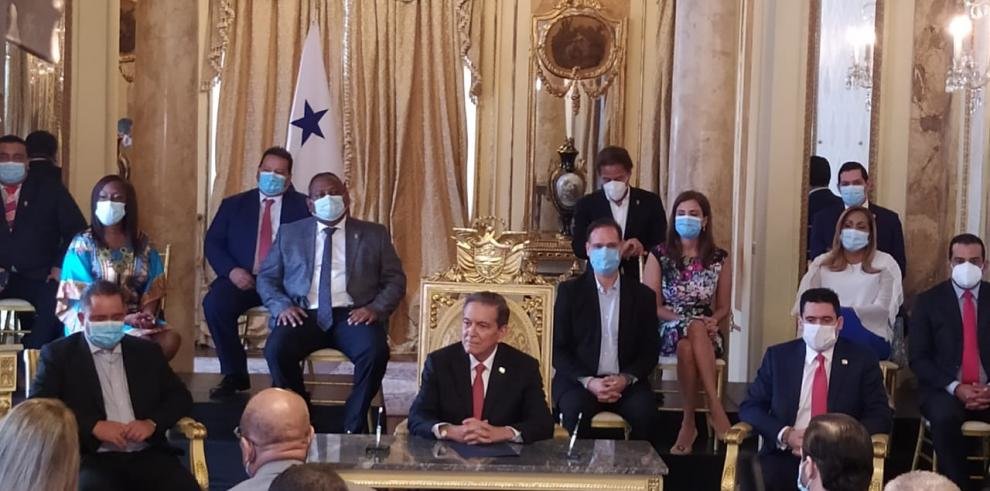
On Monday Cortizo, without specifying which projects were involved, announced in front of several deputies and the President of the Assembly, Marcos Castillero, that “the fact that some of the contents of three of the five moratorium bills could violate aspects of the Political Constitution of the Republic led us to veto them as unenforceable”.
The veto for the irrelevant of project 281, which established measures of social interest against the national emergency, such as, a special moratorium on agricultural credits for a period of one year, whose interests would be covered through the resources of the Special Interest Compensation Fund. It also regulated the payment of private schools.
This proposal was promoted by Ana Giselle Rosas, Deputy for Democratic Change.
While bill 299 dictated measures on the leases of real estate. With this initiative, the PRD Kayra Harding sought to suspend for 120 days all the launches and evictions of private real estate destined for housing, commercial establishments, professional use, and industrial and educational activities. In addition, it established that the debt was prorated in 24 months.
On the subject of leases, Cortizo said that decree 145 of May 1, 2020 already exists. "We have frozen all the rental fees for the two months following the lifting of the state of emergency," he explained.
The bill 280, promoted by the PRD Crispiano Adames, proposed additional sanitary measures for the prevention and mitigation of the coronavirus, among these, sanitary checkpoints, measures for pharmacies and banks, the media, water rationalization and others.
Before the end of the ordinary session, the Assembly sent these bills to the President, as recorded on its website.
President can use his veto right, when the issue conflicts with the Constitution. Articles 170 and 171 of the Constitution explain more.
For example, article 171 states that “when the President objects to a bill as unenforceable and the National Assembly, by the expressed majority, insists on its adoption, it will pass it on to the Supreme Court of Justice so that it may decide on its unconstitutionality. The ruling of the Supreme Court that declares the constitutional project, obliges the President to sanction it and have it promulgated. ”
Cortizo passed bill 295 so that there is a four-month moratorium on the payment of telephone, mobile, internet and electricity services for all those affected by the coronavirus.
While he partially objected to 287, which established a moratorium on loans for three months. Now, with the agreement between the Government and the Banking Association of Panama, the extension is seven months. To discuss the partial objections, Cortizo announced that he would call the deputies to extraordinary sessions.
However, other projects that were approved on the last day of ordinary sessions, to date, have not reached the hands of the President.
In fact, legislative sources say that, after a meeting with the deputies, Cortizo agreed that all other projects on health emergencies would be vetoed.
Among these is bill 300, which creates the National Emergency Plan, bill number 308, which modifies Decree Law 9 of February 26, 1998, referring to banks, bill 234, which proposes to compel the banks to consolidate customers' debts without considering their credit history, in addition to establishing a maximum fixed rate of 2% per month in the payment of credit cards.