

Travel to Costa Rica during Covid-19: What you need to know before you go
The basics
Costa Rica was one of the first countries to open back up for tourism, which it did in November 2020. So far, nearly 1 million travelers have visited the country in 2021 -- back to almost 70% of pre-pandemic levels.
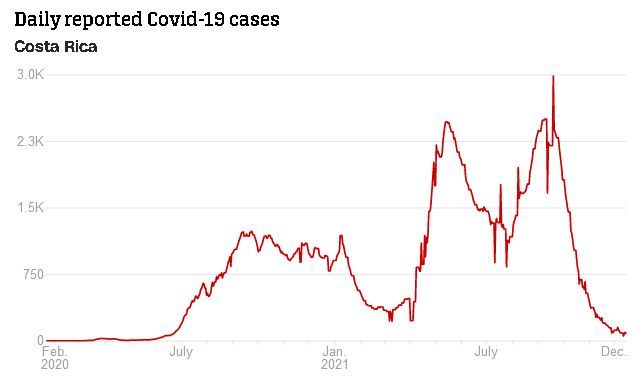
However, the Delta variant hit the country hard in 2021, with hospitals "dangerously full" at the peak, and Costa Rica ending high up on the board of the most new cases globally. Cases have thankfully dropped, and are now at some of the lowest levels seen in months.
The US CDC advises against all travel to the country.
What's on offer
Costa Rica is known for its "pura vida" (pure life), and, pandemic aside, the vida is still pura here. This is a country for nature lovers, with both a Caribbean and Pacific coast, and jungle covering about a quarter of the country.
Whether you're here for the cloud forests, the volcanoes or the incredible nature and wildlife, your shoulders will definitely drop a few inches.
Most visitors pass through capital San José as a mere routing point, but it's a beautiful city, with stunning architecture, public art and museums.
Who can go
Everyone. Costa Rica opened back up -- even for tourism -- on November 1, 2020. However, there are of course restrictions. And standard visa regulations still apply.
From January 2022, many activities will be restricted to those who've been vaccinated, the government has announced. Although entry rules aren't set to change, restrictions on the ground will make it less attractive for the non-vaccinated.
In August, Costa Rica's president signed a law that allows "digital nomads" to remain in the country for up to two years. To qualify, individuals must earn at least $3,000 per year and families must make at least $5,000. Benefits include the ability to open a Costa Rican bank account and their local U.S. driver's licenses being honored locally.
What are the restrictions?
There's no need for a negative Covid-19 PCR test result as there was initially. All passengers must fill out a Health Pass within 72 hours of travel. The website gives a QR code that you should show on arrival.
From August 1, fully vaccinated adults and anyone under the age of 18 (regardless of vaccination status) have been exempt from the requirement for travel insurance. Proof of vaccination -- which must have taken place at least 14 days prior to entry -- can be added to the health pass.
Anyone not fully vaccinated must have insurance which covers potential quarantine accommodation up to $2,000 and medical expenses of at least $50,000 related to Covid-19. This must be accompanied by a certificate in English or Spanish, giving the policyholder's name, the dates of coverage and guarantees as stipulated above.
Residents and Costa Rican nationals may be subject to self-isolation on arrival.
The land borders, which had been closed to nonresidents, reopened April 5 to visitors not needing a visa. The previous 14-day quarantine for those entering via land has also been abolished as of April 5.
America's CDC classes the risk in Costa Rica as "very high" and says US citizens should "avoid all travel to Costa Rica." Even fully vaccinated travelers are at risk of catching variants, it says. It has kept this advice through June, even though it has downgraded other countries with high infection rates. Not that this seems to be stopping Americans -- US visitor numbers were 93% of 2019 in September.
Meanwhile, the UK added Costa Rica to its "red list," meaning travelers coming from there were subjected to hotel quarantine, in June, although it has since been removed.
Undeterred, American Airlines launched flights from Chicago and Austin to San Jose on November 2, 2021. Avianca launched flights from Cancún on December 2.
What's the Covid situation?
Costa Rica has seen 568,428 cases and 7,336 deaths as of December 17. Case numbers have risen fast in 2021 -- they doubled in April, and May saw record infection and death rates, according to the government, although they have now slowed right down.
On April 28, the authorities were warning that patients were having to wait for hospital beds; two weeks later, there were 432 Covid patients in intensive care countrywide, well past the maximum optimal number of 359. By May 20 the number had risen to 520. It is the fullest the wards have been to date during the pandemic. By August 26, the numbers of people in hospital were rising, according to local media. Although September saw an initial lull, case numbers were rising again by the end of the month. However, they have dropped again -- the week leading up to December 17 saw 522 new infections, down from a record high of 17,469 in the week leading up to September 11. December 14 saw a third consecutive day of no deaths.
Along with Mexico, Costa Rica was one of the first countries in Latin America to receive vaccines in December 2020. Over 7.2 million vaccination doses have been given so far, with just under 67% of the population fully vaccinated as of December 17, according to John Hopkins University, though local numbers rank it at over 80%.
What can visitors expect?
From December, you will need to be vaccinated to access most public places, including hotels, restaurants, bars, museums,
Things are getting back to a relative normal. National parks and beaches are open -- the former are now back to 100% capacity. Restaurants and bars have reopened, to 75% capacity. There is a 30% capacity limit on cultural and sports activities. From January, buses will be back to 100% capacity.
There is a nightly curfew from 11 p.m. to 5 a.m. until December 20, at which point it will start at midnight.
Driving restrictions were relaxed on October 31.
Useful links
Our recent coverage
Back in August, Costa Rica was one of the first countries to allow Americans in, opening to visitors from six US states. Or read about this reforestation project for the great green macaws. Ready to book? Check out what to do in San José.