

‘We fight, therefore we exist’: what lay behind Mexico’s brutal football riot?
The scenes that shocked Mexico and horrified the world of soccer on Saturday were caught on shaky cell phone videos: men wearing the red and black jerseys of the Liga MX champions, Atlas, lay prone while others in the blue and black of Gallos del Querétaro beat and stripped them. Hundreds of raging fans descended on the pitch in Querétaro’s Corregidora Stadium, chasing their rivals, who sought refuge in the Atlas players’ locker room. Many Atlas fans ripped off their shirts to avoid being attacked.
The riot that broke out during the match between the two teams from central Mexico left 26 injured, three in a critical condition, the governor of the state of Querétaro, Mauricio Kuri, told reporters at a press conference on Sunday. Kuri also denied reports that there had been fatalities.
While there have been incidents of violence in and around Mexican stadiums in the past, most are linked to the country’s general insecurity than the unruliness of fans. For example in 2011, during a game between Santos Laguna and Monarcas de Morelia, a gun battle started just outside the stadium. Players ran into the locker rooms and fans dove for cover as shots rang out in the parking lot. There have been fights between fans of some of the country’s most popular teams but nothing comparable to the levels seen on Saturday. Stadiums are typically places where families gather safely to enjoy games together. So the question arises: what went wrong between these two teams?
Some argue that Saturday’s riot was predictable. While the bad blood between the teams’ fans was not well known on a national level until this weekend – Querétaro have been a yo-yo team for a long time, while Atlas had an unspectacular record until they won their first title in 70 years in 2021 – the rivalry spans more than a decade, with at least two instances in recent years where fights resulted in injuries.
According to Mexican writer Pablo Duarte, who grew up in Querétaro and is a lifelong fan of Gallos (Spanish for “roosters”), the rivalry started in 2007. On the last day of that season, Atlas beat Querétaro condemning them to relegation. Then, in 2010, 30 people were injured in a brawl between the teams’ most prominent fan groups, Querétaro’s Resistencia Albiazul and Atlas’ Barra 51.
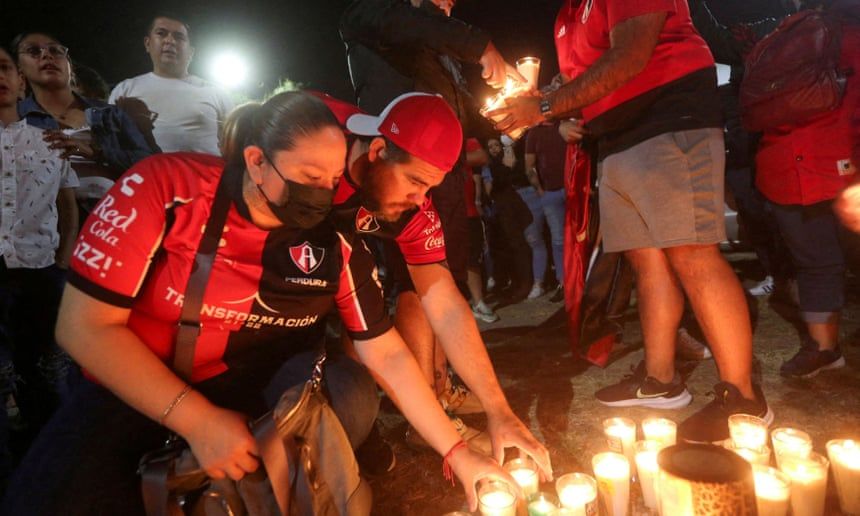 Atlas fans take part in a prayer vigil after Saturday’s violence.
“I would say that was a turning point,” Duarte says in a phone interview from Mexico City, “because it marked a disconnect between the quality of [Gallos], a team with a paltry track record – one-time cup winner and once a finalist for the Mexican championship in 2015 – and the constant violence of the fans.”
Querétaro fans also fought with fans of Atlas and San Luis at two separate games in 2013. Indeed, it seemed the only thing that overtook news about Querétaro’s brutal fights was the surprise acquisition of Brazilian star Ronaldinho in 2014. He stayed for a year, taking the team to the league’s final.
As the fierce reputation of Querétaro’s supporters grew, Atlas’ ardent fans were never far behind, says Sergio Varela, a professor of sociology at Mexico’s National Autonomous University, who has studied violence in Mexican soccer. Throughout Atlas’ decades in the wilderness, the fans endured. Despite the defeats they continued to sing, cheer and travel with the team across the country.
“Some cultural researchers argue that in Latin America, life is lived in a very melodramatic way and part of that melodrama is exaggerated feelings of sadness and defeat,” Varela says. “That could help explain why fans of losing teams seek to emphasize this idea of tenacity by signaling that even through the worst of the worst, they will always be there.”
Given the teams’ rivalry, many experts were surprised at the lack of adequate security in the stadium on Saturday. In one video, a security guard is seen opening a gate to let a stream of angry Querétaro fans through to chase down Atlas fans on the other side.
Exact details of security at Saturday’s game have yet to emerge but it appears staffing was lagging behind other fixtures in Liga MX.
Adolfo Rios, the Gallos general manager, said his team was following the stadium’s rules, which require one security guard for every 25 people. With more than 14,000 fans in the stands on Saturday he said there were around 600 security personnel present, including private guards and state and municipal police. In contrast, Estadio Azteca’s website says a typical derby between Mexico City rivals Pumas and América would have one member of security for every 14 fans.
“The rules are clear in defining the number of personnel required for a game, according to the characteristics of each game,” Gallos president Gabriel Solares said on Sunday. The issue, he added, “wasn’t the number of personnel, but their positions and how they structured their operation.”
Duarte is dismissive of the amount of security at the game. “It is unbelievable that there was so little security in the stadium when it is well known that this was a rivalry with a lot of bad blood,” he says.
The question now is whether Mexican soccer can recover its image ahead of the 2026 World Cup, which the country is set to co-host with the United States and Canada.
The Mexican Soccer Federation will meet on Tuesday to announce what measures it will take to prevent future violence and has not ruled out the possibility of expelling Querétaro from this season. On Sunday, the federation announced Corregidora Stadium would remain closed and implemented a temporary league-wide rule that organized fan groups will only be allowed to attend their teams’ home games.
The origin of such a distressing outpouring of brutality will most likely be studied for years to come, says Varela, and involves more complex social dynamics like economic inequality, lack of education and pervasive “machismo” in Mexico.
But one thing is clear, according to Duarte. As both teams struggle with losing records, the violence gave their fans visibility, as if to say: “We fight, therefore we exist.”