

What’s behind the heatwaves impacting the United States?
Virtually all of the United States has experienced above-normal temperatures in the past week. More dangerously hot weather is in the forecast this week.
More than 85 million Americans are under excessive heat warnings or heat advisories issued by the National Weather Service. Excessive heat, severe storms and flooding are all expected this week.
Forecasters warn this week’s extreme heat will linger until the weekend on the West Coast. Temperatures could break daily records in Seattle, Portland and northern California by Tuesday and climb to the highest level since a heatwave last year that killed hundreds of people across the Pacific northwest.
Many homes in the often-rainy region lack air conditioning and authorities cautioned that indoor heat is likely to build through the week, increasing the risk of heat-related illnesses, something emergency medical officials in Boston also warned of.
The extreme heat is fueling a fast-moving wildfire in California, near Yosemite National Park, forcing thousands of people to evacuate.
The heatwave in the US follows record heat in Europe that killed hundreds of people and sparked wildfires.
Here is an explanation of what is causing the heatwaves in the US:
What is a heatwave?
A heatwave has no single scientific definition. Depending on the climate of a region, it can be determined by a certain number of days above a specific temperature or percentile of the norm.
Arctic warming and jet stream migration
The Arctic is warming three to four times faster than the globe as a whole, meaning there is ever less difference between northern temperatures and those closer to the equator.
That is resulting in swings in the North Atlantic jet stream, which in turn lead to extreme weather events like heatwaves and floods, according to Jennifer Francis, senior scientist at the Woodwell Climate Research Center.
Heat domes
Warmer oceans contribute to heat domes that trap heat over large areas. At the end of this week, the heat dome will stretch from the southern plains of the Oklahoma/Arkansas area all the way to the eastern seaboard, according to the US Weather Prediction Center.
Scientists have found the main cause of heat domes is a strong change in ocean temperatures from west to east in the tropical Pacific Ocean during the preceding winter.
“As prevailing winds move the hot air east, the northern shifts of the jet stream trap the air and move it toward land, where it sinks, resulting in heatwaves,” the US National Oceanic and Atmospheric Administration says on its website.
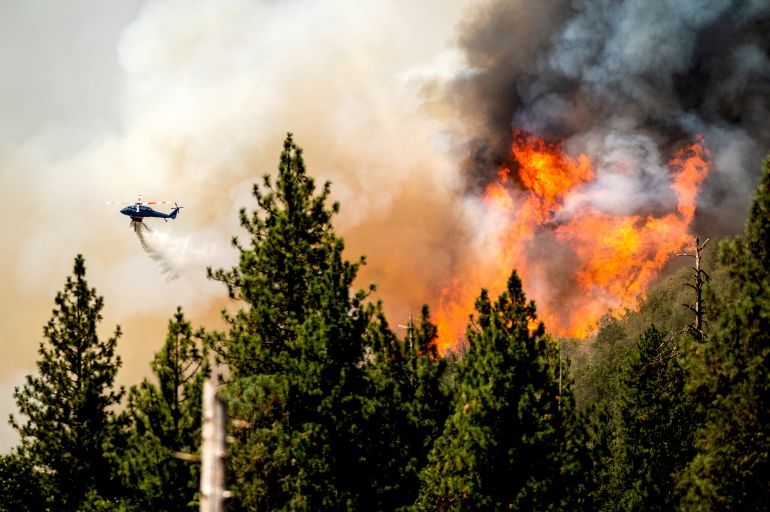 Helicopters and jets on Sunday rushed to drop water while battling the Oak Fire in Mariposa County, California
Human-influenced climate change
Climate change caused by the burning of fossil fuels is a global phenomenon that is certainly playing a role in what the US is experiencing, scientists say.
“Climate change is making extreme and unprecedented heat events both more intense and more common, pretty much universally throughout the world,” said Daniel Swain, climate scientist at UCLA.
“Heatwaves are probably the most underestimated type of potential disaster because they routinely kill a lot of people. And we just don’t hear about it because it doesn’t kill them in, to put it bluntly, sufficiently dramatic ways. There aren’t bodies on the street.”
Francis, of the Woodwell Center, said that with climate change, the world is seeing changing wind patterns and weather systems “in ways that make these heatwaves, like we’re seeing right now, more intense, more persistent, and cover areas that just aren’t used to having heatwaves”.
Alex Ruane, researcher at NASA’s Goddard Institute for Space Studies, said as the world warms, “it takes less of a natural anomaly to push us into the extreme heat categories. Because we’re closer to those thresholds, it’s more likely that you’ll get more than one heatwave at the same time. We’re seeing this in the United States.”
 Dangerously high temperatures threatened much of the northeast and deep
south of the US as millions sought comfort from air-conditioners, fire
hydrants, fountains and cooling centres
Which cities are most impacted?
On Sunday, Philadelphia, Pennsylvania, hit 37 degrees Celsius (99 Fahrenheit) even before factoring in humidity. Newark, New Jersey, saw its fifth consecutive day of 38 degrees Celsius (100 Fahrenheit) or higher, the longest such streak since records began in 1931. Boston also hit 38 degrees, surpassing the previous daily record high of 37 Celsius (99 Fahrenheit) degrees set in 1933.
Have there been any deaths?
At least two heat-related deaths have been reported in the northeast of the US, with officials warning of the potential for more.
Sports events cancelled or postponed
Athletic events were shortened or postponed. Organisers of the New York City Triathlon cut the distances that athletes had to run and bike on Sunday. This weekend’s Boston Triathlon was put off until August 20-21.