

What weapons has Ukraine received from the US and allies?
Defence ministers from NATO countries and other parts of the world will convene to discuss weapons deliveries to Ukraine on Wednesday.
The meeting comes as Kyiv seeks a significant increase in arms to fight off Russian forces. Ahead of the talks, NATO Secretary General Jens Stoltenberg said allies would continue to deliver heavy weapons and long-range systems to Ukraine.
Since the Russian invasion on February 24, Ukraine has received billions of dollars’ worth of weapons and military equipment from at least 28 countries.
Twenty-five of the 28 nations providing military assistance to Ukraine are NATO members, including the US and UK, which are supplying Kyiv with sophisticated weapons such as multiple rocket launch systems (MLRS).
Despite its growing arsenal, Ukraine, which has an active military personnel of just 200,000, is significantly outgunned by Russian forces.
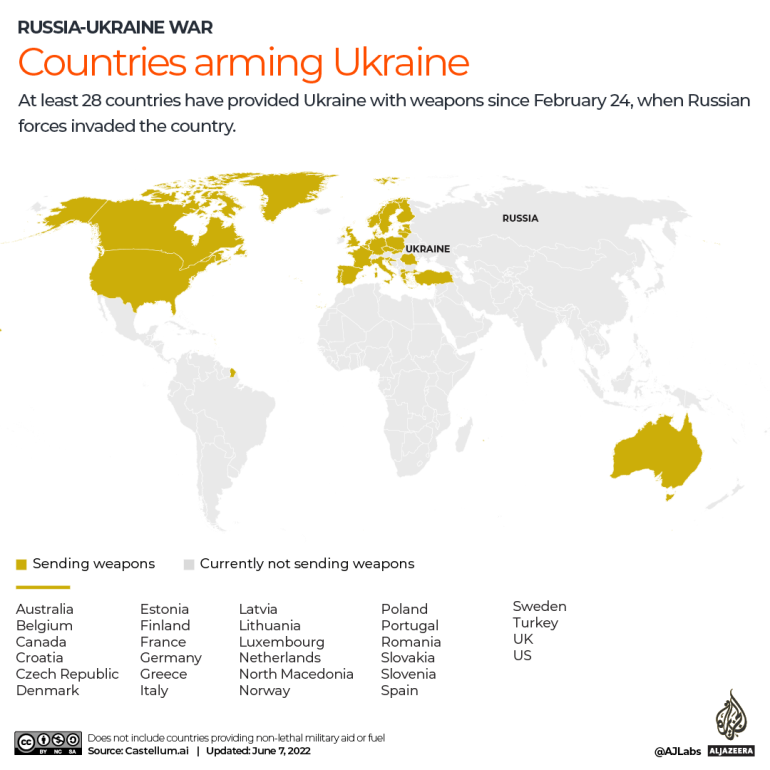
Countries who have supplied Ukraine with weapons and military equipment include: Australia, Belgium, Canada, Croatia, Czech Republic, Denmark, Estonia, Finland, France, Germany, Greece, Italy, Latvia, Lithuania, Luxembourg, Netherlands, North Macedonia, Norway, Poland, Portugal, Romania, Slovakia, Slovenia, Spain, Sweden, Turkey, the UK and the US.
These do not include countries providing non-lethal aid or fuel, such as Ireland and Japan.
What weapons has Ukraine received?
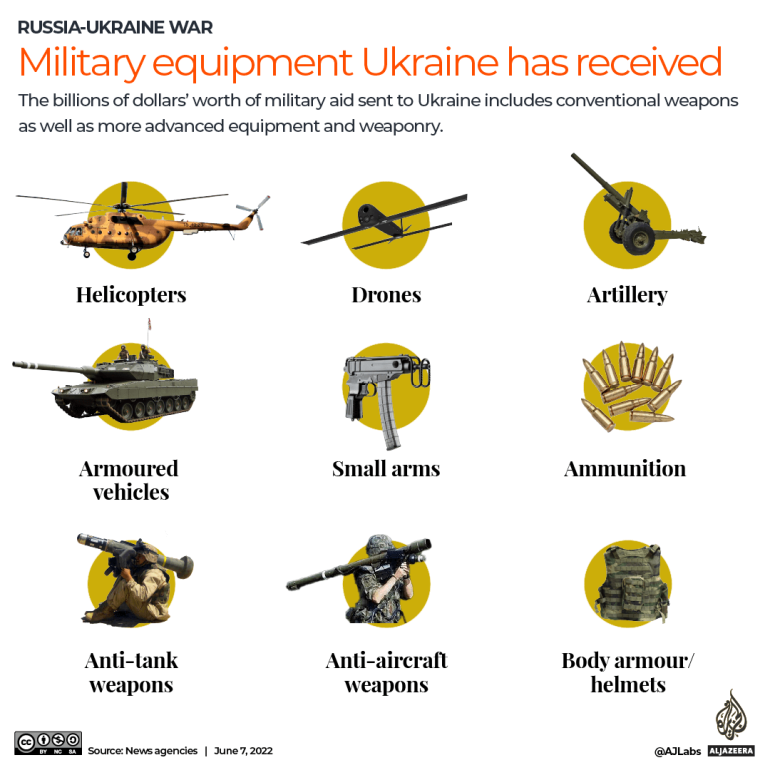
The military aid sent to Ukraine includes conventional weapons as well as more advanced equipment and weaponry.
Below is a look at the weaponry pledged by some countries, some of which has been delivered and some of which has yet to be sent. It is not an exhaustive list, as some nations keep their transfers secret.
The weapons include artillery, anti-aircraft weapons, anti-tank weapons, armoured vehicles, reconnaissance and attack drones, helicopters, small arms, ammunition and body armour.
Artillery:
Howitzers have been provided by countries such as Estonia and Norway. The US has also pledged M114 155mm howitzers – long-range artillery launchers.
Anti-aircraft and anti-tank weapons:
Shoulder-fired MANPAD systems, NLAWs, Harpoon anti-ship missiles, Stinger missiles, Javelin anti-tank missiles, MILAN anti-tank guided missiles and Cheetah anti-aircraft missiles are among the weapons pledged to Ukraine.
Armoured vehicles:
The UK has provided Ukraine with Mastiff armoured vehicles which can carry a crew of two plus eight troops. Australia has pledged M113 armoured personnel carriers and Bushmaster protected mobility vehicles, the latter of which can deploy 10 soldiers. T-72 tanks have also been pledged by Poland.
Reconnaissance and attack drones:
Turkish Bayraktar TB2 combat drones, US made Phoenix Ghost tactical drones and Puma Unmanned aerial systems are among the drones pledged to Ukraine.
The Bayraktar drone in particular garnered attention during the war as Ukrainian forces used the weapon to destroy Russian artillery systems and armoured vehicles.
The TB2 has a wingspan of 12 metres and can reach 25,000 feet. It has also been used during conflicts in Syria, Nagorno-Karabakh, Iraq and Libya.
Helicopters:
The US and Czech Republic have sent Ukraine Mi-24 attack helicopters.
Small arms:
A number of countries are sending automatic rifles, machine guns, assault rifles, sniper rifles, submachine guns, pistols, and ammunition to Ukraine.
Last week, the UK announced that it would give Ukraine M270 multiple-launch rocket systems, which can strike targets up to 80km (50 miles) away.
UK Defence Secretary Ben Wallace said in a statement, “As Russia’s tactics change, so must our support to Ukraine. These highly capable multiple-launch rocket systems will enable our Ukrainian friends to better protect themselves against the brutal use of long-range artillery, which Putin’s forces have used indiscriminately to flatten cities.”
What weapons has the US provided?
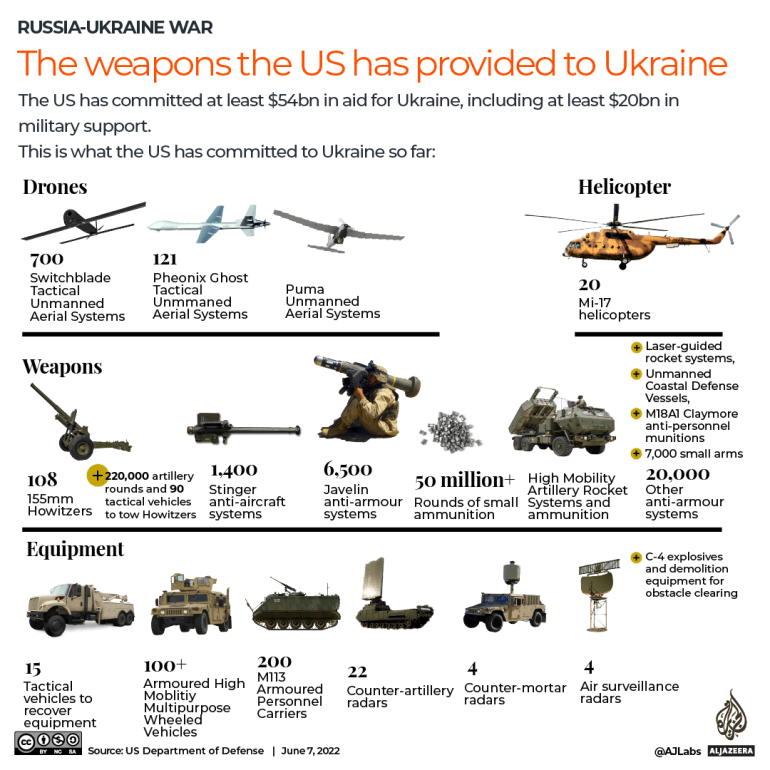
During the Russian invasion, the US has committed at least $54bn in aid for Ukraine, including more than $20bn in military support approved by Congress in May, as well as a number of aid packages approved in March.
On June 1, the Department of Defense announced the authorisation of an eleventh drawdown of equipment from DoD inventories for Ukraine since August 2021, as US President Joe Biden said the US would “continue to provide Ukraine with weapons and equipment to defend itself.”
The DoD package includes:
* High Mobility Artillery Rocket Systems and ammunition;
* Five counter-artillery radars;
* Two air surveillance radars;
* 1,000 Javelins and 50 Command Launch Units;
* 6,000 anti-armour weapons;
* 15,000 155mm artillery rounds;
* Four Mi-17 helicopters;
* 15 tactical vehicles;
* Spare parts and equipment
Advanced weaponry
Ukrainian President Volodymyr Zelenskyy has repeatedly called on Western nations to send his country more heavy weapons, arguing it is the only way to stop Russian forces from turning the war into “an endless bloodbath”.
On June 1, the Biden administration said it would provide Ukraine with high mobility artillery rocket systems (HIMARS) under the condition that Ukrainian forces not use them to hit targets inside Russian territory.
The M142 HIMARS is a high-tech lightweight rocket launcher that can strike targets at a range of 80km (50 miles). This is almost double the range of the current M777 howitzers, which the US promised to provide earlier in the conflict.
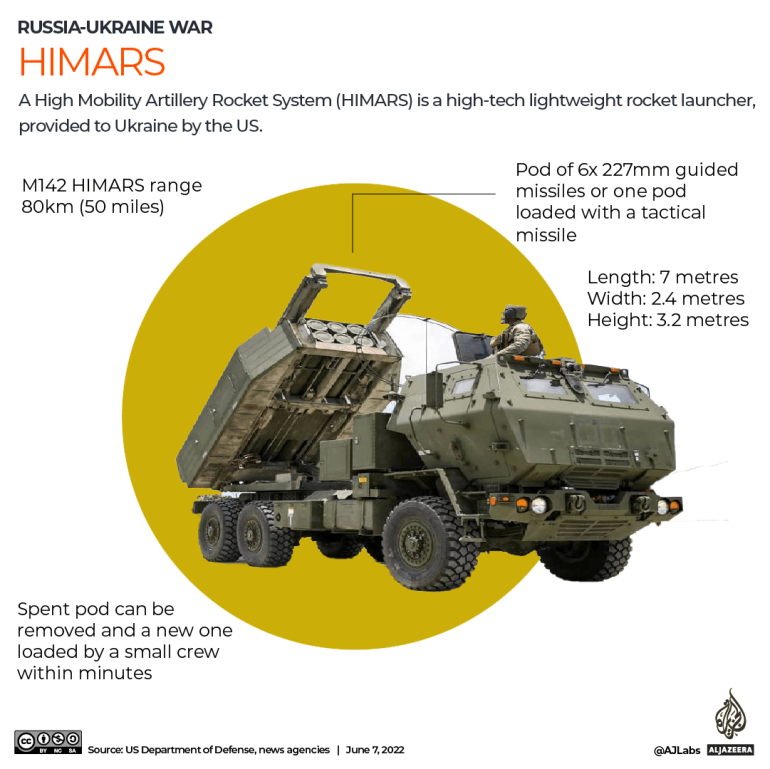
The M142 HIMARS is seven metres in length, 2.4 metres wide and 3.2 metres in height. It has a max speed of 85 kilometres/hour (53 miles per hour) and a max cruising range of 480km (298 miles).
Ukraine already has multiple launch rocket systems (MLRS) capabilities, but the HIMARS is a modernised system. The GPS-driven M142 HIMARS can carry one pod of six 227mm guided missiles or one large pod loaded with a tactical missile.
A spent pod can be removed and a new one loaded by a small crew within minutes.
The HIMARS will provide Ukrainian forces with capabilities to strike Russian lines deeper at a greater distance.